Although I don't have time to solve it, I will describe how I would do it. That hanging span is a catenary curve or hyperbolic cosine. http://en.wikipedia.org/wiki/Catenary . It looks like a parabola, but it is not. Notice when plotted that the value of y is 1 at x=0 instead of 0 like the parabola y=x^2 would be. So each hinge should pass through the catenary curve, but the straight segments will deviate from the catenary curve.
I would plot a catenary curve within a convenient arbitrary range, something like x=-1 to +1. Designate point B on the catenary at x=1, y=1.543080635. At point B, superimpose a circle plot with a radius of 1.25*2/7 and note the coordinates where it intersects the catenary. At that point, do another circle and so on until the last segment is reached. The difference between 1.543080635 and the y coordinate of the last circle intersection should be the droop, then the ratio is easily calculated.
Not sure if this isn't someone's mechanics homework?
This is not a catenary problem.
It should be realised that this frame is not statically determinate.
Nor is it statically indeterminate.
It is officially a mechanism.
As such there are an infinite number of possible reaction sets that satisfy the equations of equilibrium.
The vertical hinge reactions are all determinate. But any horizontal reaction will do.
The problem is purely determined by geometry. I suggest making the distance AB equal to 2L, the length of each link rod equal to 2l. You can then use the symmetry to work on the half frame without fractions.
The length ratio condition then becomes 28l = 5L.
I would approach this problem using minimum potential energy principles.
It is useful to define an angle for each segment relative to the horizontal.
\( \theta_i\) for each segment from left to right with i=1,2, .... 7
It can be noted that the angle of the center section is zero using symmetry, and also by symmetry only i=1,2,3 need to be considered.
First, two very simple relations can be given just based on the geometry. Note that L is the length of a segment equal to the length of AB divided by 5.6.
Then write the sum of the potential energies (U) of each segment using the end-posts height as the reference zero energy, where L is the length of a segment, m is the mass of a segment and g is the gravitational acceleration (9.8 m/s^2). Note that the potential energy of a segment can be taken at the height of its center of mass, so this is easy.
This function must be minimized to find the solution. It can be seen that the minimum energy solution will have the following condition met. \(\theta_3<\theta_2<\theta_1\)
I wasn't able to come up with a nice simple algebraic solution for the three angles that define D at minimum energy. It may be possible to do so, but I don't have time to investigate. My approach would be to do this last step numerically. The angles must be such that the sum of the cosines of the angles equals 2.3. Just search for the combination of angles that meets this constraint and that minimizes the potential energy.
This problem can also be solved by analyzing forces and torques for the static solution of each segment, but that looks more tedious to me.
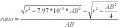
EDIT: By the way, once the 3 angles are found, the ratio R defined as the length D divided by the length of AB is found as follows:
ANOTHER EDIT: By the way, the numerical solution obtained with the minimum value search can be converted into a root solving problem using the usual technique. The constraint equation can be plugged into the energy equation, resulting in an equation with two unknowns. Then this energy function can be minimized by taking derivatives with respect to those two variables and setting both equations equal to zero. This is the way I tried to find an algebraic solution, but it doesn't seem to work out into a simple form. In principle, this can be worked out, but it looks like a case where "the cure is worse than the disease". However, this problem can be solved numerically with either root solving, or minimum value search.
I looked up a trig identity which allowed the root solving method to look more friendly. i.e. \( acos\;a=asin\;\sqrt{1-a^2} \) where the power -1 indicates the inverse trig function (i.e. arccos or arcsin).
If I didn't make a mistake, the following root equations can be solved for two of the angles and then the original constraint equation can be used to find the third remaining angle.
This way is OK but the optimisation minimum you are looking for is very shallow, convergence may be poor.
I've solved it simply by balancing forces, it's pretty straightforward. I didn't bother with trig identities to find a closed form, simply did a numerical solution, but it seemed to converge rapidly. It also seems to minimise your energy (starting the energy minimisation on my solution and the optimiser doesn't seem to be able to lower the energy).
I've got no idea what studiot is talking about - it's clearly a stable configuration as long as A and B are fixed.
I've made an attempt using a slightly different approach.
The three angles were 49.83 deg, 40.24 deg and 26.92 deg. The ratio was then about 0.3327.
I don't know if this the minimum energy solution Steveb proposed.
Any agreement with these values?
The puzzle is something I dreamed up when I was thinking about things that were catenary like but not an ideal catenary. I know - I should "get a life!"
I've made an attempt using a slightly different approach.
The three angles were 49.83 deg, 40.24 deg and 26.92 deg. The ratio was then about 0.3327.
I don't know if this the minimum energy solution Steveb proposed.
Any agreement with these values?
The puzzle is something I dreamed up when I was thinking about things that were catenary like but not an ideal catenary. I know - I should "get a life!"
Static determinancy has nothing to do with stability.
The first thing to decide is whether to treat this as a framework or as a continuous flexible cable.
Now since each of the seven bars is a significant percentage (18%) of the inter-support distance the setup cannot be considered as a cable.
For a 2D framework that is pinned at both supports the condition for static determinancy is
number of bars = 2(number of joints -2) including the supports.
Frames with exactly this number of bars can be solved by applying the three equilibrium conditions a sufficient number of times to joints or sections. These are called statically determinate.
Frames which have more bars than this are statically indeterminate and can only be solved by stress analysis and consideration of materials properties. They cannot be solved by use of the equilibrium equations alone.
Frames where there are fewer bars than the statically determinate number are mechanisms.
That means that they can be reconfigured to other arrangements of bars. There are insufficient constraints to prevent the frame changing shape.
Now looking at the seven member frame proposed
There are 8 joints, including A and B
So a statically determinate frame would have n = 2*(8-2) bars ie 12 bars.
there are only 7 so this is a mechanism.
An alternate configuration would be a sawtooth.
A further difficulty arises because there are 7 bars, not 6 or 8. This means that nearly 20% of the lowest boom of the frame is horizontal. There is no 'lowest point'
With an even number of bars the shape would be a V so the tangent at the lowest point
is horizontal. This allows the use of the fact that the 'tension' is purely horizontal at this one point to solve the force equations when deriving a hanging curve eg a catenary.
So we cannot do this with such a long horizontal bottom bar.
I am short of time right now but will publish a fuller analysis when I can.
Can you post the details of how you solved with balanced forces? When I tried to do this it looked more complicated than the minimum energy approach. I must have missed the simple way to look at it, and now I'm curious.
This is another reason why I thought that the minimum energy solution is the better approach. Only one possible arrangment will have miniumum energy and it will be the one that looks like the diagram. Note that the problem stated that the situation was like a suspension bridge and the diagram showed that there was no sawtooth shape. Hence it seemed reasonable to say that there was sufficient information to solve the problem.
One can look further at this problem and see if any of the sawtooth shapes would be stable. My gut feeling is that this particular arrangement is only stable in the lowest energy case, but the root equations I provided can be used to test this. If there are other local minimum energy points (with higher energy than the lowest state) then a stable sawtooth shape can exist for this problem.
If no one beats me to it. I'll check this out later.
Can you post the details of how you solved with balanced forces? When I tried to do this it looked more complicated than the minimum energy approach. I must have missed the simple way to look at it, and now I'm curious.
I just balanced the torques at the three mid-joints, and made the horizontal forces at the two ends of each bar the same, it comes out in a few lines to
I just balanced the torques at the three mid-joints, and made the horizontal forces at the two ends of each bar the same, it comes out in a few lines to
The extra equation you need is the length constraint:
As I said in my earlier post, I solved it numerically (before you posted your energy solution), these three equations gave much better convergence than just using the length constraint and the energy one. I'm not knocking the energy approach though - I like the simplicity.
Actually, Steve, the configuration shown is not the only 'minimum' energy solution in terms of the forces acting. Inverting the arrangement to form an arch has the same forces and dispositions.
Ask yourselves this question:
If there were only two bars would you compare to a cable?
How about three?
Or four?
How many would you think are needed to model the setup as a cable?
Using 7 bars was apparantly by chance.
TNK, thank you for raising an interesting subject, although it seems a bit removed from circuit theory.

 Facebook
 Google
 GitHub
 Linkedin