Analysing the circuit

Thread Starter

Vihaan@123

Joined Oct 7, 2025
220
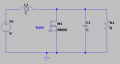
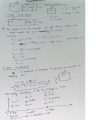
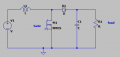
I have started analyzing the below circuit, i think it is boost circuit, i have not looked up the solution, the moment i check the solution i feel i have understood but reality is different
1762485951151.png

As soon as i saw the circuit first question comes to my mind is when we say load is it only resistor or it can be any combination?
As a first step i am assuming it is resistor alone.

1. I assume we give a fixed voltage let us say some 12V and i am switching the MOSFET at every 20Khz

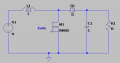
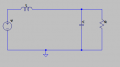
Step1: when MOSFET is OFF the starting condition. The circuit changes to
1762487126395.png
The current in the inductor cannot change immediately it starts from 0, the voltage drops completely across the inductor V.
The voltage across capacitor cannot change immediately it starts from 0.
Both the current and the voltage will raise exponentially. The final current is I = V/R;
The current through inductor is

1762486695652.png
PWM is 20Khz with duty cycle of 50% (assumption) 25uS, the current would have attained some value of I1.
The capacitor would have charged during this time

1762486739612.png

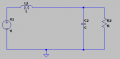
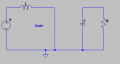
Step2: The MOSFET is ON condition the circuit becomes
1762487099402.png
The capacitor discharges through R using below equation where V1 is the capacitor voltage at 25uS.

1762487271708.png
The load circuit now got isolated from voltage source and inductor, the inductor current will increase since there is no load, but what happens to the increased current, i am not sure. Please guide me so that i can put some values and see actually how the circuit increases the voltage from 12V to 24V.
 

Attachments

Irving

Joined Jan 30, 2016
4,995
When the MOSFET is on, the increasing current in the inductor is building up the magnetic field at a rate di/dt = -V/L (which is linear for short time periods << L/R & while L remains constant, until the core starts to saturate), until, left alone, it eventually stops at a value defined by its DC resistance and the Rds(on) of the MOSFET. But we don't normally let it go that far.

When the MOSFET turns off, the magnetic field collapses, attempting to maintain the current in the inductor and generating a back EMF V(bemf) (from V = -Ldi/dt) in series with the source voltage V(s). That current now flows through the diode, further charging the capacitor towards V(s) + V(bemf), hence generating the boost.
 

WBahn

Joined Mar 31, 2012
32,702
I have started analyzing the below circuit, i think it is boost circuit, i have not looked up the solution, the moment i check the solution i feel i have understood but reality is different
It's good that you've recognized that looking at a solution leads to a false sense of understanding. Few people seem able to grasp that, or at least recognize that it applies to them.

But there are ways to use solutions to bolster your actual understanding. One of the simplest, but very effective, ways is to adopt an "empty hands" approach.

Work the problem on your own as far as you can. Give some thought as to what you think is the stumbling block. Is it a matter of knowing what you need to do, but not knowing how to do it? Or is it a matter of not knowing what needs to be done?

Once you have gone as far as you can, look at the solution. Ideally, you would only look at it far enough to see what you should do next and/or how to do it. Then go back to working it on your own. Repeat this process until you have made it through the entire problem. You can also review the entire solution, instead, focusing on not only what was done, but why it was done that way.

Regardless of how you approached the prior part, be suspicious that your actual level of comprehension is probably less than you think. So take out a fresh sheet of paper and work the problem again, from scratch, without referring to the solution or any of your prior work or notes (essentially, walk away with empty hands and rely only on what you have retained in your mind). Use only the references you were allowed to use originally. Ideally, do this after a bit of time has passed, a few days is best, but even an hour or two is usually adequate. If you can successfully work the problem now, you can have some confidence that you've gained an acceptable level of understanding. If not, repeat the process and keep doing that until you can get all the way through without referring to solution (or other non-allowed resources).
 

Thread Starter

Vihaan@123

Joined Oct 7, 2025
220
After studying basics of RLC circuits, I made very little progress i am assuming random values of L and C 5mH and 10uF, i am not sure how do i select (i need to work on that) when MOSFET is closed inductor current as guided by @Irving i = V/L*t for 20KHz and 50% duty it will be 25uS
12*25*10^-6 / 5*10^-3 = 60mA.
When the switch is opened the inductor current and voltage across capacitor cannot change instantaneously
dVc/dt = i/C = 60*10^-3 * 25*10^-6 / 10*10^-6 = 150mV.
Next steps i need to do am i in correct direction?
 

MrAl

Joined Jun 17, 2014
13,667
I have started analyzing the below circuit, i think it is boost circuit, i have not looked up the solution, the moment i check the solution i feel i have understood but reality is different
View attachment 358409

As soon as i saw the circuit first question comes to my mind is when we say load is it only resistor or it can be any combination?
As a first step i am assuming it is resistor alone.

1. I assume we give a fixed voltage let us say some 12V and i am switching the MOSFET at every 20Khz

Step1: when MOSFET is OFF the starting condition. The circuit changes to
View attachment 358418
The current in the inductor cannot change immediately it starts from 0, the voltage drops completely across the inductor V.
The voltage across capacitor cannot change immediately it starts from 0.
Both the current and the voltage will raise exponentially. The final current is I = V/R;
The current through inductor is
View attachment 358415
PWM is 20Khz with duty cycle of 50% (assumption) 25uS, the current would have attained some value of I1.
The capacitor would have charged during this time
View attachment 358416

Step2: The MOSFET is ON condition the circuit becomes
View attachment 358417
The capacitor discharges through R using below equation where V1 is the capacitor voltage at 25uS.
View attachment 358419
The load circuit now got isolated from voltage source and inductor, the inductor current will increase since there is no load, but what happens to the increased current, i am not sure. Please guide me so that i can put some values and see actually how the circuit increases the voltage from 12V to 24V.

Hi,

There are different ways of analyzing this circuit. There's the full blown method that models it as a 2nd order system plus two 1st order systems, and that is the most complete. It's not always needed though because we have assumptions that are required in most of these circuits that makes it simpler anyway. These are approximations that are considered adequate.

The first and foremost is to consider that since we want a relatively constant output, the capacitor value has to be large relative to the switching cycle time. This means that the output voltage Vc, in the steady state solution, is constant. This makes the analysis a lot simpler.
Since the inductor is defined by:
v=L*di/dt

and we know that the voltage across the inductor with the switch 'on' is v=Vin-Vc, we can calculate the change in current:
di=v*dt/L

that's just a ramp. That's what the inductor current looks like in the averaged solution, which is close to what we see in real life, and it helps understand how this works and how to select component values.
This means we can calculate di at the end of the 'on' cycle, and that is after the converter reaches the steady state.

Now as to the capacitor, we have the definition:
i=C*dv/dt
and solving for dv we get:
dv=i*dt/C

and that is the change in capacitor voltage. That means the voltage will go from the lowest to the highest in the time the switch is 'off'.

To calculate the average di we can just take the average of the starting di and the ending di for the 'on' cycle. To calculate the average dv we can do the same with the average cap voltage at the start and end of the 'off' cycle.

Once you get some values figured out you can do a full analysis and make sure it works the way you want it to work.
For lower voltages you have to also consider the diode voltage drop.

See if this helps. We can go over any of this if you like.
 
Last edited:

Irving

Joined Jan 30, 2016
4,995
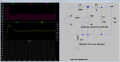
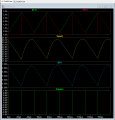
Its quite instructive to look at a simulation to see how values affect operation. Here's the simple boost converter with near idealized components.

1762694921115.png

Looking closer:

1762695885021.png
 
Last edited:

Thread Starter

Vihaan@123

Joined Oct 7, 2025
220
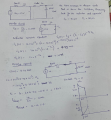
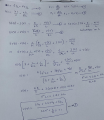
Thank you for all the support i am trying hard to get to the result, initially i tried without resistors but ended up in confusion, i felt more convenient with the resistors in the circuit and updated the circuit as below, but it does not work, the time constant chosen is 2 times more than the PWM cycle ON time, i will try to make the time constant less than the ON time and verify the result, the work done till now after several iterations is as below.
1762786101225.png
 

MrAl

Joined Jun 17, 2014
13,667
Thank you for all the support i am trying hard to get to the result, initially i tried without resistors but ended up in confusion, i felt more convenient with the resistors in the circuit and updated the circuit as below, but it does not work, the time constant chosen is 2 times more than the PWM cycle ON time, i will try to make the time constant less than the ON time and verify the result, the work done till now after several iterations is as below.
View attachment 358621
Hello again,

This looks interesting but I have a couple questions.

First, since you are using time constants (however you plan to do that) do you have a plan for how you will get the final output voltage? I ask because it's very unlikely that you will get the final output with calculations for just one cycle unless you know the final values for both L and C, which would only be had from an estimate. You would need that estimate to start with.

Second, why is the series resistance (ESR) for the inductor so high, being 1k in your diagram? That would not be typical even for a low power converter. What is your expected output power?

Also, why is the capacitor (and inductor) value so low. 50nf is very small for an output capacitor.

Also, 1u is very small for an estimate of the diode forward conduction resistance. That diode would drop around 0.5v for a Schottky which is usual for this kind of circuit.

Then, an important point is there is no load resistance. You cannot run a boost converter open circuit you have to have at least some load resistance. Without that the voltage could climb very high, being limited only by the internal losses rather than the duty cycle.


Another question is how are you working the "Mosfet Opened" part of the cycle using time constants. How are you expecting that to work.

Since this circuit is a little unusual I have to ask these questions first. It is ok that it can be unusual though, because not every boost circuit is the same, but because of the very non-typical values I just want to be sure I know what you are expecting. It is still interesting to approach this using time constants. You do have to have the right time constants though, and the time constant of the output load and capacitor will also play a part in the solution to this, which means you need to add the expected load resistance.

Just to recap:
1. Why the inductor ESR value so high?
2. Why the equivalent diode resistance so low?
3. Why the capacitor value so low?
4. Why no output load resistance shown?
5. Also, why the inductor value so low?
6. How are you working the time constants for the "Mosfet Opened" part of the cycle?

Except for #4, the other questions should not imply that then can't be the way they are, I just want to know why they are what they are, that's all.

[The attached diagram is the same as the original, unaltered except for the background in an attempt to make it more legible.]
 

Attachments

Irving

Joined Jan 30, 2016
4,995
57nH, 1k & 50nF are unrealistic values. You need to have a load resistor else it doesn't work, the 50% duty cycle assumes energy transfer occurs; without it no work is being done.

Here's a typical real world design approach, starting with the output and working back...
Assume 24v out at 1A, so load resistor is 24ohm, with max 1% ripple = 240mV and 100uF capacitor. Charge on capacitor is Q = CV = 100e-6 * 24 = 2.4mC so 1% ripple dQ = 24uC, and dQ = i * dt so dt = 24uS, say 25uS. Assume duty cycle D at operating point = 50%, t(on) = t(off) = 25uS, freq = 20kHz. That's now defined the output side.

Going to the input side, for 1A out, and assuming 100% efficiency, average input current @ 12v should be 2A from the source, conservation of energy (you can also think of this as 1A to maintain current into load, plus 1A to recharge the capacitor). However, the actual current waveform isn't a simple average; its a triangle, so we can't use a mathematical average, instead we use the RMS value (ie the AC value that gives the equivalent DC power). The RMS value of a triangle is (peak value)/√3, So for an 'average' of 2A, the peak current is 2 x √3 = 3.46A, starting from 0. Knowing that, and that V = -Ldi/dt, or L = V dt/di, L = 12 * 25uS/3.46 = 86uH, the standard nearest value being100uH.

The exact operating point (eg duty cycle, currents, efficiency) will be determined by other parameters, such as ESR of the capacitor, the series resistance/magnetic losses of the inductor and, of course switching and channel losses in the diode and MOSFET, as well as the latter components operating temperatures/heatsink requirements. Most, if not all, of these can be can be determned by a more accurate simulation and/or prototyping/breadboarding.
 
Last edited:

MrAl

Joined Jun 17, 2014
13,667
57nH, 1k & 50nF are unrealistic values. You need to have a load resistor else it doesn't work, the 50% duty cycle assumes energy transfer occurs; without it no work is being done.

Here's a typical real world design approach, starting with the output and working back...
Assume 24v out at 1A, so load resistor is 24ohm, with max 1% ripple = 240mV and 100uF capacitor. Charge on capacitor is Q = CV = 100e-6 * 24 = 2.4mC so 1% ripple dQ = 24uC, and dQ = i * dt so dt = 24uS, say 25uS. Assume duty cycle D at operating point = 50%, t(on) = t(off) = 25uS, freq = 20kHz. That's now defined the output side.

Going to the input side, for 1A out, and assuming 100% efficiency, average input current @ 12v should be 2A from the source, conservation of energy (you can also think of this as 1A to maintain current into load, plus 1A to recharge the capacitor). However, the actual current waveform isn't a simple average; its a triangle, so we can't use a mathematical average, instead we use the RMS value (ie the AC value that gives the equivalent DC power). The RMS value of a triangle is (peak value)/√3, So for an 'average' of 2A, the peak current is 2 x √3 = 3.46A, starting from 0. Knowing that, and that V = -Ldi/dt, or L = V dt/di, L = 12 * 25uS/3.46 = 86uH, the standard nearest value being100uH.

The exact operating point (eg duty cycle, currents, efficiency) will be determined by other parameters, such as ESR of the capacitor, the series resistance/magnetic losses of the inductor and, of course switching and channel losses in the diode and MOSFET, as well as the latter components operating temperatures/heatsink requirements. Most, if not all, of these can be can be determned by a more accurate simulation and/or prototyping/breadboarding.
Hi,

If you read my post you would see that I had to question a lot of this. The calculations come into question also but I did not want to address that before I got the answers to the more basic stuff.

I thought maybe this could be for some unusual application or just some sort of exercise. The values are just too weird, including the switching frequency for the values of the inductor and capacitor. With the values given, the inductor charges up quickly long before the 1/2 cycle is complete.

I guess we'll have to wait for another reply.
 

Thread Starter

Vihaan@123

Joined Oct 7, 2025
220
Sorry for the delay but i need more time as i am still trying to understand what both of you are saying, answer to the questions, i am very poor in understanding electronics.
:(
 

MrAl

Joined Jun 17, 2014
13,667
Sorry for the delay but i need more time as i am still trying to understand what both of you are saying, answer to the questions, i am very poor in understanding electronics.
:(
Hello again,

Switching circuits are not that easy at first, but then the get a lot easier as time goes by. Stick with it and if you have more specific questions just ask here.

I'd like to ask you a few questions also so I can understand where you are with your electronic theory. The better you answer these questions the better myself and others here will be able to help you. Many of us here understand these circuits very well so will always be able to help with this.

1. Do you understand the definitions of the inductor L and capacitor C in:
v=L*di/dt
i=C*dv/dt

2. Do you know how to write ordinary differential equations that pertain to electrical circuits?
These would involve derivatives and/or integrals, but the easiest are described by only derivatives. These are sometimes called simply "ODE's" which stands for Ordinary Differential Equations. They involve the variables and derivatives of the variables.
Writing them is the first step you can worry about solving them later, unless you already know how to do that.

3. Do you know how to use Laplace Transforms?
This makes some things much easier.

4. Do you use any kind of math software?
This helps with the actual calculations once you have the equations written.

5. Do you know Nodal Analysis or another type of general circuit analysis?
This helps write the equations.
 

Thread Starter

Vihaan@123

Joined Oct 7, 2025
220
Hello again,

Switching circuits are not that easy at first, but then the get a lot easier as time goes by. Stick with it and if you have more specific questions just ask here.

I'd like to ask you a few questions also so I can understand where you are with your electronic theory. The better you answer these questions the better myself and others here will be able to help you. Many of us here understand these circuits very well so will always be able to help with this.
Thank you very much for your time and to clarifying my doubts

1. Do you understand the definitions of the inductor L and capacitor C in:
v=L*di/dt
i=C*dv/dt

I understand them but i often get confused with the voltage applied for example the DC source and the back emf of the inductor. Are both same? Is it because of the voltage that we apply to the inductor the current changes or because of the current changes the voltage is induced?
I struggle with sudden connections and disconnections of the circuit.
Similarly for capacitor

2. Do you know how to write ordinary differential equations that pertain to electrical circuits?
These would involve derivatives and/or integrals, but the easiest are described by only derivatives. These are sometimes called simply "ODE's" which stands for Ordinary Differential Equations. They involve the variables and derivatives of the variables.
Writing them is the first step you can worry about solving them later, unless you already know how to do that.

Yes i know writing differential equations, solving is a challenge (finding the initial values).

3. Do you know how to use Laplace Transforms?
This makes some things much easier.
Yes i know them but not used them extensively by referring i can solve them.

4. Do you use any kind of math software?
This helps with the actual calculations once you have the equations written.
I am using LT spice, i have never got opportunity to solve big equations so never used it.

5. Do you know Nodal Analysis or another type of general circuit analysis?
This helps write the equations.

Yes i know but there is always possibility i will go wrong for example if the inductor voltage suddenly changes writing the KVL will be difficult as often people say it changes the sign.
similarly, if the capacitor discharges and if there are several resistors i am not sure which combination it can discharge, basically finding Thevenin equivalent is a challenge.
 

Thread Starter

Vihaan@123

Joined Oct 7, 2025
220
I feel Vl voltage will be 23.7V as output of inductor should be 11.7, for 11.7V the inductor voltage will be 23.7 as DC voltage of 12V will be subtracted.
 

MrAl

Joined Jun 17, 2014
13,667
View attachment 358801
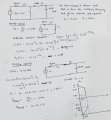
This is the current state of work where, i am confused with the inductor voltage value and few other questions in the sheet. Please guide me.
Ok it looks like you got the first half cycle right. The inductor gets charged while the cap stays at 0v because it does not get any current yet.
The initial current for the inductor was 0 amps, but after the first half cycle it becomes 3.0 amps as you calculated, and that looks right.

Ok now for the second half cycle we have to include the inductor current and the capacitor voltage. We can use ODE's for this.
If you like you can try using the average current for the next half cycle but using the ODE's will provide the exact results, and it may be hard to use averages here.
The exact results require that the capacitor and inductor interact which means we no longer have a first order system. This makes it a little more complicated but still within reason.

Ok let's start by defining some simpler terms for the variables.

For the inductor...
X1=inductor current i (note the upper case 'X')
x1=derivative of inductor current di/dt (note the lower case 'x')
i0=initial inductor current (we will get to this later).

For the capacitor...
X2=capacitor voltage v
x2=derivative of capacitor voltage dv/dt
v0=initial capacitor voltage (we will get to this later).

Let's also say that the diode, for now, is perfectly ideal so it drops no forward voltage. Once we do this we can go back and change it to have a voltage drop too.


WRITING THE ODE's

First we write the ODE for the inductor. The inductor voltage is:
vL=x1*L (same as L*di/dt)
and from the schematic when the switch is open the inductor is between the source E=12v and
the capacitor with voltage X2 (same as Vc). Thus the voltage across the inductor is:
x1*L=E-X2 [EQU 1]

which is the same as
L*di/dt=E-Vc

just with simpler notation.

Now for the capacitor, we know the current is:
Ic=x2*C (same as C*dv/dt)

and the current in the load is:
Ir=X2/R (same as Vc/R).

The total current through the cap and load must be equal to the current through the inductor X1, so we can write:
X1=x2*C+X2/R

and writing it with x2*C on the left we get:
x2*C=X1-X2/R [EQU 2]

which is in a more standard form.
To get EQU 1 and EQU 2 with just the derivatives on the left, we just divide by the constant:
x1*L=E-X2 becomes:
x1=(E-X2)/L

and
x2*C=X1-X2/R becomes:
x2=X1/C-X2/RC (where RC=R*C here).

So we have two equations:
x1=E/L-X2/L
x2=X1/C-X2/RC

and these are the ODE's without initial conditions.

Next we can either solve these and solve for initial conditions, or we can use Laplace Transforms and
include the initial conditions in with that. We can continue with that next.

But first, can you follow the logic behind this so far?
Recall that we used the inductor voltage and the capacitor current with the derivatives. We keep the inductor current X1 and capacitor voltage X2 as regular variables.
You might note that we don't yet know what X1 and X2 are but we do know what E, L, and C are. E=12v and L=100uH and C=100uf.
Using the Laplace Transform we can convert the derivatives x1 and x2 into regular variables X1 and X2 if we solve that way.

If you still have any questions just post them here. This will get very easy very soon :)
 
Last edited:

MrAl

Joined Jun 17, 2014
13,667
View attachment 358801
This is the current state of work where, i am confused with the inductor voltage value and few other questions in the sheet. Please guide me.
Hello again,

This is in addition to the previous post with the ODE outline.

I had forgotten to address your comment about the inductor current should be decreasing.
That is true, but only once the converter has reached steady state. While the input voltage is higher than the output voltage, the inductor current could increase, and for the first and second half cycles it will increase with the values you chose.

Also, you might get away with using the average values to get a feel for how this works. The average values are based on the average values for a ramp: (v2-v1)/2 or (i2-i1)/2.
Since the current after the first half cycle is 3, then for the next half cycle the change in current comes from:
12=L*di/dt
and solving for di we get 3 amps. This means the current goes from 3 amps to 6 amps during the second half cycle. The average of that is 4.5 amps.
Using that with:
dv=i*dt/C
we get:
dv=1.125
So the estimate of the current after the second half cycle is 6 amps, and the cap voltage estimate is 1.124 volts.
These should be close to the actual values at the end of the second half cycle. However, the cap voltage is also similar to a ramp, and since the voltage went from 0 to 1.125, the average is 0.5625, and since the average current drawn by the load is then 0.5625/24=0.0234375, we can subtract that from the average of 4.5 amps, and we get 4.4765625 amps.
Now going back to dv=i*dt/C, we now get:
dv=1.119140625 volts.
The exact value is closer to:
dv=1.110 volts.
So it's close enough just to get a feel for how it works (less than 1 percent difference).
Now that we have a decent estimate of the cap voltage, we can go back and recalculate the inductor final current at the end of the 2nd half cycle and update that as well. We'd get another close estimate. Instead of 6 amps we'd get around 5.87 amps.
I'm not sure how far we can take this though, but it's similar to using a particular method for solving PDE's. We keep updating the solution set.
You should check this over too and make sure it is all correct.
 
Last edited:

Thread Starter

Vihaan@123

Joined Oct 7, 2025
220
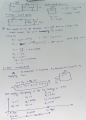
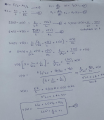
I have applied Laplace transform
1763108069603.png
But it does seem to be more math intensive, should i learn to interpret the equations? Do i need to use mathematical tool to do Laplace transform and converting back to time domain?
 

Attachments

MrAl

Joined Jun 17, 2014
13,667
I have applied Laplace transform
View attachment 358856
But it does seem to be more math intensive, should i learn to interpret the equations? Do i need to use mathematical tool to do Laplace transform and converting back to time domain?
Hi,

Well first, it's nice to see you sticking with it. You'll learn a lot that way.

If you want to wait on the Laplace Transforms, then try the averaging method first that I also explained.
The Laplace Transform technique though is guaranteed to work and give excellent results.

Yes, it is best to use math software to do the Inverse Laplace Transform. You already know how to convert expressions like E to E/s so you probably don't need the Laplace Transform, just the Inverse Laplace Transform. Software like Maxima has that built in. I never do this by hand anymore, but if you want to then use partial fraction decomposition first.

One additional note:
When we have two storage elements (L and C) we have to solve all for the associated variables. It looks like you solved for the capacitor voltage, which is a good thing, but you also need to solve for the inductor current. This is because you can only do so many half cycles before you need the calculated value of the initial inductor current. I'll outline this briefly...
First half cycle: inductor current iL
Second half cycle: capacitor voltage vC
we could get that far because we had iL from the first half cycle.
Third half cycle: updated inductor current, using the previous iL from the first half cycle.
We can only get that if we have a complete expression for the inductor current which would include i0.
Fourth and remaining half cycles: we need both i0 and v0 to go further with the time calculations.

It looks like you got pretty far already though. I did not actually check out your V(s) result yet though I'll have to wait until later. It does seem to look like it has the right form. If you end up with very strange time domain results, you'll know to go back over it :)

You should learn to interpret the equations yes. They allow you to compute the exact solutions so you can know if you made a mistake with something else later.
 
Top