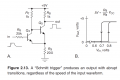
same way the toggle switch or light switch work... you gently apply higher pressure until tipping point is reached and SNAP! switch state changed in an instant, even though you were gently increasing pressure for 5 seconds.
the tipping point is the key... provided by elastic force of a spring.
to see how this works in above circuit, you need to know how BJT operates.
if IN is low, Q4 is off. so Q5 will be on due base current through R7. this means that OUT is low... (Vce of Q5 is low and voltage drop across R9 is also low)
then you start gradually increasing IN and Q4 is starting to conduct. this means Vbe for Q5 will get lower and at some point it will turn off, and OUT will be high.
more importantly, at this moment current though R9 will be significantly lower:
instead of high current through R7 and R8 when Q5 was on, now it gets lower current through R6 and R7 because Q4 is on.
and lower current through R9, means voltage drop across R9 will be lower too.
but because IN voltage is slow changing, this means Vbe for Q4 is INCREASED, and drive Q4 even harder into ON state.
this snapping is the equivalent to spring force that was rapidly toggling switch.
same thing goes in reverse just the tipping point is different. and every time tipping points are not same, we are talking about hysteresis.
so as the IN is gradually lowered, current through Q4 decreases. at some point Q4 will conduct so little that Q5 is begging to turn on. when that happens, larger current will increase voltage drop across R9 (just a little but even a little is more than enough). and since IN is changing slowly, and emitter voltage suddenly increased (a little), Vbe of Q4 gets even smaller, causing it to turn off completely and in an instant.
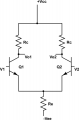
The description in post #2 appears to be correct, but the words not used were "Positive feedback", which is due to resistor R9 being in series with both emitters.
that is not the only thing omitted. i was trying to answer it without regurgitating descriptions already found in books.
if interested to see more, consider input stage of an opamp. this circuit is called differential amplifier. this is very commonly analysed and - in great detail. by connecting input V2 to output Vo1 circuit becomes identical to one in question (essentially just a special case of differential amplifier).
when one input increases and the other decreases, the "long tail" resistor Re forces the current to "steer" from one transistor to the other... (like the spring in toggle switch).
All digital signals are still analog. What makes the difference between a digital signal and an analog signal is that a digital signal only has two stable states (or voltages). You want to transition from one state to the other as quickly as possible.
A "slow" analog signal is characterized by the slope of the rise and fall, i.e. Δv/Δt.
A digital signal wants Δt to be as short as possible, i.e. as high a slope as possible. The way to achieve that is by increasing the voltage gain of the circuit. The one factor that limits the slope of rise and fall is the capacitance within the circuit itself as well as that of external loads.
Observe that a single logic gate is a 1-bit analog to digital converter.

 Facebook
 Google
 GitHub
 Linkedin