Analog Filter Design Valkenburg (1982)

Thread Starter

mondo90

Joined May 16, 2025
122
Hi,
I wanted to study analog filter design and decided to give "Analog filter design by M.E Van Valkenburg (1982)" a try. I got a hard copy in a really good condition however, going through chapter 2 on Op-Amps makes me want to return this book.
1.
1762202975284.png
1762202947848.png
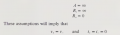
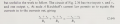
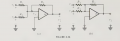
(V1 + Vx)/R1? I guess he rather wanted to say (V1 - Vx)/R1 right? Where is node "A" he talks about? I assume this is Vx

2.
He says that for an Op-Amp:
1762203116350.png
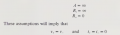
V+ = V- is only true with some sort of negative feedback which he doesn't mention at all in this paragraph. More so he says this in a reference to a figure that depicts op-amp in open loop configuration:
1762203255433.png

3. Minor issue - he references schematics shown several pages ahead.

I am curious to hear if you read this book and what is your opinion.

Thank you.
 

Thread Starter

mondo90

Joined May 16, 2025
122
What is it in this chapter that you do not understand?
For the point #1 I made, how can he write: (v1 + Vx)/R1 ? We want to get a current through R1 and that is (V1-Vx)/R1. So I am saying this books seems to have a serious mistakes. Same with the point 2 I made, infinite gain does not imply V+ = V-
 

MrChips

Joined Oct 2, 2009
34,627
1762203954440.png

This is correct.
An ideal op amp has infinite voltage gain. A real op amp's voltage gain is typically > 100 000.

Since the input impedance is infinite, no current flows into the input. Hence you can apply KCL to the external resistors.

Since the voltage gain is infinite, the op amp is of no use except as a comparator. You need to tame the op amp by applying negative feedback. When you do that the voltage difference between the inverting input and the non-inverting input is zero.
 

WBahn

Joined Mar 31, 2012
32,702
Hi,
I wanted to study analog filter design and decided to give "Analog filter design by M.E Van Valkenburg (1982)" a try. I got a hard copy in a really good condition however, going through chapter 2 on Op-Amps makes me want to return this book.
1.
View attachment 358206
View attachment 358205
(V1 + Vx)/R1? I guess he rather wanted to say (V1 - Vx)/R1 right? Where is node "A" he talks about? I assume this is Vx

2.
He says that for an Op-Amp:
View attachment 358207
V+ = V- is only true with some sort of negative feedback which he doesn't mention at all in this paragraph. More so he says this in a reference to a figure that depicts op-amp in open loop configuration:
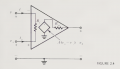
View attachment 358208

3. Minor issue - he references schematics shown several pages ahead.

I am curious to hear if you read this book and what is your opinion.

Thank you.
I think you are misreading his diagram (which is easy to do, because it is not very well annotated).

You will probably find somewhere in the reading that he is defining v_x to be the differential voltage at the input:

\(
v_x \; = \; v_+ \; - \; v_-
\)

If that's the case, then since the v+ is hard-tied to 0 V, that means that

\(
v_- \; = \; -v_x
\)

Which is then consistent with his equation.

He should definitely have the Node A labeled if he is going to reference it.

As for figures appearing several pages ahead of where they are referenced, that is something that the author probably had little, if any, say in the matter, particularly in 1982.

As for applying the ideal op-amp criteria, it is usually stated early on that the discussion will assume that the opamp is operating in it's active region unless indicated otherwise.
 

Thread Starter

mondo90

Joined May 16, 2025
122
@WBahn ,thank you for demystifying Vx, indeed that makes sense, however I still think could have been done clearer.

As for applying the ideal op-amp criteria, it is usually stated early on that the discussion will assume that the opamp is operating in it's active region unless indicated otherwise.
but what does active region mean here? A fully saturated opamp on either end is also active yet it doesn't imply V+ = V-. Even with negative feedback setting a gain of say 5, it desn't mean V+ = V-. So his statement is incorrect as it is.
 

WBahn

Joined Mar 31, 2012
32,702
@WBahn ,thank you for demystifying Vx, indeed that makes sense, however I still think could have been done clearer.


but what does active region mean here? A fully saturated opamp on either end is also active yet it doesn't imply V+ = V-. Even with negative feedback setting a gain of say 5, it desn't mean V+ = V-. So his statement is incorrect as it is.
When the amp is railed, it is not considered to be active, it is saturated. Active means that it is acting as a high-gain differential amplifier.
 

simozz

Joined Jul 23, 2017
170
I am curious to hear if you read this book and what is your opinion.
Definitely the best practical book (with many examples) on active (also good for passive) filter design in my opinion. There are a few others, but are more theoretical focusing more on the mathematical aspects of the filtering theory which makes more difficult to get something done in practice, so you might get lost in polynomial approximation theory rather than focusing on solving the transfer function.

It explains very well both Butterworth, Chebyshev and Bessel frequency approximations and I am pretty confident that if you continue the book you will learn how to design these approximations filters. As far as I remember, is a bit poor about Cauer/Elliptic approximation.

Worth the money.
 

simozz

Joined Jul 23, 2017
170
Okay but a finite gain also doesn't guarantee the condition he made.
Consider that this is not a book focused on Op Amp theory, but mainly on Active Filter Design, so it mainly threat them as ideal in its examples.
It explains Slew Rate and others useful details but if you go for an Op Amp specific book go for Sergio Franco's book or another focused on it.

As far as I remember, is a bit poor about Cauer/Elliptic approximation.
I was wrong. Picked up from from my shelf, has a chapter for both Inverse Chebyshev and Cauer.
 

MrChips

Joined Oct 2, 2009
34,627
Okay but a finite gain also doesn't guarantee the condition he made.
When the op amp's output hits the rail it is no longer in the active or linear region, regardless of the gain setting.
The only way the op amp will be in the active region is to apply negative feedback.

An op amp is a control system. With positive feedback you get a run-away situation. You need negative feedback to keep it from running away.
 

Thread Starter

mondo90

Joined May 16, 2025
122
Thanks for your opinion @simozz

It is not that I look for OP AMP book, I deliberately read this chapter to see how it covers the material I am already familiar with. Then seeing this statement made me doubt if it is a valuable resource. I will continue reading as both you and @WBahn seem to give a thumb up for it :)
 

WBahn

Joined Mar 31, 2012
32,702
Thanks for your opinion @simozz

It is not that I look for OP AMP book, I deliberately read this chapter to see how it covers the material I am already familiar with. Then seeing this statement made me doubt if it is a valuable resource. I will continue reading as both you and @WBahn seem to give a thumb up for it :)
I haven't given a thumbs up or down -- I've never reviewed that particular book.
 

Thread Starter

mondo90

Joined May 16, 2025
122
"I haven't given a thumbs up or down -- I've never reviewed that particular book."

@WBahn, okay my wrong impression then. So what would you recommend for analog filter design?
 

MrChips

Joined Oct 2, 2009
34,627
There is another subtle but important point you may be missing.

Let us label the non-inverting input as V+ and the inverting input as V-.

The open loop gain is very high, regardless of what resistors are placed in the op amp configuration.
V+ = V- otherwise the op amp is in saturation.
 

Thread Starter

mondo90

Joined May 16, 2025
122
Thanks @MrChips, I got your point on the finite gain - it is only possible when V+ ~= V-. This of course changes any instant but the point is in order to maintain a finite output V+ - V- -> 0; the difference tends to 0. Otherwise the circuit saturates.

As for the book, I will take a look at Active Filter Cookbook by Don Lancaster however it seems to be on active filters only while sometimes it is enough to just add a passive LR ladder.
 

simozz

Joined Jul 23, 2017
170
Get Active Filter Cookbook by Don Lancaster.
Took a look. I didn't like it at first glance (but this is of course just my opinion).

I didn't find a detailed procedure for filter design in it, I mean starting from bandwidth specs, determining the required order (which depends mainly on passband and stopband attenuations, and so on. It mentions that the order it is the highest degree of the TF, but it seems it doesn't expose the correct criteria for specifying it.

Valkenburg's book threats rigorously more in depth the theory than Lancaster's book. In addition to the previous comment, the latter only mentions approximtions only around pages 72-77.

Note that Valkenburg's book has also a chapter dedicated to Sensitivities.
 
Top