An unusual error in my hacked DMM FS8233

Thread Starter

q12x

Joined Sep 25, 2015
2,227
This is a side project from my usual thing Im doing right now.
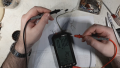
Please watch this movie where I explain and present the problem in a very detailed form.
My conclusion, it is definitely the power wire that is coming from the SMPS. As shown, I made the test with the batteries and is behaving without error. The error appears only when I connect this wire, and doesnt matter where I connect it - from inside or from outside. See the experiments I did and please share your opinion about what it may be and how to SOLVE it ! Thank you !
 
Last edited:

MrSalts

Joined Apr 2, 2020
2,767
I didn't watch the video - the intro was rather annoying so I stopped it after about 10seconds. Try explaining with words. I'm not watching a 15 minute video (I have no idea how long that intro music lasted).
 

panic mode

Joined Oct 10, 2011
5,116
nope.... i tried that but gave up.

"...here is what i tried..." does not describe what the problem is. i tried different location and no dice.

please mention PSU model, fault type, measured output etc.
 

Thread Starter

q12x

Joined Sep 25, 2015
2,227
Is quite simple. Here is what I tried: And nothing from these permutations worked. Eh, well.
The idea is to power that DMM from a 5V voltage PSU, like in the movie. I actually converted down the 5V into 3V with a VReg. To fit exactly on the batery voltage.
- I get an error in functionality (shown in the movie), the DMM is reading some inexinstent fv and is eroneous AFTER reading any R value. But not WHEN is reading the value itself. But after, when the probes are in air. Or my hands in vicinity. I hunted the problem down and I am very sure it is from the power cable I attach. If Im powering BACK from batteries, as it was originally, is working just FINE, without any over-mentioned errors. So is definitely that power cable the source of the problem.
This is a list with what I tried so far. I did some very simple tests, shoot in the dark but I couldnt get any correction for the error with these permutations. Eh...well. Ill figure it out, but MUCH more slowly if doing it alone.
1667804724760.png
 

MisterBill2

Joined Jan 23, 2018
27,830
OK, and all should understand that I do not watch movies or most video presentations. They are often an insufficient source of information with far to much talk and music, and thus a waste of time and bandwidth. And usually the talk is faster than my listening.

The apparent problem, I am guessing, is that a DMM that functions correctly when powered by 3 volts of batteries does not function correctly when powered from a 3 volt regulator supplied by a 5 volt switching power supply.

The stated failure is that the readings are not correct.

The problem is first, that the external supply connection converts the entire DVM and leads package into an antenna that may pick up unknown signals. An additional problem or two is that the power supplied to the DMM is probably not pure DC from a low impedance source.
 

DickCappels

Joined Aug 21, 2008
10,661
It has been said that some voltmeters cannot measure their own power supply voltage. In this case, it might be that the circuitry assumes that the negative end of the battery is free floating. How about trying a 3 volt source that is completely floating?
 

crutschow

Joined Mar 14, 2008
38,598
You cannot power most battery-powered voltmeters from an external grounded supply.
The voltmeters operates with the battery power floating, since the battery is not connected to the voltmeter external ground connection, so any external voltmeter power supply must also float from any external voltage being measured.

You can check that by using the meter to measure its own internal battery voltage.
If you measure a voltage at both of the battery terminals, the battery is floating.
 
Last edited:

Thread Starter

q12x

Joined Sep 25, 2015
2,227
The apparent problem, I am guessing, is that a DMM that functions correctly when powered by 3 volts of batteries does not function correctly when powered from a 3 volt regulator supplied by a 5 volt switching power supply.
You understood the problem perfectly ! It is exactly what I did.
It does function, but with an additional error that was not there while powered normally from 3V batteries.
The error is like this:
-1- while NOT measuring anything, when the probes are on the table, and importantly, my arms or hands are very close to them or touching them, the display is picking random frequency, around 300Hz. Why I say important, because when I lift away my arms or hands from a certain area around the DMM, it starting to behave normal, without any random fv reading.
-2- I only tested measuring Resistors. Its the only thing it is VERY good for. In my experience and I love it for that. It is searching automajically for the x R value, no need to switch the knob to a certain range like the old DMM. Some of you probably already know already this function. Anyway, AFTER measuring a 10k, it was continuously search for other R values but not stopping from the search as before. It is randomly jumping from M to null to k.
Notice how in the picture attached, I keep my hands in air, but it is displayed a value there. That value actually is switching randomly at an interval of 1/s.
1667862019459.png
These are the 2 major errors I observed. Maybe there are others. I didnt do all the DMM operations. I did measure voltage one time and AFTER measuring, it is jumping in values as with the R, but for the V values.
My opinion is it's autosearch function mest up somehow.
-3- All the measurements are FINE, are ok, with this error that happens AFTER the measuring. So the values measured are OK. It is doing its thing as a DMM. No problem there. But After, instead of stopping from its usual automatic search, it is jumping around.
-4- If im putting back the batteries, everything gets back to normal as before !!! No errors of any kind. This tells me loud and clear it is the power supply Hack that I made. Like @MisterBill2 enunciated very well.

--5--Thats why I wanted you to watch my movie because I did ALL this explanations here in writing, there live in the video and more. Including changing the batteries. It is a very good and efficient way of explaining a problem through a video. It's like showing you the problem instead of explaining it in writing. It is how I see it. But I also understand your point of view as well, the music is too much perhaps, it is a german military march from 1945 btw, my beautiful carphatian voice, accent or speed might not be on the same resonance with some ears. heh. Or movies in general excepting me personally. Hmm. I will try my best to not bother you with movies. Even if I make the best ones on the whole world, haha. We'll see about that.
 

Thread Starter

q12x

Joined Sep 25, 2015
2,227
You cannot power most battery-powered voltmeters from an external grounded supply.
The voltmeters operates with the battery power floating, since the battery is not connected to the voltmeter external ground connection, so any external voltmeter power supply must also float from any external voltage being measured.
I understand your point and I will be sincere telling you that it didn't occur to me. I didn't think on this possibility.
Your explanation will be correct if it was reading erroneously the values. But it is not. It is actually measuring correctly (the limited/few test values I put it to read) ! It is only AFTER the reading, when the probes are in the air, and my hands near or touching the device, that random behavior error appears. I still not think is because floating power supply. But it may very well be, because when I insert back it's batteries, the error disappear. Very strange.
 

Thread Starter

q12x

Joined Sep 25, 2015
2,227
It has been said that some voltmeters cannot measure their own power supply voltage. In this case, it might be that the circuitry assumes that the negative end of the battery is free floating. How about trying a 3 volt source that is completely floating?
I did that already. I inserted already 'a 3 volt source that is completely floating' meaning it's original batteries. And is working fine, as before. The trick is how to do it from a SMPS connected to the mains, like I have. How to do that? I personally don't know. But I'm open to experimentation.
 

panic mode

Joined Oct 10, 2011
5,116
try connecting one or more of different size capacitors in parallel with the SMPS output... capacitors are not ideal so they behave differently at different frequencies. this is why you see in schematics all the time couple of bypass capacitors of very different values - something like 0.1uF and 220uF. one is good at dealing with bypassing high frequencies, the other is better for low frequencies etc. this is why one should put 2-3 different types of caps in parallel.
 

Thread Starter

q12x

Joined Sep 25, 2015
2,227
try connecting one or more of different size capacitors in parallel with the SMPS output... something like 0.1uF and 220uF. ...this is why one should put 2-3 different types of caps in parallel.
I did already what you are telling me. Check this sketch I made, telling you the components I put, the polarity of each, and how many. The very first thing I did was to put in BOTH ends of the wire, 2 filtering capacitors. Also I show them in the video. See their values in my sketch. I Put them in the output of the VReg that is set for 3V, from the 5V SMPS. And I also put them on the DMM board, where the wires soldered. Basically at both ends of the wire. But I didnt see any effect. Maybe the value was too small? Now that you mention 220uF ? I only put 10uF. Hmmm.... It might be. But I also put 100nF as you mentioned and in parallel.
Please click on the image to make it larger and see it at better resolution- thank you.
1667868107856.png
Why is that a problem, if the probes are not measuring anything?
- That is very true, and for awhile I live with this error. Not much, like 1 month or so. It is functional after all. But...is very annoying and Im afraid not to damage it from this interference if I leave it too long exposed to it. So my better judgement is to correct this error.
 

Thread Starter

q12x

Joined Sep 25, 2015
2,227
Im telling you, I did already this and is still not working.
I also know that video, from long time ago.
I also shown in my video as well that those capacitors had no effect.
 

Thread Starter

q12x

Joined Sep 25, 2015
2,227
I just made the test with the value I didnt think to put. Before I put 100nF and a 10uF in parallel.
Now, I put 2 capacitors in parallel, one of 100nF and another of 220uF.
- It didnt work. No effect. The same error is present.
I told you is a very strange problem.
How do I put a 3 volt source that is completely floating, but from this SMPS that I already have? What circuit/component can simulate/emulate such floatingness?
 
Top