amplifier measurement

Thread Starter

alfianabdi

Joined Jun 17, 2015
5
hello all.

i have designed and fabricated an chip, which also consist of an amplifier.
the amplifier has 0.8V supply, 5kHz bandwidth and 1uA total power consumption.
it is designed to have 3pF load capacitance.

which one the best way to measure it?
1. just probe the output to oscilloscope using active / passive probe?
2. connect the output to a buffer, and probe the buffer output with active / passive probe?
3. connect the output to a buffer, and connect the buffer output to oscilloscope using bnc or sma cable?
i have tried option 1, and 2, but didn't get the result i expected,

how to find the compatible voltage buffer?

thank you for your help
 

ericgibbs

Joined Jan 29, 2010
21,439
The BUF04701 is a unity gain buffer.

What result did you expect from the test #2, when using the BUF04701.?

What did you see on your scope.?
 

Thread Starter

alfianabdi

Joined Jun 17, 2015
5
The BUF04701 is a unity gain buffer.

What result did you expect from the test #2, when using the BUF04701.?

What did you see on your scope.?
when using the buffer, i got some kind of oscillation, no matter how i change the input, the output is constant sinusoidal.
my expectation is, i will get signal around 35-40 dB in that 5kHz band (from my amps post layout simulation) from the buffer output compare to my amplifier input signal, since it is an unity gain buffer.

without buffer, using active and passive probe, the output follow the input changes, both amplitude and frequency, but the level is too small, as if it was not amplified
 

ericgibbs

Joined Jan 29, 2010
21,439
hi,
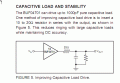
Try the Fig #5 circuit of the datasheet, output configuration.
Also are the power supply supply rails to the amplifier decoupled, is the amplifier on a PCB or a project bread board.?

Are you expecting the unity gain amplifier to 'amplify' the input signal.???
E
 

Thread Starter

alfianabdi

Joined Jun 17, 2015
5
hi,
Try the Fig #5 circuit of the datasheet, output configuration.
Also are the power supply supply rails to the amplifier decoupled, is the amplifier on a PCB or a project bread board.?

Are you expecting the unity gain amplifier to 'amplify' the input signal.???
E
no i mean, this buffer connected directly to the output of my amplifier,
and my amplifier has been fabricated using 0.18 CMOS, 40 dB gain and 5 kHz bandwidth, 3 pF load

input ----- [my amplifier (40 dB)] ------ [buf04701 (0 dB)] ----- output

the input is connected to my amplifier, and since the buffer gain is 0 dB, i expect 40 dB gain at the buffer output to the input.

both my amplifier and the buffer are soldered to PCB.
 

ericgibbs

Joined Jan 29, 2010
21,439
OK, I follow that.

Have you tried the Fig #5 circuit that is used to drive a higher capacitive load.?
The OPA output using the 20 ohm, should be able to drive the load of a scope probe.
Refer image.

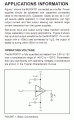
On your PCB do you have adequate decoupling capacitors on the OPA power rail.?
Use your scope on the power rails to check for signs of instability.

You say that when you scope directly to your 40dB amp, that the output is stable, are you sure that the presence of the scope capacitance is not causing the amp to become stable while its being measured.?? ie: is you 40dB amp design inherently unstable.?
 

Attachments

Thread Starter

alfianabdi

Joined Jun 17, 2015
5
yes, i will follow the fig #5. but i have to make sure everything is correct this time ,it cost a lot to print the pcb and put my chip there.

in previous experiment, i didn't have the 10-20 Ohm resistor at the output of buffer.
also before i don't have decoupling cap, neither for +5V nor -5V,
how it affect my circuit? how i check the instablity using power rail?

at last stage simulation before fabrication i got enough 45 degrees phase margin, i expect my amplifier to be stable.

my amps designed with 3 pF load, the buf04701 has 4pF input capacitance, if i included the line inside the chip and wirebonding, it total around 5-6 pF.
do you know any buffer which has high impedance with less than 2pF capacitance?

thank you
 

ericgibbs

Joined Jan 29, 2010
21,439
Decoupling of the OPA is essential, refer image.

Try this quick check, connect a scope probe to the 40dB output, say channel 1 and connect channel 2 scope probe to the OPA output.
Do you still see the oscillation on the OPA output.?

I will look for a very low input capacitive OPA, if I find one I will post details.
 

Attachments

Top