Alternate method to power dozens of leds

Thread Starter

jj_alukkas

Joined Jan 8, 2009
753
I need to make a signboard with hundreds of 3mm led and was wondering if there is any alternate method to wire them up rather than placing 4 in series with a resistor and then paralleling them with other strings. Will wiring them in parallel and running them on a limited voltage like 1.6v or pwm work ? Or anything which makes putting them together easier. Thank you.
 

Alec_t

Joined Sep 17, 2013
15,117
What power supplies do you have available?
What LED current do you want?
What is the LED forward voltage? (Not many LEDs will give much light with only 1.6V).
 

Thread Starter

jj_alukkas

Joined Jan 8, 2009
753
Thank you for the replies.
The power supply is a 12v lead acid battery, so a max of ~13.5v. The 1.6v was just an example, just so I can try to convey the question. Basically, I want to light up 100leds or so. Individual control is not required since its a sign board, wiring can be parallel or series as long as they light up with a safe current, but what I want is to simplify the build process, so was wondering if there is any other way to wire them up without having 3 or 4 leds in series with a resistor. Hope I explained my question correctly. Thank you!
 

dl324

Joined Mar 30, 2015
18,326
I'd arrange them in a matrix. 10x10 will give you 100 individually addressable LEDs that will require 20 wires.
 

BobTPH

Joined Jun 5, 2013
11,514
He has said he doesn't want individual control. All LEDs should light at the same time.

Wiring them in series / parallel with a resistor on each series is the correct way to do it. There is not a better way.

Bob
 

mcgyvr

Joined Oct 15, 2009
5,394
In general you need to decide how low your battery will be drawn so you have a known "min" voltage to work with..
Then you put as many LEDs in series so that the sum of the Vf is not greater than that voltage..

Example.. 12V battery..
If you say I want it to work until the battery falls to 10V and each LED has a Vf (forward voltage) of 2V then 10V/2V = 5 LEDs in series is what you would do.. Each group of 5 will have its own resistor.. Throw as many of those in parallel that you want to achieve your light array..

After the battery voltage falls below 10V there won't be enough voltage to overcome the forward voltage rating of the string and the LEDs will be off...

And you do know that they are going to get dimmer and dimmer as the battery is used up right?
 

philba

Joined Aug 17, 2017
959
Each of your LED strings will require one resistor to limit current. The number of LEDs in a string (N) is related to the forward voltage (Vf) of the LEDs and the supply voltage (Vs). McGyvr's example uses a Vf of 2.0V and a Vs of 12. The resistor is determined by ohms law by using the LED current (If) and the remaining voltage (Vs -(N*Vf))/If. If and Vf can be found on the LED datasheet or other literature from the supplier.

If you use a boost converter like this one, you can increase the number of LEDs per string. This will also give you constant illumination as the battery voltage falls during discharge. If you set the booster to 60V, and use Mcgyvr's example 2 Volts as the Vf, you can put 29 LEDs on a string and use a resistor with 2/If ohms. With an If of 20 mA, you would need a 100 ohm (2/.02) resistor per string. Note, I don't endorse that supplier or specific boost converter. I'm just using it as an example. By the way, white LEDs often have a much higher Vf - 3 to 4 volts.
 
Last edited:

Sensacell

Joined Jun 19, 2012
3,784
That's good if the LEDs are higher current devices though I get the sense that the TS doesn't want to build a bunch of circuitry. You can buy fairly inexpensive modules based on that or similar ICs.

I have been assuming the LEDs are relatively low current, 20-30, mA types.
You can program the current by changing the sense resistor?
 

philba

Joined Aug 17, 2017
959
Yeah. looks like 12.5 Ohms for a sense resistor for 20mA LEDs though that was with a quick read of the DS. I'm not sure they've actually tested that configuration as all their examples are for much higher current. I like the LT stuff but that's a pricey chip.
 

k7elp60

Joined Nov 4, 2008
562
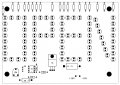
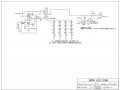
My ICON (Neds place) is a LED sign I created. It has a number of LED's in series, each series group has a resistor and the whole thing works on 12VDC and a a control to PWM the intensity of the LED's I did another one that is an open sign. The documents are posted. The PCB layout shows the position of the LED's. The schematic also shows the PWM dimmer and a SCR crowbar circuit to blow a fuse if the AC supply happens to exceed about 15VDC.OPEN SIGN PCB.jpg OPEN SIGH.jpg
 
Top