Almost-Fully digital High Power PSU, am I overlooking something?

Thread Starter

Lorenzo Di Mauro

Joined Oct 16, 2016
27
I Think i found an alternative solution : if I change the MOSFET to a
PSMN0R7-25YLDX

Which is a lower CRSS, Slightly higher RDSon, LOGIC LEVEL MOSFET

Will I be able to keep my current solution?
 

schmitt trigger

Joined Jul 12, 2010
2,111
Your power supply looks good.
But to echo other posers, your Mosfet selection is critical as you have a low voltage drive.

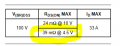
The real parameter you should be looking at, is the RDSon at 4.5 volts.
For instance, the NVMFS6B25NL from OnSemi:

upload_2016-10-23_19-7-33.png
 

ronv

Joined Nov 12, 2008
3,770
I Think i found an alternative solution : if I change the MOSFET to a
PSMN0R7-25YLDX

Which is a lower CRSS, Slightly higher RDSon, LOGIC LEVEL MOSFET

Will I be able to keep my current solution?
A 25 volt part running at 24 volts in a buck converter might not be a good idea. See if you can find a logic level one at least 30 volts.
'm still concerned that you are planning on reading an A to D then doing something to your PWM. I think that will be to slow.
 

Thread Starter

Lorenzo Di Mauro

Joined Oct 16, 2016
27
A 25 volt part running at 24 volts in a buck converter might not be a good idea. See if you can find a logic level one at least 30 volts.
'm still concerned that you are planning on reading an A to D then doing something to your PWM. I think that will be to slow.
I guess you are right, I will use the 30 V version of this MOSFET .

However I Made some slight modifications and increased the frequency to 800 KHz to reduce the inductor /capacitor size to 5.3 uH and 470 uF respectively , with this change I was able to drastically reduce the PCB size of this prototype and thus to be able to manufacture it faster. (From 6x5 to 5x3.6 mm)

As for the chip, it SHOULD be fast enough for the job to properly manipulate the PWM fast enough . If it isn't , I'll just go for a bigger 32 bit MCU.
 
Last edited:

ronv

Joined Nov 12, 2008
3,770
I guess you are right, I will use the 30 V version of this MOSFET .

However I Made some slight modifications and increased the frequency to 800 KHz to reduce the inductor /capacitor size to 5.3 uH and 470 uF respectively , with this change I was able to drastically reduce the PCB size of this prototype and thus to be able to manufacture it faster. (From 6x5 to 5x3.6 mm)

As for the chip, it SHOULD be fast enough for the job to properly manipulate the PWM fast enough . If it isn't , I'll just go for a bigger 32 bit MCU.
It's not the digital speed that bothers me (to much), but I think the A to D conversion time for a PIC is like 6 usec. Maybe someone else has tried to do this, but I don't think it will work. If the plan is to use the comparator in the PIC, that might work.
 

Thread Starter

Lorenzo Di Mauro

Joined Oct 16, 2016
27
It's not the digital speed that bothers me (to much), but I think the A to D conversion time for a PIC is like 6 usec. Maybe someone else has tried to do this, but I don't think it will work. If the plan is to use the comparator in the PIC, that might work.
It can go down to 100 ns even if the reccomended time for conversion is about 1.6 us, which is still fast enough to do all the calculations needed to drive the signal fast enough (assuming 125 ns instruction speed).
 

Thread Starter

Lorenzo Di Mauro

Joined Oct 16, 2016
27
Wow, that could have been bad.

Silly me, when I made my PCB I made a HORRIBLE mistake about trace width (and I'm surprised none of you noticed anything about it) and how they were massively undersized for the current I needed (could have gotten to 700+ °C!)

So in my way to redesign the PCB to avoid a firey situation, I decided to "massively" change the circuit:

I went for ultra-low crss MOSFETS at 5.2 mOhm, logic level, 60 V VDS:

http://www.nxp.com/products/discret...ms-logic-level-mosfet-in-lfpak56:PSMN5R6-60YL

sinze the current required to drive the MOSFETs is amazingly low, I decided to use two more MOSFETs to divide the power needs (and so reduce the trace width needed for the job):


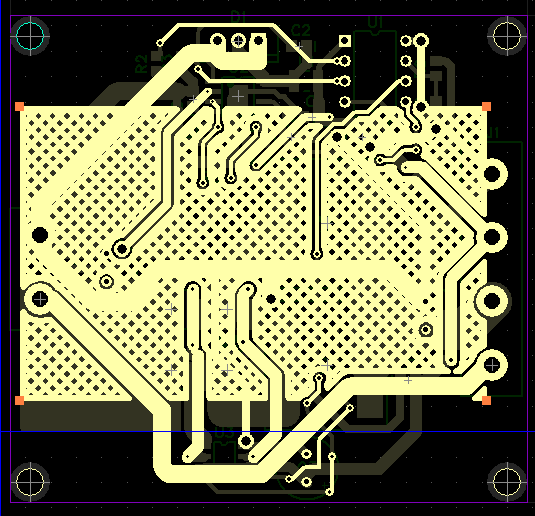
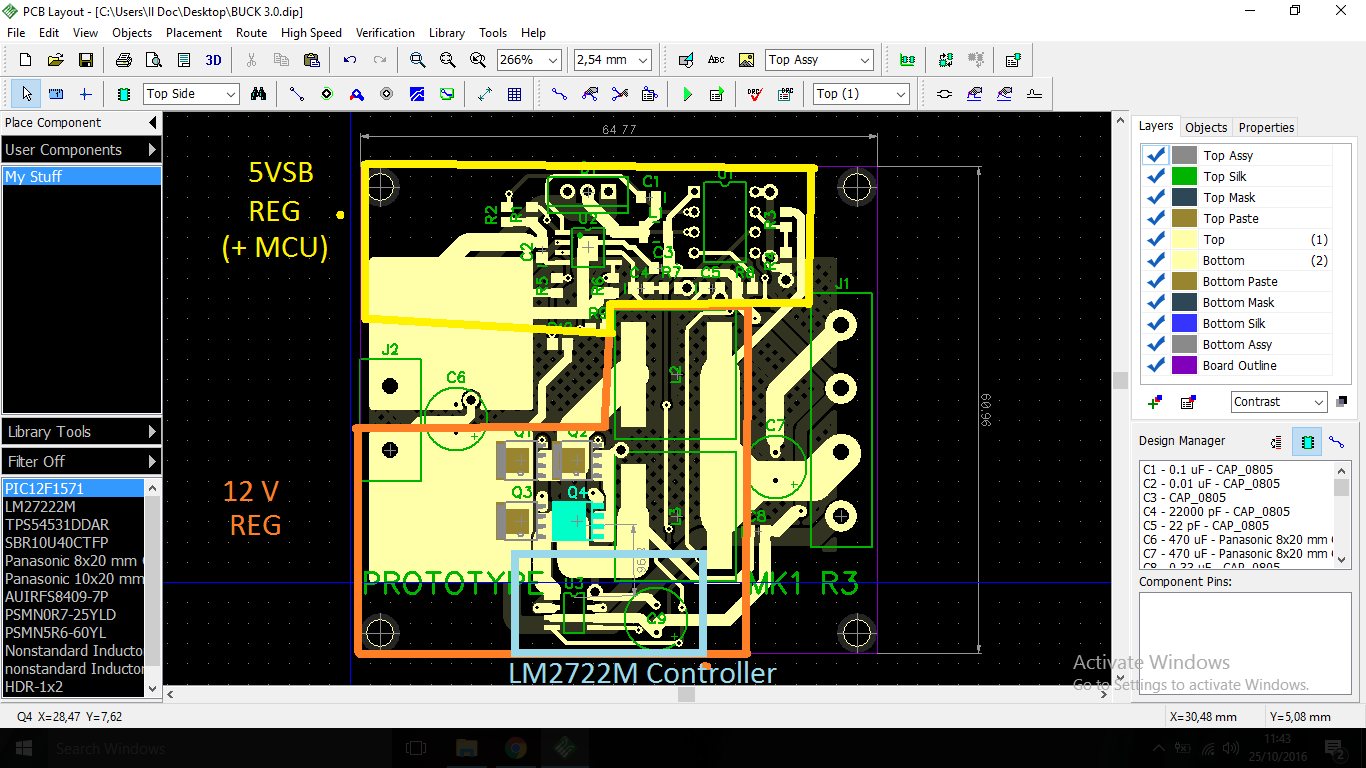
which led me to rebuild my PCB like this:


which made it possible to use a maximum of 4 mm traces while mantaining:

- Low temperatures (anything before 700 °C is more than good to me!)

- High current Capability (Actually it could very well go up to 40 A like this, who knows?)

I'm actually concerned how people gave me the "good to go" pass without even bothering to check the PCB, I know no one is forced to help me, but I see so many "dumber" question (even though no question is ever really dumb, just more or less complex) I would've expected someone to take this more seriously. I'm just an electronic student after all, I can't be expected to know everything about PCB Designing.

So, for the last time before I actually risk blowing up way too much cash for my taste: Is this PCB any good? What could I improve?
 

ronv

Joined Nov 12, 2008
3,770
Wow, that could have been bad.

Silly me, when I made my PCB I made a HORRIBLE mistake about trace width (and I'm surprised none of you noticed anything about it) and how they were massively undersized for the current I needed (could have gotten to 700+ °C!)

So in my way to redesign the PCB to avoid a firey situation, I decided to "massively" change the circuit:

I went for ultra-low crss MOSFETS at 5.2 mOhm, logic level, 60 V VDS:

http://www.nxp.com/products/discret...ms-logic-level-mosfet-in-lfpak56:PSMN5R6-60YL

sinze the current required to drive the MOSFETs is amazingly low, I decided to use two more MOSFETs to divide the power needs (and so reduce the trace width needed for the job):


which led me to rebuild my PCB like this:


which made it possible to use a maximum of 4 mm traces while mantaining:

- Low temperatures (anything before 700 °C is more than good to me!)

- High current Capability (Actually it could very well go up to 40 A like this, who knows?)

I'm actually concerned how people gave me the "good to go" pass without even bothering to check the PCB, I know no one is forced to help me, but I see so many "dumber" question (even though no question is ever really dumb, just more or less complex) I would've expected someone to take this more seriously. I'm just an electronic student after all, I can't be expected to know everything about PCB Designing.

So, for the last time before I actually risk blowing up way too much cash for my taste: Is this PCB any good? What could I improve?
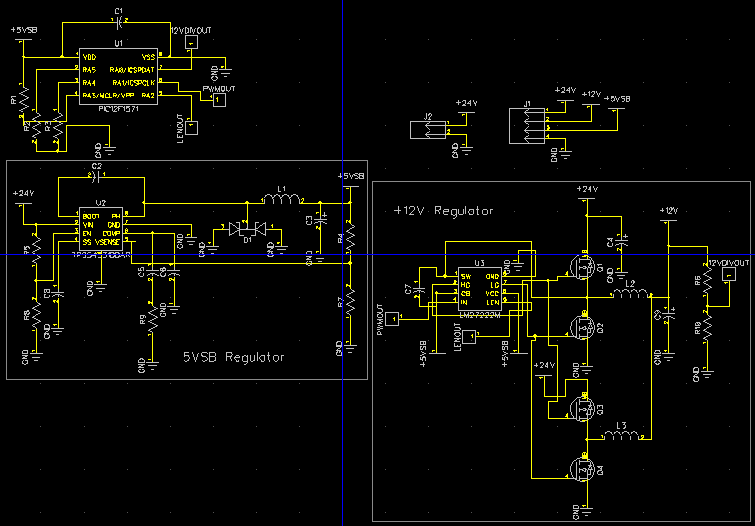
It's difficult to go over someones layout. For example you have "stuff" on the board that isn't on the schematic. So probably the best you can hope for is that someone will help with the schematic.
But having said that you are missing the diode for the driver. If you really try to run it at 800Khz the driver is probably to far away from the FETs.
I don't understand why you would double up on the FETs and inductor.
 

Thread Starter

Lorenzo Di Mauro

Joined Oct 16, 2016
27
It's difficult to go over someones layout. For example you have "stuff" on the board that isn't on the schematic. So probably the best you can hope for is that someone will help with the schematic.
But having said that you are missing the diode for the driver. If you really try to run it at 800Khz the driver is probably to far away from the FETs.
I don't understand why you would double up on the FETs and inductor.
I'm don't have extra stuff from the schematic, I simply didn't put it fully here.

I know I need a Diode, but what would you suggest me to use as a protection Diode?

I'm not sure the driver is far or close enough to the FETs, I thought it was pretty close honestly (less than 10 and 15 mm respectively).

As for the multiple MOSFETs, I made this consideration:

At full load (30 A) the inductor will dissipate about 4 W of power, with such a huge power dissipation it is likely to get into the VOLCANO HOT zone.

Also the MOSFET I had was insufficient on the VDS Breakdown voltage to be "safe enough", and also at 800 KHz it would either require a massive current (all 4.5 A) to generate 1 W of switching dissipation happiness.

However, those two MOSFETs will, in conjunction, have less than 1-1.5 W of power in the most extreme case (and also the heat will be split for convenience) so that's why I thought it was a better idea to use multiple MOSFETs to reduce the heat..
 

Thread Starter

Lorenzo Di Mauro

Joined Oct 16, 2016
27
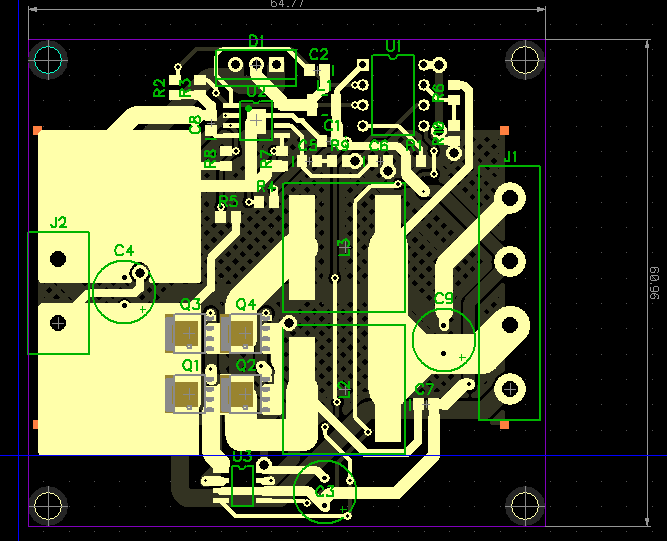
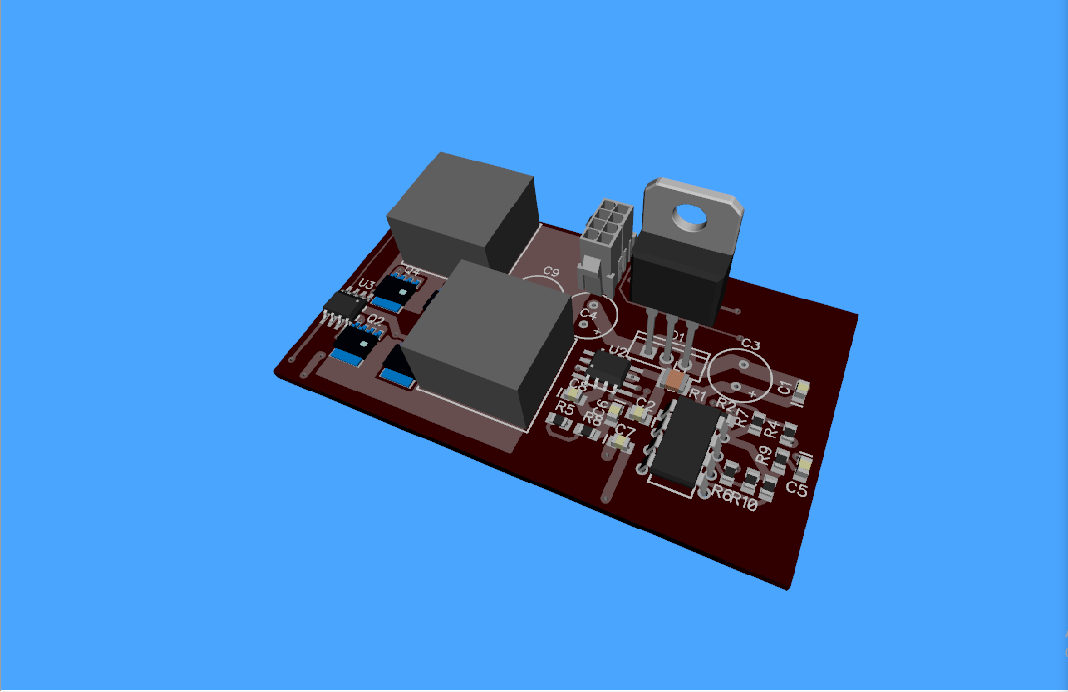
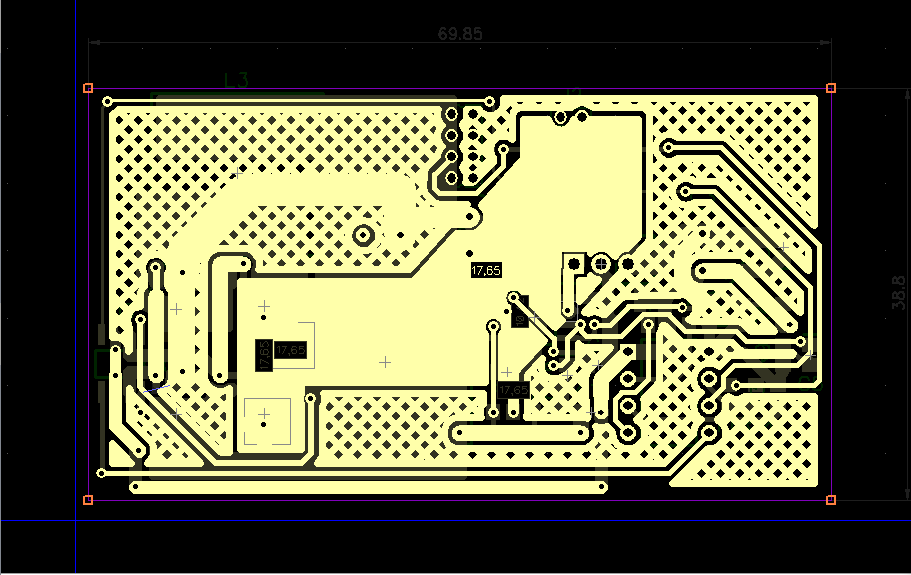
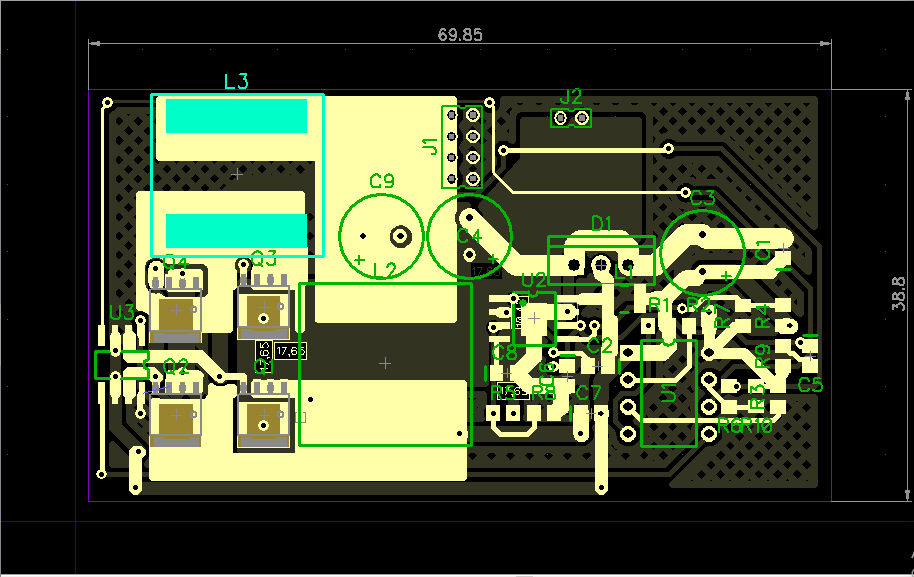
So, I decided to redesign it ONCE AGAIN (This may very well be my 9th time I'm redesigning this thing) And I think I should be pretty enthusiastic about the results.

I got the area down from 394.22832 cm^2 to about 271.406 cm^2 (which should be a rather substantial difference in size nonetheless) while also being able to add:

- 2 Pin and 6 Pin ATX EPS12V Connectors
- More thermal headroom
- Somewhat better component placement

Notice how I went for MASSIVE copper pours to make three giant traces: 24 V, 12 V and GND (5 V doesn't need to be that big TBH), with this I should be able to draw 30-40 A without worrying about the PCB traces getting too hot for my tastes (which, in my honest opinion, is already a sign of assurance).

At this point I don't think I should be modifying this thing any futher, and simply get ready to do some actual testing, I decided this would be the best idea to properly test the circuit:

1) Test at 0 W Draw (to ensure 12V stays within spec at all times)

2) Test at "small" W Draw (using an old Sempion CPU + 939 Motherboard)

3) Test ad "Mid" W Draw (Using a q9300 + 775 PC)

4) Test a "HIGH" W Draw (Using a powerful GPU)

if all these tests pass with flying colors, I should be safe to assume I can, without a shell of a doubt, make a final prototype of this thing, so yeah, at last I'm asking you guys if you think I should do some other modifications to the schematic and/or PCB.

The schematic is basically the same as above.

Here's the updated PCB:


ronv

Joined Nov 12, 2008
3,770
So, I decided to redesign it ONCE AGAIN (This may very well be my 9th time I'm redesigning this thing) And I think I should be pretty enthusiastic about the results.

I got the area down from 394.22832 cm^2 to about 271.406 cm^2 (which should be a rather substantial difference in size nonetheless) while also being able to add:

- 2 Pin and 6 Pin ATX EPS12V Connectors
- More thermal headroom
- Somewhat better component placement

Notice how I went for MASSIVE copper pours to make three giant traces: 24 V, 12 V and GND (5 V doesn't need to be that big TBH), with this I should be able to draw 30-40 A without worrying about the PCB traces getting too hot for my tastes (which, in my honest opinion, is already a sign of assurance).

At this point I don't think I should be modifying this thing any futher, and simply get ready to do some actual testing, I decided this would be the best idea to properly test the circuit:

1) Test at 0 W Draw (to ensure 12V stays within spec at all times)

2) Test at "small" W Draw (using an old Sempion CPU + 939 Motherboard)

3) Test ad "Mid" W Draw (Using a q9300 + 775 PC)

4) Test a "HIGH" W Draw (Using a powerful GPU)

if all these tests pass with flying colors, I should be safe to assume I can, without a shell of a doubt, make a final prototype of this thing, so yeah, at last I'm asking you guys if you think I should do some other modifications to the schematic and/or PCB.

The schematic is basically the same as above.

Here's the updated PCB:


upload_2016-10-25_16-38-2.png
Do you have a data sheet for the inductors and the output capacitor.
 

Thread Starter

Lorenzo Di Mauro

Joined Oct 16, 2016
27
View attachment 114273
Do you have a data sheet for the inductors and the output capacitor.
I calculated them using decent accurate conversions from some datasheet of Texas Instruments, nonetheless it should be fine.

I see the diode is missing, but I don't honestly know what to put to it and at that point I'd rather not put it at all. The capacitor is indeed there, you simply are searching for it in the wrong place, but it IS there (C4 is the capacitor of interest here). Again, how should I move forward for the protection diode? What do I consider when choosing one?
 

ronv

Joined Nov 12, 2008
3,770
I calculated them using decent accurate conversions from some datasheet of Texas Instruments, nonetheless it should be fine.

I see the diode is missing, but I don't honestly know what to put to it and at that point I'd rather not put it at all. The capacitor is indeed there, you simply are searching for it in the wrong place, but it IS there (C4 is the capacitor of interest here). Again, how should I move forward for the protection diode? What do I consider when choosing one?
Lorenzo, you are driving me nuts! :D
You need to start over and make a specification, a schematic with all the parts (with part numbers).
The little diode can be a small ~1 amp schottky diode. It looks to me like C4 is on the 24 volts.
The protection diode, if you want to protect everything from reverse polarity needs to be big enough to handle all the current.
If your aim is 30 amps that diode would dissipate 15 watts or so. big heat sink. Doesn't make much sense to me to worry about .5 watts in the FETs the add a part that wastes 15 watts.
I've probably messed you up here. :( It might be better for you to start a new thread with your complete schematic and spec.
 

Thread Starter

Lorenzo Di Mauro

Joined Oct 16, 2016
27
Do you think it's truly necessary to use a protection diode? I looked online a lot and many sites claim that a stable buck converter shouldn't need one at all.
 

Thread Starter

Lorenzo Di Mauro

Joined Oct 16, 2016
27
The AVERAGE current may be low, but the PEAK current, specially as you are charging the Miller plateau, is quite large.
The controller will handle it just fine, I'm sure he'll live.... /s

At this point all that's left is to actually build one of these. I'll send it to craft and I'll let you guys know if it does the job (Which could very well happen in 2-3 months because I recently transferred and I lack all my components and materials, it sucks to be a new engineer student...)

Thank you guys for all the help you gave me, at this point I think it's my job to try and (hopefully not) fail. I'll even make a video to show how this little beast actually works, maybe it'll be a little wonder, who knows.
 
Top