Advice on toroidal inductor design for power harvesting

Thread Starter

Viroos

Joined Jan 16, 2025
6
Hi, I'm a mechanical engineer, but occasionally do some electro-mechanical systems too, but I feel that my knowledge in EE is insufficient. Now I need to design a toroidal inductor in order to harvest power from overhead high voltage lines. How to do it right? The winding should be "simple" or like in Rogowski coil? The core should be iron, ferrite or laminated steel? Thanks!
 

ronsimpson

Joined Oct 7, 2019
4,645
A toroidal coil does not pick up power from other sources. The power line would have to be in the center of the coil. It is probably the worst shape to use. The Rogowski I have will not pick up power unless it is around the power lines. Very much the same thing.

How much power do you need to steal (harvest)? How close can you get to the power line. What voltage?
 

MisterBill2

Joined Jan 23, 2018
27,159
To get power from overhead wires using a toroid device is simple: Pass the pickup connection wire thru the toroid opening and knot it so it will not slip out. Then, carefully toss the toroid over the overhead wire. Now the high potential will follow the wire back down. But perhaps the TS is seeking a less obvious method.
 

Thread Starter

Viroos

Joined Jan 16, 2025
6
A toroidal coil does not pick up power from other sources. The power line would have to be in the center of the coil. It is probably the worst shape to use. The Rogowski I have will not pick up power unless it is around the power lines. Very much the same thing.

How much power do you need to steal (harvest)? How close can you get to the power line. What voltage?
The design is for the electric corporation itself. The coil will be made as two halves with the cable centered inside it.
 

Thread Starter

Viroos

Joined Jan 16, 2025
6
To get power from overhead wires using a toroid device is simple: Pass the pickup connection wire thru the toroid opening and knot it so it will not slip out. Then, carefully toss the toroid over the overhead wire. Now the high potential will follow the wire back down. But perhaps the TS is seeking a less obvious method.
Lol, but I'm looking for inductive (or perhaps capacitive) method.
 
For 50/60Hz the best is to use a laminated steel core, it has highest permeability comparing to iron powder or ferrite cores.

No need a Rogowski coil, Just wind enough secondary windings to get desired voltage on output for given load.
 
Last edited:

ronsimpson

Joined Oct 7, 2019
4,645
The design is for the electric corporation itself. The coil will be made as two halves with the cable centered inside it.
Now I understand, maybe. lol
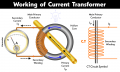
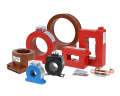
I think you want a current transformer. Toroidal is the way to go. Split core. No gap.
I have made many of these.
Pass the cable in the center, 1 turn. You can get some power from the secondary. There will be many turns.
1737069314214.png
 

BobTPH

Joined Jun 5, 2013
11,463
To get power from overhead wires using a toroid device is simple: Pass the pickup connection wire thru the toroid opening and knot it so it will not slip out. Then, carefully toss the toroid over the overhead wire. Now the high potential will follow the wire back down. But perhaps the TS is seeking a less obvious method.
I love it. Perhaps you were the student in the story of the Barometer Question.
 

Alec_t

Joined Sep 17, 2013
15,101
So now we know you need a current transformer.
The design is for the electric corporation itself.
I'm surprised a corporation doesn't already employ an engineer with expert knowledge of current transformers, rather than having to seek advice on an internet forum?
 

MisterBill2

Joined Jan 23, 2018
27,159
Remember that there are safety considerations when using current transformers, although feeding a bridge rectifier into a filter may solve that issue.
 

MisterBill2

Joined Jan 23, 2018
27,159
It can be both amazing and quite disturbing to observe what some folks in charge simply do not know. Especially if they are managing something like the electric utility organization serving your own neighborhood.
On the other side though, a question: How many actual EEs got any actual class time covering circuit protection, such as fuses and circuit breakers?? Probably that would have been in one of the power courses. I had to learn about that myself, personal study, a while after graduation.
 

sparky 1

Joined Nov 3, 2018
1,218
Power harvesting is capturing power from the environment such as wind and solar ect.
A toroidal ferrite core can be used to transfer an induced current from primary to secondary and or tertiary windings.

A wireless power transfer used to charge a cellphone uses 2 coils in mutual inductance. This is a separate mechanism that is not harvesting.
However to adjust voltage and current, a toroidal ferrite having a desired turns ratio and resonance can be used for conversion.
It is the plain coils that are used for wireless transfer. Ferrite in general can reduce the number of turns of copper wire.
The magnetic flux is more attracted to iron as a pathway, the study of heat, light, sound and fusion is physics a prerequisite EE.
After graduating MS in EE a Doctorate of Electrical Science prepares for R&D where the graduate works with research scientist. Usually.

A Toroidal ferrite transformer type is different from two coils without ferrite for wireless transfer, these have a separate function.
Youtube advertisers make free energy claims that are not true, In reality they are paid to harvest your email address.
 
Last edited:

ronsimpson

Joined Oct 7, 2019
4,645
And the electric corporation doesn't have any electrical engineers to give this task to?
When I took EE there was a separate line of study for transmission line and power plants. Some schools have their very own power plant. Those engineers probably never soldered a transistor.

I have contracted with power companies because they don't know ............ They know things I don't care to know. I probably should have known more about POWER but did not want to get into that field.
 
Top