Adding resistor in series using a transistor switch?

Thread Starter

bigjoncoop

Joined Feb 1, 2019
204
I know I'm over thinking this...

Is it possible to add a resistor in series with a wire/circuit using a transistor?

Im currently using a small trimpot to add a variable resistance in series with a circuit / wire, but instead of having to manually adjust it carefully periodically from adding between 80ohm - 100ohm I just want to use an Arduino to control a few transistors to either add a 80ohm, 90ohm, or a 100ohm resistor in series.

But I can't for the life of me figure out how use the transistor to put the resistor in series! I've already built the circuit but I wasn't paying attention and I'm adding the resistor in parallel which is obviously not what I'm trying to do....

Thx
 

SamR

Joined Mar 19, 2019
5,470
Digipot? driven by the Arduino... Show what the circuit is and maybe we'd get a better idea of what you are trying to do? Or switch 3 transistor switches?
 

panic mode

Joined Oct 10, 2011
4,864
without knowing the circuit, impedance and signal levels one cannot offer suggestion other than to use relays. there are IC switches but one needs to know the application and specs before picking one... most of them are low voltage (5V or less). if you like fancy, that costs a bit more, go for Ideal Switch from Menlo Micro.
 
Last edited:

Thread Starter

bigjoncoop

Joined Feb 1, 2019
204
@SamR
@dl324
@MrChips
@panic mode

Thx for the quick replays!
Didn't realize it wasn't a simple solution, otherwise I would have given more details... Maybe just using some relays would be the best approach since I have a bunch of little guys.

Basically this is to trick a 07 Honda from engaging VCM (Vechile Cylinder Management) which deactivates 3 cylinders when the correct conditions are met. This is a SUPER common thing on this year Honda"s since VCM causes major issues and cuts the life of these engines in half LITERALLY!

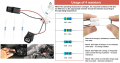
By adding approx 80ohms in series with the coolant temp sensor, it lowers the temperature by just a couple of degrees so the computer will not activate VCM.

There are a few pre-made solutions on the market that are plug and play which do this that cost between $75 - $130. The more expensive ones monitor the resistance and add or subtract a few ohms depending on environmental temperatures to ensure VCM never activates. The cheap ones are just a variable resistor with fixed resistor values that you adjust manually depending on what time of year it is.

There are a lot of people like myself that just add a resistor in series and swap it out a few times a year. I currently use a modified a potentiometer with some series parallel resistors, that adjusts from 80ohms to 105ohms.
***

My current idea is to use an Arduino to monitor the resistance/ voltage drop on the coolant temperature sensor and automatically add a series's resistance in 5ohm intervals to ensure the computer only thinks the coolant is at 165° which is 3° below where it activates VCM. (exactly what these pre-made smart Solutions do)

I just started this project and my first step was to make sure I could use an Arduino to insert a resistor in series on the temp sensor wires...

That is where we're currently at and why I made my post today. I can easily insert a resistor using the Arduino but I can only figure out how to do it in parallel using transistors.

***

The temperature sensor (ECT) only uses 2 wires and 5v
 

panic mode

Joined Oct 10, 2011
4,864
solution may be simple, but if details are missing, one can only guess... and group of people like this forum can come up with many variants ... even if some would not work for intended application. so the idea is to get the reigns of the topic before it blows up.
 
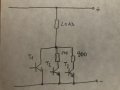
IMG_0993.jpegBy switching just T1 the load is connected directly to power supply.

T1 & T3 disconnected and T2 switched add a 100 ohm to load.

T1 disconnected and T2&T3 switched add 90 ohm to load.

Note: If the load has to be at Gnd side just flip the schematic and use Pnp transistors.
Using mosfets (instead bjt) the added resistance can be more precise adjusted since the mosfet Rds_on is quite good defined.
 
Last edited:

djsfantasi

Joined Apr 11, 2010
9,237
View attachment 329158By switching just T1 the load is connected directly to power supply.

T1 & T3 disconnected and T2 switched add a 100 ohm to load.

T1 disconnected and T2&T3 switched add 90 ohm to load.

Note: If the load has to be at Gnd side just flip the schematic and use Pnp transistors.
Using mosfets (instead bjt) the added resistance can be more precise adjusted since the mosfet Rds_on is quite good defined.
Assuming the switches are switching circuit common (ground), your scheme will work. One side of the switches must connect to ground.
 

Thread Starter

bigjoncoop

Joined Feb 1, 2019
204
so this is what you are doing but just want to switch resistors out without need to pop the hood:
View attachment 329147
Yes exactly. That solution there is one of the most basic cheapest options. There are a range of options but all basically do the same thing. As I mentioned before there is a $130 solution that monitors the temperature sensor and automatically adjusts the added resistance to make sure the VCM is never activated.

Which is what I am trying to accomplish without spending $130 by using an Arduino to monitor the temperature sensor and automatically adjust the series resistors.

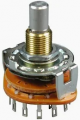
This calls for a 4-position rotary switch.

View attachment 329149
Yeah that is basically what I am using now, a potentiometer that goes from 80 - 100 ohms.

But the end goal is to use an Arduino to monitor the temperature Sensor, and automatically add the necessary resistance in series.


View attachment 329158By switching just T1 the load is connected directly to power supply.

T1 & T3 disconnected and T2 switched add a 100 ohm to load.

T1 disconnected and T2&T3 switched add 90 ohm to load.

Note: If the load has to be at Gnd side just flip the schematic and use Pnp transistors.
Using mosfets (instead bjt) the added resistance can be more precise adjusted since the mosfet Rds_on is quite good defined.
This seams promising... It appears to be adding resistance in "series" with the temp sensor.

Correct?

Currently I just cut either of the 2 sensor wires and add a resistor in series with the wire. This adds the extra resistance to the circuit...

When I look at you diagram it confuses me a little because it's going between both wires.
 
Last edited:

panic mode

Joined Oct 10, 2011
4,864
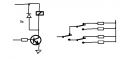
yes... but... the problems you are not anticipating or considering are polarity and common mode. using simple resistor does not have any of that. but using transistors it does... and to make this go away one can use relay option. depending on connection scheme one can get different outcome. using something like this would get only one resistor connected at a time, regardless which or how many relays are energized. since current in sensor circuits is small, you want relays made for that - good candidate would be signal relay with gold plated contacts (G6K-2F-Y... or similar).
1723552510017.png
 
Last edited:

panic mode

Joined Oct 10, 2011
4,864
Note: If the load has to be at Gnd side just flip the schematic and use Pnp transistors.

this is not driving load... it is attenuating sensor signal. and so far it is unclear what the specs are. we do not know potential at those wires. chances are that one of them is connected to either positive or negative supply of the microcontroller. but it is plausible that supply is higher too. if so that would exceed limits of digital potentiometer. even if not, it is probably wise to isolate the control circuit from sensor circuit.
 
Last edited:

DickCappels

Joined Aug 21, 2008
10,661
Done that in the past. You can use an opamp and a bilateral switch (CD4066) if there is not too much current going through the resistance.

Can you tell us about the signal amplitude and the size of the load, for example “3 VP-P @ 1 kHz into 1k no offset.”
 

DickCappels

Joined Aug 21, 2008
10,661
CD4066 has Ron about 100 Ohm....
CD4016 has Ron about 280 Ohm....
those are not suitable when used resistors values are less than that.
but there are ICs with much lower resistance.
this is what TI offers:
BUT by adding an opamp you get around the resistance of the transmission gate.
 
Top