Adding noise to a lightbulb using a function generator

Thread Starter

luke007

Joined Feb 26, 2017
6
Hello,
I am looking to add a small amount of noise into a incandescent light bulb through the use of a function generator. I believe the usual way of doing this would be using an optocoupler to isolate the function generator from 120 VAC. I do not want to control the incandescent bulb just add in extra noise/signals to the lightbulb. I intend to keep the signals from the function generator around 2 Vpk max. Attached is a simple outline of the circuit with XFG1 being a function generator.
Questions:
Would 60 Hz noise affect the 120 VAC 60 Hz from the wall more compared to 10 kHz or 50 kHz noise?
What type of optocoupler or other device would be suitable for just adding in signals from a function generator not controlling a load?
Is there any additional issues I am not taking into account?
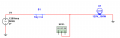
Lightbulb Circuit.PNG
 

Tonyr1084

Joined Sep 24, 2015
9,744
Aside from the two usual question: "Why?" you also asked about any potential problems. Well, I'm fearing a grounding issue. If your signal generator is grounded you could feed 120 VAC back through your signal generator and smoke it big time. Maybe even enjoy one of the opening salvos in William Tell's Overture. Y'know, the part when the cannon goes BOOM.

As far as noise - 120 VAC is a pretty big amplitude. If anything you're going to have to figure out how to modulate the sine wave the same way FM Radio works. You have to modulate the 60 Hz sine wave. Simply driving a 2V, 10KHz into the line isn't going to accomplish anything. Other than possibly blowing up your signal generator.

And boy I hope I'm wrong.
 

Thread Starter

luke007

Joined Feb 26, 2017
6
I am aware of blowing the function generator. That is why I included the question about optocouplers. Typical optocouplers include a triac or other switching methods but this would not be needed for this application.
 

Tonyr1084

Joined Sep 24, 2015
9,744
Opto's can't do it alone. Besides, if they COULD they'd act as a diode, passing current in one direction only.

I'm also unaware of any opto's that can handle 120 VAC.
 

tcmtech

Joined Nov 4, 2013
2,867
Just use a low voltage bulb and run it off the output of a audio amplifier of similar wattage rating to the bulb then feed the input of the amplifier with whatever frequency or set of frequencies you wish to test with and record your data from there.
 

Reloadron

Joined Jan 15, 2015
7,869
Adding noise to a 120 Volt 60 Hz sine wave is not likely to change much of anything for your light bulb. A 100 Watt incandescent lamp powered by 120 Volts 60 Hz will draw about 833.33 mA of current. If adding noise to the power source increases the true RMS value of the voltage to the bulb, subsequently increasing the current draw they you will likely have a hotter burning bulb. The actual filament temperature of a 100 watt incandescent bulb is said to be around 4,600 degrees F. Depending on the bulb and other variables the glass envelope can be anywhere between 150 Degrees F. and 250 Degrees F. This will not be easy to measure let alone attribute any change to noise on the 120 Volts 60 Hz powering the bulb. That would be my take on this anyway. So what you want to do is find a way to add noise (high frequency) to a US 60 Hz 120 Volt line power.
You would do as well using a Variac or Autotransformer to power the 120 V lamp at 110V, 120V, and 130V and note the changes in the glass envelope temperature for the three RMS Voltage values. As each voltage is changed it will take time for the glass bulb temperature to change. The actual temperature of the bulb will likely also be a function of the surrounding air ambient temperature and the air must be still.

Ron
 

wayneh

Joined Sep 9, 2010
18,095
Just use a low voltage bulb and run it off the output of a audio amplifier of similar wattage rating to the bulb then feed the input of the amplifier with whatever frequency or set of frequencies you wish to test with and record your data from there.
I'll just add that, instead of temperature, it'll probably be easier to measure illumination. A resistive filament can't be hotter (cooler) without also being brighter (dimmer).

I believe you could also inject noise to a bulb that is already under control of a TRIAC (a lamp dimmer). You would feed noise to the triac and it would control the power to the bulb.

But tcmtech's solution is far more elegant. Computerized function generator to make any waveform you want , plus amplifier to power the bulb.
 

Tonyr1084

Joined Sep 24, 2015
9,744
OR stick a small magnet to the glass on the same plane as the filament. The magnetic flux will interact with the current through the filament and make it vibrate at 60Hz. IF you can hear anything then like R!f@@ said, build a 120v 10KHz inverter and see what happens. And perhaps make it a square wave or triangle wave. Sine waves are smoother, you may get more noise out of the bulb by slamming the direction of the current.

But I'm still wondering "WHY" you want to do this. Is it to annoy someone? It's working. I'm annoyed.
 

crutschow

Joined Mar 14, 2008
38,391
Connect an inductor in series with the bulb with a value that has a high reactance to the applied signal but low reactance to 60Hz.
Connect the output of a high frequency (perhaps audio) transformer across the inductor.
That will allow the 60Hz current to readily pass to light the bulb but be a high impedance to the high frequency "noise" applied to the input of the transformer and appearing across the inductor (and thus the light bulb), while being safely isolated from the line.

The high frequency transformer will need to be able to drive the impedance of the bulb when it is lit.
If its 100W, 120V as you show, then it's impedance is about 144 ohms.
A small audio power transformer can handle that.
 

Thread Starter

luke007

Joined Feb 26, 2017
6
Thank you all for your responses they are very helpful. I will look more into these solutions. Sorry to annoy you Tony. The best answer I can give to why is that this is a small portion of an experiment and looking into how interference affects temperature is important. This is part of a student project for a corporate partner so I do not think I can tell you anymore even though I would like to.
 

Tonyr1084

Joined Sep 24, 2015
9,744
I'm not so think as you annoy I am. Sharing with us the purpose of your endeavor helps us understand what you're trying to accomplish and why. Sometimes we don't need the why, but in cases like this understanding your goals can help us direct you to a successful conclusion.

Reading the posts between my last entry and now - Crutschow has a working solution (I think).

Good luck with your school project. We're all about helping people in school. Well, most of us, most of the time. Sometimes we can get a little snarky. Sorry for my snark about annoyance.
 
Top