Add phantom power to mike

meth

Joined May 21, 2016
298
The phantom power is drawn form the mixer/module/whatever device this is connected to. Almost every device that has the XLR microphone input feeds it with phantom power. If you want to connect this to a device without phantom power that might be tricky because I dont know how you gonna feed 48V without major modification (space-wise.. you would need transformer or some boost....)...

So the more important question is - what do you want to connect this to? Tell us the device model.
 

meth

Joined May 21, 2016
298
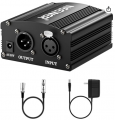
After short research, I just found out that there are phantom power supplies on the market:
1738586336101.png

I have never used one of these. This looks nice and it is super cheap (this one is ~30$) so if you ask me no manual modification of existing equipment is worth if you can fix your issue for 30 bucks.

EDIT: There is also power module from the same manufacturer, which can be bought as an accessory.
 

Thread Starter

steverod

Joined Jul 11, 2024
48
Thanks. That is good. All I'd need is the '4-pin locking socket' to XLR adapter.

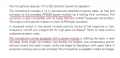
edit: I just spoke to the shop, they're unsure whether it will work without Audio Technica's power box but the Audio Technica power module is quite pricey. I've attached the specs. Anyone care to comment? It's a good mike and just what I need.
 

Attachments

Last edited:

meth

Joined May 21, 2016
298
Those connector output variants don't seem standard. Maybe it is some kind of protection so you cant use it with another phantom power supply. Maybe reconsider a similar product from another manufacturer that has more standard XLR output (hot, cold, ground).
 

meth

Joined May 21, 2016
298
yeah the power module comes, if you buy it additionally :D very weird choice of product design, I rather much avoid manufacturers that dont have equipment with standard outputs, but you are obliged to buy additional accessories.
 

MisterBill2

Joined Jan 23, 2018
27,186
I was going to suggest "SWEETWATER" because they sell a huge variety of audio stuff for both PA and recording. And also they seem to be honest, AND THEY WILL EXPLAIN.
Those tiny 4-pi locking connectors are the major pain source because they are so terribly expensive. Much more than top quality XLR connectors and MUCH more difficult to install on a cable.
ALSO: BEWARE!!! Phantom Power is by no means anything for the unknowing to play with. For starters, it is a DC voltage between the two BALANCED signal wires and the shield conductor. So from the start it is not a "One wire hookup". Putting 48 volts, or even just 5 volts, across a dynamic microphone will do some damage. Almost instantly, and certainly PERMANENTLY.
 

MisterBill2

Joined Jan 23, 2018
27,186
I am glad that the EBAY purchase worked for you. And I hope that the price was reasonable. I say that because sometimes I see ebay prices well above the sell prices quoted by known commercial organizations known to be honest.
 

MisterBill2

Joined Jan 23, 2018
27,186
In addition, that microphone described in the post #1 link seemed very much to be intended for a wireless microphone transmitter. There was a whole lot of missing information with post #1, by the way.
AND, once again I suggest using SWEETWATER as a supplier because they appear to be honest, in addition to actually knowing about the products that they sell.
 

MisterBill2

Joined Jan 23, 2018
27,186
Aside from all of the comments so far, I HAVE NEVER SEEN A SEPARATE PHANTOM POWER CONNECTION ON A MICROPHONE!!!
Without exception, the phantom power supply from the device connected to the microphone is balanced, with the same DC level on both pins #2 and #3, with the shield pin #1, being the common negative. THAT IS THE DEFINITION OF PHANTOM POWER!!
There are certainly other schemes around, and I would not ever consider using them for any reason. I HAVE worked with an "audio technics" wireless mic package and it does use that tiny 4 pin connector and it is a ROYAL PAIN in every aspect.
 
Top