Active peak detectors behaviour

Thread Starter

PsySc0rpi0n

Joined Mar 4, 2014
1,786
This is no longer a leak. This is the current breakdown. Do not you know that in the case of a breakdown in a real diode, the current is much more leaky. Some radio amateurs use conventional silicon diodes (with a fairly small leakage) as zener diodes for a voltage of 100-300 volts. This was done in the USSR.
Hum, ok. This is not easy for me to understand. There are too many details I have no knowledge about. Also, I sure did not know that radio amateurs use conventional silicon diodes as zener diodes for those voltages.
I'm just looking/searching for an easy to use peak detector for higher frequencies starting at about 20Mhz or so.

I'm also trying to find suitable components for this range of frequencies such as OpAmps and diodes!

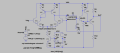
D2 stops the amplifier saturating on negative inputs and eliminates the recovery time from that saturation.
D3, at least partially, offsets the voltage drop of D1.
Thanks for the insight! I like to use my AoE book as a first source of information and go from there to the practice. LTSpice simulation and minimal comprehension of the circuit is what I seek after reading in AoE.

As this point, looks like version B of AoE of the detector is the best of the 3 I presented here. So I want to focus on that one and choose models that I can later compare results from real circuit with the ones obtained in LTSpice!
 

Thread Starter

PsySc0rpi0n

Joined Mar 4, 2014
1,786
The things I learn about LTSpice here and in Yahoo groups. It's amazing I mean, I knew 2 signals can be summed but never thought about doing it in LTSpice neither how to do it!

Thanks @Bordodynov .

Now, could I get an explanation about the 2 resistors added? I would appreciate it very much.

Thanks
 

Bordodynov

Joined May 20, 2015
3,431
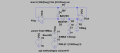
Operational amplifiers do not like a large capacitive load.To solve this case, a resistor is connected in series with the capacitor.In addition, such a resistor (R2) reduces the phase shift, which is good when using a common negative connection.Without a resistor, oscillation is possible.In a real circuit, in one of my projects I used a resistor.Using an ideal operational amplifier, you may not notice this (oscillations).A real peak detector always has a reset circuit.Resistor R3 simulates leakage of the discharge key element.
 

Thread Starter

PsySc0rpi0n

Joined Mar 4, 2014
1,786
Ok, thank you for the explanation about the added resistors. The other circuit for 20Mhz, I think I can recognise there a current mirror if I'm not mistaken and not much more.
I just want to ask what do those 2 options do. The method=gear and cshunt=1f options

Anyway, I'll focus in that other circuit version B.

Thanks
 

Bordodynov

Joined May 20, 2015
3,431
In this case, these options are not needed. They are used for difficulties in convergence calculations. This is an adaptation of the previous scheme where such difficulties were. See HELP -Dot Command-Option.
 

Thread Starter

PsySc0rpi0n

Joined Mar 4, 2014
1,786
Ok. I'll see the help about the commands.

Edited;
A little bit offtopic. I'm using Linux, therefore LTSpice is running under Wine and when I go to Help, I can see the topics but nothing shows up on the right side of the Help window. Could this be due to .chm files (help file) missing in the correct folder?
 
Last edited:
Top