Active BPF without gain

Thread Starter

Dritech

Joined Sep 21, 2011
907
Hi all,

I need to design an active BPF to attenuate any signals outside the 20Hz to 600Hz range, while keeping the signal with a unity gain (no gain needed).
Below please find the circuit which I tried, but I am not convinced about the frequency response of this filter.
Could anyone please suggest the best values to select for achieving the best performance.
Any suggestions would be highly appreciated.
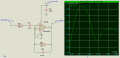
upload_2018-4-4_22-35-58.png
 

crutschow

Joined Mar 14, 2008
38,322
That is not really an active filter.
It is a passive 1-pole high-pass filter at the op amp input, followed by a 1-pole low-pass passive filter in the op amp feed back, with the op amp just acting as a buffer.

If you want a good filter you should use a decent active filter, such as a Sallen-Key, one for the high-pass and one for the low-pass.
AD's filter tool that jpanhalt referenced is good for designing them.
Texas Instrument's free FilterPro is also good.
 

Thread Starter

Dritech

Joined Sep 21, 2011
907
Hi all,

Thanks for your feedbacks.
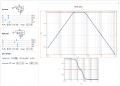
As most of you suggested to use a Sallen Key filter, I used Wolfram to design a new filter.
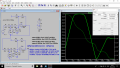
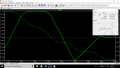
Below please find the frequency response when using the values shown in the snapshot below.

I am still not convinced about the output of the LPF. The response did improve when I replaced the AD8619ARZ with an ideal op-amp, but the frequency response was getting distorted when replacing the AD8619ARZ with another op-amp (ex the LM324).

Any suggestions on how to improve the LPF attenuation and why the circuit i not performing well when replacing the op-amp to LM324 ?

Thanks in advance.

upload_2018-4-7_21-10-17.png
upload_2018-4-7_21-9-38.png
 

Audioguru

Joined Dec 20, 2007
11,248
An LM324 is old, noisy, has crossover distortion and a poor high frequency response above 2kHz. Maybe the inside of the LM324 is heating and distorting with the slow voltage swings of the output at low frequencies?
 

OBW0549

Joined Mar 2, 2015
3,566
Any suggestions on how to improve the LPF attenuation and why the circuit i not performing well when replacing the op-amp to LM324 ?
I think there are two interrelated things going on here which conspire to give you the less-then-ideal response of your filter at high frequencies:

First, both the AD8619 and the LM324 have rather modest gain-bandwidth product (GBW) specs (this specifies the frequency at which the op amp no longer amplifies (i.e., its open-loop gain is 1, or 0 dB). Also, these op amps (like all op amps) have a finite, non-zero open-loop output impedance. Both these factors interfere with the op amp's performance at high frequencies in a Sallen-Key filter, which relies on the op amp (whether the circuit configures it for unity gain or for higher gain) to emulate a true voltage-controlled voltage source (VCVS) at all frequencies.

And secondly, your choice of component values is making things worse by presenting your op amp (especially in the low-pass section) with an extremely heavy, low impedance load on its output; this heavy load further reduces the op amp's open-loop gain, and also exaggerates the effect of the op amp's output impedance.

I think you'll get MUCH better results if you change R1 and R2 in the low-pass section to 33 kΩ and change C1 and C2 to 10 nF and 22 nF, respectively. This will lighten the load on the op amp's output and should give better high-frequency performance. It might also help to change the components in the high-pass section as well: increase R1 and R2 by a factor of 10, and reduce C1 and C2 by the same factor.

Also, it would be a good idea to switch to an op amp with a much higher GBW, say around 10 MHz or so. An LM6132 dual op amp would take care of both the HP and LP sections.

Hope this helps a bit...
 

Audioguru

Joined Dec 20, 2007
11,248
Bordodynov, I saved your filter because I have never seen one opamp do both the lowpass and highpass filters of a bandpass filter at the same time. Very good work.:)
 

Thread Starter

Dritech

Joined Sep 21, 2011
907
@Bordodynov , interesting circuit, thanks.

@OBW0549

Thanks for your feedback. I used the tool from Analog Devices which provided the values similar to what you suggested.
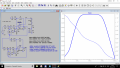
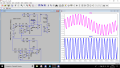
Below are the two frequency responses I got when using the AD8619 (top) and the LM6132 (bottom).
I may be wrong, but it seems that the AM8619 has a smoother response.Any suggestions?
Also, will using high value resistors increase the overall noise of the circuit?

upload_2018-4-8_17-46-52.png

upload_2018-4-8_17-45-15.png
 

OBW0549

Joined Mar 2, 2015
3,566
Below are the two frequency responses I got when using the AD8619 (top) and the LM6132 (bottom). I may be wrong, but it seems that the AM8619 has a smoother response.Any suggestions?
Yes, the AM8619 curve looks smoother, but look at where the high-frequency peak is with the LM6132: all the way out at 10 MHz. With the peak at such a high frequency, you can reduce it to insignificance simply by inserting a single-pole RC filter (a couple of kHz cutoff frequency or thereabouts) on the output of your Sallen-Key LPF.
 
Top