AC current in open circuit

Thread Starter

Flamingo90

Joined Aug 5, 2024
12
Please correct my assumption if I’m wrong, but I assume if I take a copper wire and keep it straight in a manner that the copper wire ends arent touching, then I take a magnet and move it up and down, the electrons would flow back and forth, right?

If my assumption is correct, would that mean electrons would flow if I didn’t make the ends of the copper wire touch?

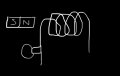
Looking at the drawing I made, would the bulb light up if I moved the magnet through the wire loop, provided the copper wire ends arent in contact with each other? Doesnt an antenna work in the same principle? Thanks
 

Attachments

AnalogKid

Joined Aug 1, 2013
12,043
Please correct my assumption if I’m wrong, but I assume if I take a copper wire and keep it straight in a manner that the copper wire ends arent touching, then I take a magnet and move it up and down, the electrons would flow back and forth, right?
No.

There will be localized eddy currents, but no bulk electron movement. For that to occur there must be a complete circuit from and to a conductive load of some kind. You will know when electron flow happens because that flow will produce a magnetic field that opposes the motion of the magnet. This is captured in the minus sign in Faraday's Law of Induction and Lens's Law.

https://en.wikipedia.org/wiki/Lenz's_law

ak
 

WBahn

Joined Mar 31, 2012
32,702
Please correct my assumption if I’m wrong, but I assume if I take a copper wire and keep it straight in a manner that the copper wire ends arent touching, then I take a magnet and move it up and down, the electrons would flow back and forth, right?

If my assumption is correct, would that mean electrons would flow if I didn’t make the ends of the copper wire touch?

Looking at the drawing I made, would the bulb light up if I moved the magnet through the wire loop, provided the copper wire ends arent in contact with each other? Doesnt an antenna work in the same principle? Thanks
Within limits, yes.

If the two ends of the wire are close enough together, you simply have a capacitor between them, and so AC current can flow through this capacitor by alternatingly charging the capacitor one way and then the other. But this is a VERY small capacitor, so the frequency will have to be very high in order to get any meaningful AC current flowing. The further apart the ends of the wire, the smaller the capacitance until you get to the point where the magnet causes only tiny currents to flow before the resulting voltages due to the resulting charge separation are big enough to counteract the Lorentz forces due to the motion of the magnet.
 

Thread Starter

Flamingo90

Joined Aug 5, 2024
12
I
Within limits, yes.

If the two ends of the wire are close enough together, you simply have a capacitor between them, and so AC current can flow through this capacitor by alternatingly charging the capacitor one way and then the other. But this is a VERY small capacitor, so the frequency will have to be very high in order to get any meaningful AC current flowing. The further apart the ends of the wire, the smaller the capacitance until you get to the point where the magnet causes only tiny currents to flow before the resulting voltages due to the resulting charge separation are big enough to counteract the Lorentz forces due to the motion of the magnet.
I just found this video which demonstrates the situation I was asking at around 13:00 mark. It appears the current can flow but then stops in the end like a wave hitting a wall. I believe with my diagram, a bulb might light up, but then stops when the electrons reach the edge of the wire.
 

WBahn

Joined Mar 31, 2012
32,702
I


I just found this video which demonstrates the situation I was asking at around 13:00 mark. It appears the current can flow but then stops in the end like a wave hitting a wall. I believe with my diagram, a bulb might light up, but then stops when the electrons reach the edge of the wire.
Not enough electrons will flow in order to heat the element (your diagram implies an incandescent bulb) enough to emit any light before the charge separation halts the flow.
 

Thread Starter

Flamingo90

Joined Aug 5, 2024
12
Not enough electrons will flow in order to heat the element (your diagram implies an incandescent bulb) enough to emit any light before the charge separation halts the flow.
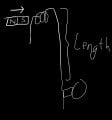
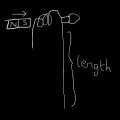
Please find the two images I drew, one has a longer length of wire after the bulb, and another has a shorter length wire after the bulb.

Correct me if I’m wrong, but I think placing the bulb near the beginning of the wire gives the bulb an opportunity to heat and light up before the electrons jam up near the end of the wire. Like a direct relationship between lighting and bulb placement. But with the bulb being placed near the end of the wire, that opportunity becomes low.
 

Attachments

WBahn

Joined Mar 31, 2012
32,702
You are thinking of the electrons like water in a mostly empty pipe, but instead, it is more like a full water pipe -- the effect travels down the wire at the speed of light (in the medium) because it's the the fields around the wire that matter.

Make your wire a couple of miles long and you will still not see enough current to heat the bulb up.
 

Thread Starter

Flamingo90

Joined Aug 5, 2024
12
You are thinking of the electrons like water in a mostly empty pipe, but instead, it is more like a full water pipe -- the effect travels down the wire at the speed of light (in the medium) because it's the the fields around the wire that matter.

Make your wire a couple of miles long and you will still not see enough current to heat the bulb up.
Thanks I feel I understand your point, so I think youre saying for the time for atoms to vibrate and heat up to emit light in the filament, it’ll be too late as the electrons have already reached in the end of the wire.
 

AnalogKid

Joined Aug 1, 2013
12,043
Thanks I feel I understand your point, so I think youre saying for the time
No.

This has nothing to do with time. There is no complete circuit, so the bulb will not light. No amount of wire or strength of magnet can make up for that. No circuit, no light.

ak
 

Thread Starter

Flamingo90

Joined Aug 5, 2024
12
No.

This has nothing to do with time. There is no complete circuit, so the bulb will not light. No amount of wire or strength of magnet can make up for that. No circuit, no light.

ak
Mhh I think for there to be electricity, we need to have a difference in potential of electrons, from high potential to low potential, or high concentration of electrons to low concentration of electrons, would you agree?

I linked a video above from the other reply demonstrating an electron flow without there being a circuit loop, the electrons move until the wire is in the same potential with the source and they stop like a wave hitting a wall.
 
Last edited:

WBahn

Joined Mar 31, 2012
32,702
No.

This has nothing to do with time. There is no complete circuit, so the bulb will not light. No amount of wire or strength of magnet can make up for that. No circuit, no light.

ak
But there IS a complete circuit -- there is a capacitor connecting the two ends of the wire, so AC current CAN flow. But this capacitor is so small that the frequency would have to be extremely high in order to get enough current to light up a light bulb.
 

AnalogKid

Joined Aug 1, 2013
12,043
Depending on the length of the wire, the amount of theoretical capacitance might be less than quantum physics can support.

ak
 

nsaspook

Joined Aug 27, 2009
16,249
Depending on the length of the wire, the amount of theoretical capacitance might be less than quantum physics can support.

ak
That's unlikely as the Planck length is 1.616255×10⁻³⁵ m or about 10−20 times the size of a proton. At the nano scale, things like Quantum Capacitance become important factors in modeling electrical characteristics.
 

Attachments

WBahn

Joined Mar 31, 2012
32,702
Depending on the length of the wire, the amount of theoretical capacitance might be less than quantum physics can support.

ak
Not even close. While it is certainly so small as to present such a large impedance that there is no way for enough current to flow in the circuit to light a light bulb at any kind of frequency that the TS is going to be able to move the magnet, it is there.

Even if we just look at something like the parallel plate capacitance of two ends of a 24 AWG wire separated by 1 mm, you get a capacitance of a couple of femtofarads. The fringing fields of that kind of geometry will likely increase that substantially, but that will be in the rough ballpark. While extremely tiny, that is a scale of capacitance that is routinely encountered in IC design, where attofarad-scale capacitances can often have significant impacts.
 
Top