Define current. Not to be a smart ass but, it all depends on the level of detail you are looking for. If you attach a bridge rectifier the it can clearly be identified which path the current takes as it becomes a Train of DC pulses (camel humps).
The big question is, how to measure the AC current coming into your home or, more exactly, how to measure the power consumed in your home since the current entering and leaving your home is equal (as you noted with your question).
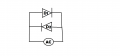
in the circuit in the first cycle D1 on and D2 off
in the second cycle D1 off and D2 off
my question is how to know in first cycle which diod is on and off ?
in the circuit in the first cycle D1 on and D2 off
in the second cycle D1 off and D2 off
my question is how to know in first cycle which diod is on and off ?
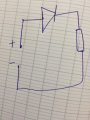
First, you should have some load or you will essentially have a dead short minus 0.6 volts.
Second, conventions of current flow (or electron flow) will tell you that anything on your oscilloscope positive will flow to the common terminal (neutral terminal) and vice verse.
If you want to figure it out from first principles, you need to read up on lenz's law. It will tell you the direction of current flow based on the direction of the magnetic field and whether the conductor is approaching or leaving the higher density of magnetic lines of flux.
By convention. There is no absolute reference for positive, negative, up, down, left, right, etc. These concepts are "defined" by a group picking one of two options and getting everyone on earth to agree on it. So "positive" current moves from the more positive voltage to the more negative voltage by convention. As Wally said, the physical electrons move from negative to positive.
It's arbitrary.
If the "positive cycle" is defined as the A terminal being more positive than the B terminal, then conventional current will flow from A to B.
But, if the positive cycle is defined as the B terminal being more positive than the A terminal, then conventional current will flow from B to A.
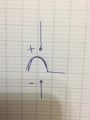
The polarity (voltage) of a signal or circuit is usually displayed as the Y component on a graph.
The positive part of Y is on top of X. The negative part of Y is below X.
Make sense?
I say positive half cycle, or negative half cycle.
If you have an AC source floating freely in space it is arbitrary which side you call plus and which you call minus. That all changes quickly if you buy your AC signal from a power company over a properly bonded or grounded pair of wires.
In a grounded system one of the AC wires is bonded to ground, actually the Earth itself. That nails the voltage on the bonded wire to zero volts.
The other wire now have to move up and down I voltage relative to the bonded wire, and you have a solid reference point so positive and negative have a hard meaning for everyone at any time who measures or uses this voltage.
We generally diagram electronic circuits like we diagram mechanical systems. Up/Down is really meaningless for a electronic circuit. What we are usually interested in is the flow of energy (electrical power) using Passive sign convention.
Since the sign convention only deals with the directions of the variables and not with the direction of the actual current, it also applies toalternating current (AC) circuits, in which the direction of the voltage and current periodically reverses. In AC circuits, even though the voltage and current reverse direction, a "formal" direction of current flow and voltage polarity are defined by considering the voltage and current direction in the first half of the cycle "positive". During the second half of the AC cycle, in a resistive AC circuit, both the voltage and current in the device reverse direction, so the sign of the voltage and current reverse. Since the power is the product of voltage and current, the two sign reversals cancel each other, and the sign of the power flow is unchanged.
From an algebraic point of view, a sinusoidal wave is measured in 360 degrees. The first 180˚ is considered to be in the positive region of the graph. In other words anything above the Y axes (the zero point) is considered positive. We start at the left most point on the graph. From there, moving toward the right and upward the X voltage (or current if you must call it that) (which it isn't, it's just electric pressure), the X voltage above the Y axes is in the positive region. When it swings below the Y axes the numbers and the voltage are in the negative region.
Typically a sinusoidal wave is pictured as a snake (if you will) slithering up and down as it moves along. But when calculating the period it's considered to be a circle because the period has a rise time, a peak, a fall time, a threshold (zero) time, another fall time as it swings back toward the lower peak and swinging back to the left most zero point where the voltage is once again rising (but still below zero). Finally arriving back where it started, completing an entire circle (360˚)
Basically, when the wave form is above the center line it's considered positive and when below it's negative. HOWEVER, it's possible to have an offset voltage where the sine wave can be ±10 volts (for instance) and be sitting on a line powered by a 20 volt DC source. In such a case the entire wave form would be positive. At certain points it would be +30 volts and at other points it would be +10 volts.
What everyone is trying to tell you is that it's only positive because we call it that. Who knows what it really is?! In fact, since voltages are measured from a specific reference such as ground, what we think of as zero voltage may be a cosmic voltage of thousands of quadrillions of volts. OR you can say that YOU are an inch taller than me - or an inch shorter. But that says nothing about how tall either of us are. Just that one of us is a common point of reference. On the grand scheme of things, look at how small we are on our earth. Look how small our earth is compared to the sun. Look how small our sun is compared to our galaxy. Look how small our galaxy is compared to the known universe. And who knows how much more space there is beyond the universe. We think we're big because from our point of view we are. Same with voltages. When we say it's all relative - IT'S ALL RELATIVE.
But generally, to answer your question, positive is above the zero line.
Look how big we are compared to an ant. How big an ant is compared to bacteria. How big bacteria is compared to an atom. And how big is the nucleus of an atom compared to its electron orbits? How vast is the inner space of the nucleus? Mesons and Muon's. Particles even smaller that we have yet to discover. IT'S ALL RELATIVE.
It's arbitrary.
If the "positive cycle" is defined as the A terminal being more positive than the B terminal, then conventional current will flow from A to B.
But, if the positive cycle is defined as the B terminal being more positive than the A terminal, then conventional current will flow from B to A.

 Facebook
 Google
 GitHub
 Linkedin