AC circuit big confusion after all these

shortbus

Joined Sep 30, 2009
10,049
Nonetheless you had asked me to forget about the ground and plus and minutes and neutral words.
You seem to be resistant to normal every day conventions in this naming. What would you call the middle point between the two ends of the pole transformer? Neutral is used in many "scientific" things to designate the middle of a scale of values, the most obvious one being the ; http://chemistry.elmhurst.edu/vchembook/184ph.html
So then, what is your word for it?
 
@Alchemy One has a house that is wired with grounded outlets that are not grounded and are not GFCI. They need to be GFCI protected.

This

https://www.te.com/commerce/Documen...ang=English&PartCntxt=6609021-2&DocFormat=pdf

Illustrates what can happen when you have grounded and ungrounded stuff like computers trying to talk to one another. A good example would be a parallel printer where one device (computer) is plugged into an open ground outlet and the printer is plugged into a grounded outlet.

Those output capacitors on the load side have about identical leakage currents (modeled as a resistor), so about 1/2 the line voltage is impressed on the ungrounded ground. The 5V logic in the computer does not like 60 VAC and poof.

These filters are located in devices with switching power supplies and 3 prong cords.

So, I had one computer destroyed when this occurred in an outlet strip and a piece of instrumentation destroyed when it occurred in a lab and there was potentially 420 outlets at work that were defective, One ground pin could let go if two plugs were inserted in a duplex outlet. fortunately, I had a way to test.

Management decided to replace all lab outlets from ivory to brown. Put red dots on hall outlets that would affect the labs so the janitor would not plug his polisher into red outlets. Any outlet with a computer in an office was tested and replaced if necessary.

An upgrade of the electrical would be a nice thing to do. I still have fuses at home. Some circuits have mini-breakers or breakers that fit in an edison base. GFCI's are on outside receptacles. The bathroom is still wired normally. The hair dryer does have a cord GFCI. There are electric toothbrushes and a shaver charger. So, still safe.

When I was 15 or so and there was no GFCI outside, I was sanding my car in my bare feet while lying on my side on the ground. I caught a flat frayed extension cord between my toes and could not let go. No one was home either. I thought about the problem and I decided to scream intentionally. It actually worked.
 

Thread Starter

Alchemy One

Joined Oct 5, 2019
217
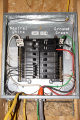
This breaker panel although it doesn't have fuses, nonetheless it is pretty old. I sure don't even see the one main turn off switch on top.
 
Last edited:

Reloadron

Joined Jan 15, 2015
7,893
The image you posted seems to more resemble a sub panel. You are sure this is the mains point of entry? Removing the panel cover should be more revealing. My old house was originally all knob and tube wiring and the mains service was 60 Amp and the mains entry used two 60 amp cartridge fuses. Removing the panel cover should reveal where the power comes from and if one of the dual breakers is being back fed.

Ron
 
Yep, superficially it does look like a main lug rather than main breaker panel, There seems to be no main breaker.
having a main breaker, can also be a main breaker panel converted to essentially to a sub-panel with a main breaker.

You really need to see if the grounds and neutrals are isolated. That makes it a sub-panel.
 

Reloadron

Joined Jan 15, 2015
7,893
You really need to see if the grounds and neutrals are isolated. That makes it a sub-panel.
Yeah, here is an example of a sub panel I recently installed in my garage. The top left breaker is my backfeed to the panel by design. The breaker is a 50 amp dual breaker and my run is AWG 6 Armored cable.

Breaker Panel.png

The image was an in work picture and as can be seen plenty of open breakers available for use. I ran 6 duplex outlets on each of three walls North, West and East and the first in each string is GFCI. The garage door opener is also GFCI as is all the overhead lighting. However, as can be seen the Neutral and Ground are not bonded since this is actually a sub panel. Additionally and here nor there the garage is part of the whole house backup generator system. Anyway it's an example of a back fed sub panel. The last of the wiring is done for this year. Next year I hope to add a gas fired forced air heating system and insulate the joint.

Ron
 

Thread Starter

Alchemy One

Joined Oct 5, 2019
217
Yeah, here is an example of a sub panel I recently installed in my garage. The top left breaker is my backfeed to the panel by design. The breaker is a 50 amp dual breaker and my run is AWG 6 Armored cable.

View attachment 188123

The image was an in work picture and as can be seen plenty of open breakers available for use. I ran 6 duplex outlets on each of three walls North, West and East and the first in each string is GFCI. The garage door opener is also GFCI as is all the overhead lighting. However, as can be seen the Neutral and Ground are not bonded since this is actually a sub panel. Additionally and here nor there the garage is part of the whole house backup generator system. Anyway it's an example of a back fed sub panel. The last of the wiring is done for this year. Next year I hope to add a gas fired forced air heating system and insulate the joint.

Ron
That is just too good looking.
 

Reloadron

Joined Jan 15, 2015
7,893
Your panel looks to be late 50s early 60s. My parents actually had a similar desigh in a home built in 1966, there was no mains disconnect. I have seen similar before.

The first thing on my mind is to leave everything as it is so I have power. ( I suppose I have to pay that permit fee.
This is where a nightmare can begin. I have no idea where you live but I can tell you how things work in my little corner of the world in Bedford Heights, Ohio 44146 USA. First I go to city hall and pull a permit and of course pay a fee. Will I be doing the work or will I be hiring an electrical contractor? Hiring a contractor the contractor must be on their approved contractor list and that includes State Certification, being bonded, and being on the city's approved licensed electrician list. This is just to replace the mains circuit breaker panel. The going rate around here is about $1,500 plus permit fees of about $150. Part of all of this involves removing power which is done by pulling the meter which involves the power company. Those two large black wires feeding your panel are hot 240 VAC. Now if I label the permit check box I am doing the work, then I am on my own with the power company but when the work is done they send out an inspector to make sure my work complies with NEC code plus any local and state codes. Here in Ohio they are pretty much a carbon copy of the NEC and likewise in my town. All of this amusing stuff aside what it comes down to is whatever your local laws are is what you should comply to.

One problem is that if you wire things and you inadvertently start a fire your home owners insurance may no longer be your friend. Fires isolated to electrical issues can become a nightmare.

The best plan is a well thought out plan making sure you know all the materials needed and have them at hand. When I added my first generator transfer switch I had my power company come out and kill the power (pull my meter) I did the work, had a scheduled inspection, and the power company came back and restored power and placed a new seal on the meter. When you relocate a breaker panel think about where mains will end up not to mention all the branch circuits. This is where a well thought out plan comes into play.

The first thing on my mind is to leave everything as it is so I have power.
Sometimes when something works it is best not to screw with it unless new needs for change arise but just remember once you start yanking things out there is no easy going back.

Ron
 
That is just too good looking.
I got that from a chemical engineer when I was wiring a toxic gas safety panel of my own design.

He wanted the project done faster and he asked "Why does the wiring have to be neat"? It's for the ability to troubleshoot later. I hate all yellow wires for instance.

I flat out refused to work on someone else's design because it was Impossible to troubleshoot.
There was a bunch of what i would call "Building stuff" like FAP panel, ventilation monitors, Hydrogen alarm panel, Local gas detector, panic buttons etc.

They had wires coming from everywhere. They hardwired it to screw terminals to two rack mounted boxes. I finally said we have at a minimum, create a plug so that you can interface to the building through a connector. You also have to give me power to the box on the wall so that the hood ventilation monitor can be powered and independent from your junk.

They still had terminal strips, but at least you could disconnect and remove the stuff from the equipment rack.

The manager was a real bean counter so they designed an "alarm" system as a sequential interlock system.
A burst of wind would shutdown the reactor and since most of the alarms didn't latch, you didn't know what shut the system down. The hood velocity had no readout and no analog out either, so you didn't know when to clean the detector or even orienting the detector after cleaning.

Compromising on safety was not a good idea.

In my parts, I do know the meter base has very specific location requirements and I mean very specific.
The meter base has to have the power companies sticker on it, but can be purchased locally. The same base bought elsewhere without the sticker doesn't count.

Don't forget you might consider a service upgrade too. e.g. 100A to 200A

Ground rods have very specific requirements too. Also don't drive it into the foundation. You may have to test the ground resistance. The ground probably needs to be welded to the ground rod. See CADWELD. It's a thermal weld.

You cannot touch the meter. Period. The meter base is your responsibility. So is wiring the base to the weatherhead.

A number of houses that have had upgraded services have had external disconnects installed. Not sure why? In case of fire, anyone can kill power or it might be distance to the breaker panel. from the meter base. I've been told that with the smart meters, remote disconnection is possible.
Usually, they don't go overboard on sealing the meter unless there is evidence of tampering.

So, the power company removes and installs the meter and will update wiring from the pole to the demark point. e.g. where the power connects to the house usually at an overhead splice if not underground utilities.

I ran into an "inspector" of sorts. He says they come around periodically to see if the remote energy saving cut off for the AC is in place if you elected to have one. The guy installing your new AC can disconnect it. but cannot reconnect it.
 

Reloadron

Joined Jan 15, 2015
7,893
That is just one option among many others, being subject to those who enjoy, having a monopoly over knowledge and the power it brings.
Now, now, that is not quite true. There was a time when I applied my automotive knowledge but now I don't even change my own oil anymore. I also pay an energetic neighbor for my lawn service and just paid his granddaughter to paint some of my fence. I think of it as helping the local economy rather than simply not wanting to be bothered. I still do my own electrical work and always help neighbors with my area of expertise. Then too my neighbors help me. Helped one neighbor upgrade his home to 200 amp service, same neighbor who stores his motorcycle in my garage along with my own. That same neighbor plows my driveway every winter and does my snow removal. Life has plenty of trade offs I figure. My talents put beanies and weenies on a table for decades and got our kids educated (so they would not be living in my basement) and I have come to really like this retirement thing. Life is good.

When it comes to your project things would likely go much, much better if you had a skilled tradesman (electrician) to help you along or your friend who inspects. That could go well if he oversaw your project. It's about not just skill set but planning and having the materials ready.

Ron
 
It was nice when I had a retired bricklayer help me from the ground rebuilding a chimney and using his tools.
He mixed the mortar for me and told me I had to seal the chimney cap. The top layer of cement. I removed a layer of bricks and I was glad I did when it was time to put a stainless cap on it. It had a place to grip on the clay pipe.

Most of the time I'm on my own. A lot of times, I don't trust youtube videos. One sent me on a wild goose chase looking for a car splice that doesn't exist in my year. For water in the passenger compartment, you get the wrong answer. There is a $5.00 additional part referenced in a TSB that diverts water around the cabin air filter. That's the real solution to the water.

It's usually difficult for me to get help on this forum too.
 
Top