Absolute Bandwidth Problem

Thread Starter

Stereoblind

Joined Mar 10, 2015
14
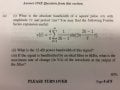
I'm currently going over some past papers to prepare for an exam. I'm looking at the problem I've attached in the image. I know how to do (ii) and (iii) but I can't get my head around (i)? Surely the absolute bandwidth is infinite given the range of the sum but we've been constantly told that we can't have infinite bandwidth so I'm a bit confused?
 

Attachments

korchoi

Joined Jun 5, 2015
59
A square wave theoretically has an infinite amount of harmonics, each having a frequency that is a pair(as far as i remember) integer multiple of the fundamental.
So it goes like this for 1Khz square: 1KHz, full amplitude;2Khz, half amplitude;4KHz, a quarter of the amplitude; 6KHz, a eight of the amplitude, up to infinity.
We can't have infinite bandwidth response in real circuits because of their frequency-dependant reactive features.
That's quite a load of data and i have no clue on fourier.
In the end, the answer is up to you.Check the context of your exam to choose the right answer.
 

MrAl

Joined Jun 17, 2014
13,667
Hi,

Actually a square wave has fundamental amplitude 4/pi, and there are only odd harmonics like 3,5,7,9, etc., with amplitudes (4/pi)/3, (4/pi)/5, (4/pi)/7, etc., but it does to infinity at least in theory. There might be something else in the course work material that would tell us what they really want to know.
 
Top