Absolute encoder power rating

Thread Starter

jsbach

Joined Jan 18, 2025
7
Hello,

I'm not sure how to understand absolute encoder power rating. For example, the datasheet for the EN16AB Series gives 12 Vdc / 4mA. What does it mean. That the maximum power that can be dissipated on the encoder is 0.048W? Or does it mean that when 12 Vdc is applied across the ground contact and some of the other contacts then 4mA current will flow? Or something else?

And about terminology. Some other datasheet (namely, for PAC18R) doesn't have power rating but it has contact rating. Does it mean the same as power rating?
 

MaxHeadRoom

Joined Jul 18, 2013
30,557
To me it means that this inductive absolute encoder draws 4ma when powered with 12vdc,
all it requires is this to set up the power to produce an induced phase angle between two windings usually.
In some cases the output is a reading the result of the co-tangent angle between two sine waves.
Power it up and measure the current!
 

panic mode

Joined Oct 10, 2011
4,864
no...
that encoder is just a switch (a coded switch) so it does not draw any power.

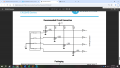
you need to connect it to some external circuit to read its state and that includes pullup resistors - as shown in the datasheet .
the datasheet tells you rated stress limits of the encoder itself. use cases vary so they had to pick something...so to state expected life, they need to provide some numbers. and so they picked 12V and 4mA and determined that with that combination they can guarantee 30000 cycles. mechanical wear is one factor but higher voltage and current are likely to help deteriorate contacts sooner.

in most case one would operate it at same voltage as the MCU meaning 3.3V or 5V...
 

Attachments

Thread Starter

jsbach

Joined Jan 18, 2025
7
you need to connect it to some external circuit to read its state and that includes pullup resistors - as shown in the datasheet .
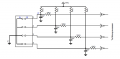
Yes, I understand how this suggested circuit works in general. It only confuses me from the power rating perspective. Lets consider, for examle the contact # 1. When it closed - i.e. A and B are connected, then C should be also at ground. This means that no current should flow through the contact # 1. If, on the other hand, A and B are not connected, C should be at half the VDC. But in this case no current should be drawn becasue A and B are not connected. So, I can't see where that 4 mA current could appear from. What is wrong in my reasoning?
1743908952923.png

That is a rather crude form of encoder, what is your application and means of control or subsequent reading of the encoder ?
I'm going to use it to drive four of the address lines of an EEPROM when reading.
 

panic mode

Joined Oct 10, 2011
4,864
wrong...

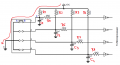
when top switch of encoder is closed, current flows through it.
magnitude of the current is determined by operating voltage Vcc and pullup resistor R1

1743910996867.png
 

WBahn

Joined Mar 31, 2012
32,703
Yes, I understand how this suggested circuit works in general. It only confuses me from the power rating perspective. Lets consider, for examle the contact # 1. When it closed - i.e. A and B are connected, then C should be also at ground. This means that no current should flow through the contact # 1. If, on the other hand, A and B are not connected, C should be at half the VDC. But in this case no current should be drawn becasue A and B are not connected. So, I can't see where that 4 mA current could appear from. What is wrong in my reasoning?
View attachment 346259


I'm going to use it to drive four of the address lines of an EEPROM when reading.
Both of your conclusions are incorrect.

If A and B are shorted together, then, yes, C is at GND. But that puts VDC across the left-most 10 kΩ resistor, so it will have about 1.2 mA flowing through it. Where does that current go? Out through the switch contacts.

If A and B are open, then the voltage at C is going to be very close to VDC because the horizontal 10 kΩ resistor is driving a high impedance input (of the Schmidt-trigger inverter), so very little current will flow, which means that there will be very little drop across the vertical 10 kΩ resistor, which means that the voltage at Node C will be very close to the voltage at the top end of that resistor, which is VDC.

But note that that circuit is just a recommendation of a possible configuration.

The 12 V rating is the absolute voltage that should appear across any of the contacts in the encoder. When that 12 V is there, there will be no current flow through that switch.

The 4 mA is for when the switch is closed, at which point there will be almost no voltage across that switch.

What is not clear (or perhaps I'm missing it), is whether those ratings are per-switch, or total. It's hard to tell because they don't say that their recommended circuit applies if VDC is 12 V. The safest thing is to treat it as a maximum of 4 mA total current and adjust VDC and the resistance values to stay well below that (like no more than half is a good rule of thumb when practical).
 

Thread Starter

jsbach

Joined Jan 18, 2025
7
Both of your conclusions are incorrect.

If A and B are shorted together, then, yes, C is at GND. But that puts VDC across the left-most 10 kΩ resistor, so it will have about 1.2 mA flowing through it. Where does that current go? Out through the switch contacts.

If A and B are open, then the voltage at C is going to be very close to VDC because the horizontal 10 kΩ resistor is driving a high impedance input (of the Schmidt-trigger inverter), so very little current will flow, which means that there will be very little drop across the vertical 10 kΩ resistor, which means that the voltage at Node C will be very close to the voltage at the top end of that resistor, which is VDC.

But note that that circuit is just a recommendation of a possible configuration.

The 12 V rating is the absolute voltage that should appear across any of the contacts in the encoder. When that 12 V is there, there will be no current flow through that switch.

The 4 mA is for when the switch is closed, at which point there will be almost no voltage across that switch.

What is not clear (or perhaps I'm missing it), is whether those ratings are per-switch, or total. It's hard to tell because they don't say that their recommended circuit applies if VDC is 12 V. The safest thing is to treat it as a maximum of 4 mA total current and adjust VDC and the resistance values to stay well below that (like no more than half is a good rule of thumb when practical).
Thank you very much for such detailed clarification. Now I see what is going on there.
 

Tonyr1084

Joined Sep 24, 2015
9,744
the datasheet for the EN16AB Series gives 12 Vdc / 4mA. What does it mean.
It means the contacts are rated to switch 4mA. It's not a switch like a light switch or fan switch or some other common switch, it's only meant to handle tiny currents like that of control circuits where electronic components are looking for a data signal of some sort.

In short - the switch contacts are very small. Not intended for higher amperage loads. 4mA is quite small. 0.004 amps or "four thousandths of an amp".
 

Tonyr1084

Joined Sep 24, 2015
9,744
An example of how your encoder might work is when A/B are closed and where C is powered, the outgoing current on B might feed a MOSFET. Since the gate of a MOSET does not draw a current other than when it first turns on the FET only needs a voltage present based on its type and rating to turn the FET on. The switch is not intended as a control switch for anything other than micro-circuits. I have some encoders from a couple scrapped stereos. They switch the signal going to a microcontroller (µC). The µC controls volume or channel selection or whatever it was programmed to do based on user input via the encoder.
 

MisterBill2

Joined Jan 23, 2018
27,164
Considering that I did not chase down a link to that encoder part number, all that the 12 volts 4 mA tells us is the specified power requirement for that absolute encoder. That defines the requirements from the external support circuit. The power requirement may provide a possible hint at the internal technology inside the encoder, but it really tells us nothing else directly.
So unless others have followed a link to additional information about that model, all you have is reasonable guesses.
 

Tonyr1084

Joined Sep 24, 2015
9,744
There are numerous types of encoders. The kind I mentioned that are in my possession are switch type encoders. When rotated (for instance) clockwise, switch set A closes before set B. While A is closed, B closes. While B is closed A opens. While A is open B opens, and the cycle repeats. It's just the opposite when the encoder is rotated in the opposite direction. Then there are electronic encoders that may consist of a couple of LED's and receivers. When the beam from LED A falls on receiver A, A outputs a voltage based on the supply. That voltage may be - in your case - 12 volts but be limited to being able to output as much as 4 mA. As the encoder continues to rotate - again, clockwise for example - A outputs, then B outputs, then A stops outputting, then B stops outputting; and the cycle repeats. Or reverses when the encoder rotates in the opposite direction.

Mister Bill is right, we can only speculate, or as he put it - a "reasonable guess".

Can you show us a picture of your encoder? How many leads or connections does it have? For sure that will tell us a lot more about what you have.
 

panic mode

Joined Oct 10, 2011
4,864
if someone would read what TS posted, they would know that TS did locate datasheet but has trouble interpreting parts of it. he asked for help interpreting datasheet for specific part number, not for a lecture on inner working of other trypes of encoders such as sin/cos or incremental etc.

just saying... ;)


EDIT, plenty of people have trouble formulating question or providing appropriate level of detail. i congratulate this TS for being above average.

Hello,

I'm not sure how to understand absolute encoder power rating. For example, the datasheet for the EN16AB Series gives 12 Vdc / 4mA. What does it mean. ....
 
Last edited:
Top