About Stepper Motors

Thread Starter

q12x

Joined Sep 25, 2015
2,227
Check #28 for L298.
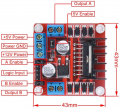
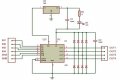
I was just demystifying L298N Motor Driver Module for 4 wires cct right now. It turns out it is having only a fixed 7805 VReg at 5V @500mA and 2 filter capacitors, one for the variable Input and another for the constant 5V output.
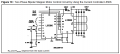
I also find this cct online, that is the exact same cct from that module datasheet, but is much more clear to me:
1667475652770.jpeg
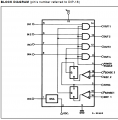
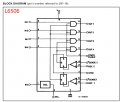
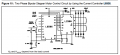
Then, I was also paying attention to the recommended current controller IC L6506 recommended to be used with L298 .
It is a new chip for me, and I really have no idea what really does... although I read its datasheet, Im still loking stupid at it.
1667475937111.png
 
Last edited:

Thread Starter

q12x

Joined Sep 25, 2015
2,227
- I believe I may understand the practical reason for this L6506 IC. I believe, it is using some sort of feedback from the motor and it is --maintaining-- the same speed and torque of the motor, by automatically regulating the current.
The text selection I made is telling me what --might-- be. And I think I'm right.
1667499224542.png
- I strongly believe it is pretty much like my lathe, when I apply force on the motor spindle, when Im cutting into metal, the speed and force is maintained and not decreased as long as I press into the axe.

The simple way....
I believe...(I dont know for sure) the simplest way of driving this L298 IC is to use an arduino. Exactly like @ScottWang said to look, at its Motor Driver Module, in it's #28 for L298 post.
1667499877687.png1667499941730.png

The complicated way...
Is using this L6506 IC internal cct logic. Since I dont have the chip and no one told me about it to take it in time. I didn't look very hard either in the datasheet as well.
1667500158375.png
Ive already read the entire description of this L6506 chip and I decided is a very cool function to have with my stepper motors.
I believe is a moderately 'simple' logic circuit to build. I looked at the prices already for the L6506 IC and is a bit expensive for the moment. I will live without it for awhile, and build myself its internal logic cct.
- I think is best to do the simple way first, to get it running and familiarize with the L298 chip itself. And after that, add this new layer of cool but more complicated cct. That's the plan. Wish me luck.
- Any helpful comments are welcome. My first time with this L298 chip. Very virgin right now. Haha.
 

Thread Starter

q12x

Joined Sep 25, 2015
2,227
Those chips have been around a long time but have some bad specifications if you look at the data sheet. Here is a link explaining it - https://www.rugged-circuits.com/the-motor-driver-myth
I only followed your directions so far. Here they are:
in #28 and #39
Maybe you can try this -- L298N Motor Driver Module for 4 wires. 17HS4401 datasheet.
and also in #41
Whether you use a L298 or ULN20003 or SN754410 or a discrete component H bridge circuit for actually driving the coils
I believe these 2 guys know what they are talking about. Who do I trust then? You? Them? Also these chips are not cheap. Now you come and say after I buy them that are no good? I didnt start to make any tests yet. The tests will tell how good they are. You worry me mister @shortbus.
 

sarahMCML

Joined May 11, 2019
697
I was looking on the ST Microelectronics site for an application note hoping to find one that might explain a little more of the internal circuitry of the L298, but there isn't one. So the high internal losses must be down to the complex design problems of that time.
They do have a couple of App. Notes that may be of interest though. AN240, especially the part about short circuit protecting the L298. AN235 is more technical, but worth a read.

Try the chips anyway, as you have so many, you can always put 2 or 3 in parallel. Just make sure you have a good heat sink!
 

shortbus

Joined Sep 30, 2009
10,050
You worry me mister @shortbus.
I worry myself.

I never said the L298 was no good, I said they have a large voltage drop. This has been known for a long, long time. If your saying I should have spoke up long ago when others talked about them, why would you have listened then? You are spending much time and money to do something that is available in a small inexpensive package from many sellers.

Personally I would rather run my steppers from a small enclosed module that does everything that a stepper needs, instead of two big breadboarded circuits. Where in those circuits if a connection comes loose you have to spend much time troubleshooting. But that's just me.

Both me and Danko told you in this thread to go with a driver module and you said you didn't want to.
 

Thread Starter

q12x

Joined Sep 25, 2015
2,227
Try the chips anyway, as you have so many, you can always put 2 or 3 in parallel. Just make sure you have a good heat sink!
I dont have 'so many', I have 10, haha. Like everyone else I buy in 10pcs or 100pcs from online markets when they are cheap enough. These were not that cheap. At least for my pocket. I pay to learn what not to use. Not my first time. But Im speaking too soon. I believe, like with my other weak power transistors before discovering I have those BD441's, these L298N IC's contains also weak Tr's inside. Rated to a lower wattage. So pretty much they can drive safely, without heating, I dont know, some small to very small motors, perhaps? But not medium motors like I want to believe these are. I still think they are small.
- I get your point @shortbus but you had to mention this problem much more earlier, or I should have waited more patiently until someone would have said it. Eh well. Like I said, not my first 'Pay to learn what not to use' experience. It's frustrating.
- I also didnt pay serious attention that they contain BJT's inside and not mosfets. But I know there are very high power BJT's in this world so thats why I let it slip. Also I was staring at them containing BJT but not thinking for a second they may be weak or medium BJT !!! Thats my mistake. I was certain they MUST contain High power BJT like my BD441 or even more powerful. That was my honest thought all this time.
- All I hope is they are not THAT bad. I didnt started any tests yet. I took a day break. To recharge myself. But I will soon.
All being said so far, I still thank you for the comments, or the heads up about them, as hard to digest as they are. Now I know what to expect in my tests and not break the table in half. Haha. Like @sarahMCML said, putting them in parallel is a very smart solution + a good heat sink.
Thank you.
 
Last edited:

Thread Starter

q12x

Joined Sep 25, 2015
2,227
I managed to make a L298N work, spinning successfully both my motors. That's the good news.
It is running cold at 3.3V with 400mA for NEMA17 and 100mA for the scrapped motor. (Both 4wire).
If I increase the voltage to 3.8 or 4V, it will heat Up quite quickly. Acceptable heat.
If I bring it to 5V, it will overheat quite drastically and at this point it really needs an aluminum radiator.
But even at 3.3V, the motors are running, but visible under-powered.
Is good that you give me the warning in time that this chip is weak. Else, I was probably over powered the chip like an idiot.
And a short movie about it:
 
Last edited:

sarahMCML

Joined May 11, 2019
697
I managed to make a L298N work, spinning successfully both my motors. That's the good news.
It is running cold at 3.3V with 400mA for NEMA17 and 100mA for the scrapped motor. (Both 4wire).
If I increase the voltage to 3.8 or 4V, it will heat Up quite quickly. Acceptable heat.
If I bring it to 5V, it will overheat quite drastically and at this point it really needs an aluminum radiator.
But even at 3.3V, the motors are running, but visible under-powered.
Is good that you give me the warning in time that this chip is weak. Else, I was probably over powered the chip like an idiot.
And a short movie about it:
Better late than never I suppose, but I've been playing with a discrete version of the L6506 chip, something that you talked about but I suspect didn't get to do. I used it to drive a cheap L298N module from Aliexpress.
It works a treat at controlling the current through the motor coils to whatever is set. As you wind up the motor supply voltage you can see the chopper coming into play and limiting the motor drive current earlier and earlier in the drive waveform.

I used what I had available, parts of two 74LS11 Triple 3-Input AND gates, one 74LS76 JK Flipflop, one TLC555 Timer and two sections of a TLC3704 Quad Comparator (CMOS version of the LM339).

My motor was the head stepper from an old hard drive, and unfortunately doesn't have the working voltage on it, so it could be either 5V or 12V. It's 23 Ohms coil resistance, 400 steps/rev.
Run straight from the L298N at 5 V works fine, although it isn't particularly powerful, but probably enough for the job it had to do. Run from 9V or above it get rather hot after a while,but I can hold it, so I'm unsure as to its original voltage.
Run with the new circuit attached I can happily supply 20V to the L289N, and the motor stays cold, with the current maintained at a reasonable level.
 

Thread Starter

q12x

Joined Sep 25, 2015
2,227
This is entirely different discussion from my main direction. But is good. I really like new improvements and new tests ! New experiments ! This is good. For both of us.
I've been playing with a discrete version of the L6506 chip, something that you talked about
I remember L6506 from the datasheet of the L298N. Vaguely because I fly over it very quickly.
I just searched for it to be sure and not talk uninformed. Here is -the best- diagram explanation of what it is used for. Now I remember it better.
1669466540488.png
Hold on ! You said discrete? You mean you built up it's internal circuit? Oau, you are crazy, haha, same as me. Haha.
You mean this ? OAU ! Very cool / very nice ! Now I like you !
I am intrigued.
Screenshot_4.jpg
..but I suspect didn't get to do..
So I mentioned this IC because I see it there mentioned in the L298N datasheet. So it had to be good, right? I Do Not have this IC. Neither you as well. So my curiosity about it, influenced your curiosity as well. That is very good. And you made 1 more step and actually build its internals, very cool ! I was considering at some point but I said, naah, since I have other more important plans. I know, I hate that 'naah'. Haha.
It works a treat at controlling the current through the motor coils to whatever is set. As you wind up the motor supply voltage you can see the chopper coming into play and limiting the motor drive current earlier and earlier in the drive waveform.
I believe your word ! But I would really like a Movie with your L6506 internal circuit, functioning! If you cant make a movie , is fine, dont worry. But it will be, at least for me, a bit more intim observation. Also some explanations along the presentation will be also much better than simply film it. It's interesting that you made it, Very!

I used what I had available, parts of two 74LS11 Triple 3-Input AND gates, one 74LS76 JK Flipflop, one TLC555 Timer and two sections of a TLC3704 Quad Comparator (CMOS version of the LM339).
Looking on L6506 block Diagram, I remember I had only 1 chip of CD4081BE - AND gate in my entire arsenal. So I purchase 20pcs and they are on their way for some time. They are CMOS version. Still, not really very clear about the difference between TTL and CMOS, which is better is more important for me. Or each has its own good and bad? Hmmm. In time I will get it. Especially when working with them.
Ive also received (your) 7474 - 74LS74 x20 Positive-Edge-Triggered D Flip-Flops with Preset, Clear & Complementary Outputs. You used it at some point, when I was experimenting with diodes as OR - AND gates for the count to 7 circuit, if you remember that little thing. That's the context. I thought to mention it to you that this very easy to remember chip, I have it already. I thought is a smart thing to have it, simply because it's name - 7474. Hehe.
My motor was the head stepper from an old hard drive, and unfortunately doesn't have the working voltage on it, so it could be either 5V or 12V. It's 23 Ohms coil resistance, 400 steps/rev.
Yes, the same problem I had as well. What to do to discover it's working voltage? Simple. (This solution is for a DC motor, not a stepper) put it directly to your PSU. BUT, be smart about it and have in mind precaution and safety. In other words, have in mind all the time, the idea "not to burn it". Play it safely. So, we start first the PSU, dial down to a very safe voltage, lets say 2V. Also limit the Amperage knob to 1A. Safety first, right? Next, we connect the motor wires to the PSU that is at 2V for the moment. Next, we dial UP the voltage, very slowly, to reach 3V and wait 5seconds, then 4V, and wait 5seconds, all this time keep your hands on the motor, or touch it to your cheek or to your lip to sense when it is heating up. Ideally is using a digital thermometer, but the lip or cheek method is very fast. This method works as you dial up enough voltage until the motor gives signs of heating up. When is starting to warm up, that is your sign that you are OVER powering it. You should stop the voltage increase, and actually decrease a little back the voltage, until the motor is running cold, continuously for 30sec or so. There, it's is optimal working voltage. At least in free mode, without load on its axe. The same test is done when it's axe is loaded. This is a test for a DC motor that I know and practice. For a stepper motor, should be the same thing, only that the power for the motor will be through a motor driver like a dedicated chip or transistor circuit. You will have to keep an eye on both of them, heating up. Both the motor and the driver heat. You can eliminate one heat variable by building a powerful driver, that will not heat up at all for small voltages. So you can concentrate only on the stepper heating up all the time, you are varying the voltage. For example: if you get 8.47V, then it is more likely it will run cold and safe at 8V(unloaded).
Run straight from the L298N at 5 V works fine,
Leave it run for at least 1minute or even more. Then you can say it is running cold (or fine).
Run from 9V or above it get rather hot after a while,but I can hold it, so I'm unsure as to its original voltage.
If is running hot, it is BAD. Not good. It should run cold. Also it is very unsafe to jump the voltage too high; it's risky and even dangerous to it's destruction.
Run with the new circuit attached I can happily supply 20V to the L289N, and the motor stays cold, with the current maintained at a reasonable level.
So in this case, with the new cct, you increased the voltage as much as you wanted, but keep the amperage in control with this circuit. Very interesting !!! I know these things but one is to actually do and see it, and another just knowing them.
I should make this cct as well. Hmmm... Hehe. But I still have other project that is more important in front of me.
You did well so far and see if you can make a movie with this cct. For my pleasure.
 

Thread Starter

q12x

Joined Sep 25, 2015
2,227
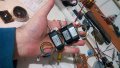
And finally today, after 2months and a bit from purchase, I received the third set of motors, those NEMA8 that cost me a small fortune and it was completly my mistake not knowing their real size in time before buying. But I will have to live with it. The idea is that I receive them now. Very small size from how I imagined them before buying. They are cute, as small as they are but exorbitantly expensive. A capitalistic trick played on the expense of my small pocket.
20221203_021102.jpg
 

sarahMCML

Joined May 11, 2019
697
Hi again,
Glad to see that you got your new motors!
I found the data for the 20BYGH50, but not the other one. If you have a URL for its datasheet, could you let us know it, please?
I'm surprised that the first one is 3.5V working at 0.8A, is that what you expected?

I've built up a simple controller stage on a breadboard which takes a step and direction input and outputs the correct phases to control my driver board. It should also control the L298N circuit directly, although I haven't disconnected mine from the driver board to try it. A single pin change allows it to control Unipolar steppers as well!
 

shortbus

Joined Sep 30, 2009
10,050
They are cute, as small as they are but exorbitantly expensive. A capitalistic trick played on the expense of my small pocket.
They are costly because they are rarely used. There was no capitalistic trick involved, you tricked yourself by not researching the motor size. All of the NEMA size information is just a Google away, but only if you want to know things. So you only played a trick on yourself.
 

Thread Starter

q12x

Joined Sep 25, 2015
2,227
Hello @sarahMCML ,and thanks for your answers.
I found the data for the 20BYGH50, but not the other one. If you have a URL for its datasheet, could you let us know it, please?
I'm surprised that the first one is 3.5V working at 0.8A, is that what you expected?
-Not at all. I was actually believing they were much more large and big and powerful. I realized they are so small AFTER I buy them. And I tryed to get my money back but I had no chance. Eh... In my stupidity defense, I searched hundreds of these motors and I was tired after a while. That moment of being tired, then is when I made the mistake. I totally overlooked and I was happy I find something cheap.
-Since this is the rare occasion I am really buying any motors, I tend to skip and overlook a LOT of details. Like the one you just mentioned, being at 0.8A. They mention it in their product title even, but I didnt took it seriously. I didn't notice its importance until you wave it right now. This was very stupid of me. And also it cost me. I was only --looking-- on the external shape. But not for a moment did I think to read seriously it's data. Or I did read it, didnt completely understood it and jumped to buy it. I totally imagined it would been something completely different. And it wasn't. Unbelievable. I do very stupid s*it sometimes. Also, because I am 'quick' in decisions, and 'focused to buy cheap', it helped immensely this little detail, --chinese text-- strategically left in their data page of their product.
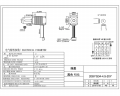
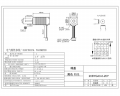
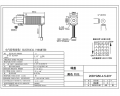
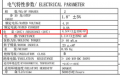
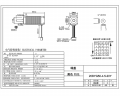
This is all their data they provide on the buying page of this particular product:
- They have only 3 data-sheets and I put them all here
Pay attention on their names difference: 20BYG34, 20BYG40,20BYG50,
(these images are web scrapped at the maximum rezolution I could get - no better than this)
1670083737454.png
1670080328587.png
1670080352669.png
I got 20BYGH50 X 3PCS (the original purchase name)
Im not very sure about their names, as you pointed. They may be of no real importance-is how I think. Or it is? Hmmm. I really dont know. The 20HS50 and 20BYGH50. They may be the same thing. Hmmm. They certainly look the same, on their external shape. If is a difference, its probably too small to take it seriously. Is what I really think about them.
I still want to believe I got some good stuff, as small and cute they may look. (and atrociously expensive)
- We will put them to the test for sure. The only thing im VERY concerned is how to drive them at their ABSOLUTE optimal performance? Meaning, at their BEST performance, not over heating, not over current, not over stress them. Or at least to be close enough to their absolute optimal working condition. Thats the only serious and important thought I have and I am really in the dark how to do it. But I will do it my way, at the end, as intuitively as I can. Because I know these things are hard to really decipher, especially from a long distance like you guys are. And Iknow motors in general are a very hard subject of discussion.
There was no capitalistic trick involved, you tricked yourself...
Of course I am partly joking and indeed it was a lot of my fault. But as I explained, it was because of the context. Also, you probably know the capitalism is not a constant. It is a LOT different/variable for every country that is experiencing it. Especially here in post-comunist Romania, where everyone used to buy their bread on rations with a cardboard card that was signed! by the party leaders, waiting hours from !!5!! in the morning to interminable rows of humans, in front of the food store. So dont imagine the American capitalism is the same with the Romanian capitalism, where everyone interpret it as a legal way of stealing. And I truly believe the Chinese 'capitalism', is not very far from ours. Hahaha... I bet for them is a bad joke and they show it. It is my absolute opinion and you dont have to quote me. Haha.
 

sarahMCML

Joined May 11, 2019
697
Hello @sarahMCML ,and thanks for your answers.

-Not at all. I was actually believing they were much more large and big and powerful. I realized they are so small AFTER I buy them. And I tryed to get my money back but I had no chance. Eh... In my stupidity defense, I searched hundreds of these motors and I was tired after a while. That moment of being tired, then is when I made the mistake. I totally overlooked and I was happy I find something cheap.
-Since this is the rare occasion I am really buying any motors, I tend to skip and overlook a LOT of details. Like the one you just mentioned, being at 0.8A. They mention it in their product title even, but I didnt took it seriously. I didn't notice its importance until you wave it right now. This was very stupid of me. And also it cost me. I was only --looking-- on the external shape. But not for a moment did I think to read seriously it's data. Or I did read it, didnt completely understood it and jumped to buy it. I totally imagined it would been something completely different. And it wasn't. Unbelievable. I do very stupid s*it sometimes. Also, because I am 'quick' in decisions, and 'focused to buy cheap', it helped immensely this little detail, --chinese text-- strategically left in their data page of their product.
This is all their data they provide on the buying page of this particular product:
- They have only 3 data-sheets and I put them all here
Pay attention on their names difference: 20BYG34, 20BYG40,20BYG50,
(these images are web scrapped at the maximum rezolution I could get - no better than this)
View attachment 282070
View attachment 282067
View attachment 282068
I got 20BYGH50 X 3PCS (the original purchase name)
Im not very sure about their names, as you pointed. They may be of no real importance-is how I think. Or it is? Hmmm. I really dont know. The 20HS50 and 20BYGH50. They may be the same thing. Hmmm. They certainly look the same, on their external shape. If is a difference, its probably too small to take it seriously. Is what I really think about them.
I still want to believe I got some good stuff, as small and cute they may look. (and atrociously expensive)
- We will put them to the test for sure. The only thing im VERY concerned is how to drive them at their ABSOLUTE optimal performance? Meaning, at their BEST performance, not over heating, not over current, not over stress them. Or at least to be close enough to their absolute optimal working condition. Thats the only serious and important thought I have and I am really in the dark how to do it. But I will do it my way, at the end, as intuitively as I can. Because I know these things are hard to really decipher, especially from a long distance like you guys are. And Iknow motors in general are a very hard subject of discussion.
I couldn't find any reference to the 20HS50 on the manufacturers website at all, even when I typed the number into their search box. Very strange!
Do a check on the coil resistance to see if it is the same as the 20BYGH50. It would be good to know.
If you want to use the L298N to drive them they should be fine as long as you use a good heatsink, and you could get the chopper IC, or build my circuit to control the drive current for safety.
 

Thread Starter

q12x

Joined Sep 25, 2015
2,227
I couldn't find any reference to the 20HS50 on the manufacturers website at all, even when I typed the number into their search box.
Do a check on the coil resistance to see if it is the same as the 20BYGH50. It would be good to know.
Good idea.
You are right! A coil resistance comparison should be sufficient to check if they are in the same ball park.
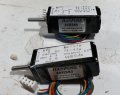
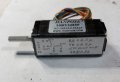
These two 20HS50 are exactly as in the datasheet specs
1670094886070.png
1670092693407.png20221203_203526.jpgAnd this 20BYGH50 has a bit more coil windings per bobbin.
I put the default 4V@0.8A from the datasheet and it should not be far from it.
20221203_203545.jpg
If you want to use the L298N to drive them they should be fine as long as you use a good heatsink, and you could get the chopper IC, or build my circuit to control the drive current for safety.
~3days ago I actually made the L6506 internal circuit, like you did. But I got stuck on a variable fv circuit.
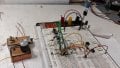
In the far right corner you can see the voltage regulator, on its ridiculous long legs. But is how I like it !!! Haha.
Down left you can see the back of the L293. I used 4081 AND gate and 4027 J-K flip flop used specifically for its -set- and -reset- functions. To correspond to the original cct. I start to believe that set and reset is called different names in other FF, but may have the exact same function, doing the same damn thing... its my impression, Ill have to test it in the future. You know I have a sherlokian nose for stuff like this. ;) sherlock, got it? Haha
20221203_204504.jpg

I had to make a variable fv circuit. from scratch, because I dont have a specialized device that can do it for me. I used a 555 cct for it. But I made a mistake. I built first a 555 PWM. I was thinking for a long time to make a separate module for PWM, a stand alone, for testing purposes. So it got stuck in my head. And I made it, mechanically, without thinking too much. And when I finish it and power and realized is PWM and not a variable fv, aaaaah. Hahaha. So I had to spend another 1.5 day to make the variable fv proper circuit. Is not bad that I made that PWM, like I said, I was thinking on it for awhile. But it cost me 2days to make it.
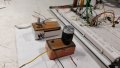
And here are both of them, tada:
20221203_204553.jpg
The smaller one, in the orange box, is the variable fv cct.
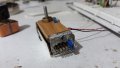
The white box one is the PWM. It actually has a variable fv made with 6 contacts and 1 jumper. As seen in the picture. They are capacitors of different values. Very tricky to mount them. That gray plastic is manual printed by myself !!! to properly and securely HOLD those pins in place. I had to think on how to HOLD them, a lot ! And indeed it is solid and good enough. Resisting to pressure !!! That was the point.
20221203_205759.jpg
I will make a movie soon about both of them. Very interesting cct inside and how I managed to keep them small and efficient. Also working ! Haha.
Ill announce you soon how the L6506 internal circuit will work, if it will.
 
Last edited:

Thread Starter

q12x

Joined Sep 25, 2015
2,227
I build it until now without the circuit. Only following my small paper cct's and diagrams.
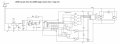
But it got a bit complicated so I had to make the full cct. Here it is.
L6506.jpg
I really dont know what those sense resistors should be so I choose a random value of 1k. The 3 Sense Resistors are R7,R8,R9.
I still have no idea what this cct should do....
Please add your corrections where you see fit.
The simulation is working as well !!! (check the proteus save file as well)
 

Attachments

Last edited:

Thread Starter

q12x

Joined Sep 25, 2015
2,227
Alright, I finished the breadboard cct.
It is not working. In the sense that the motor is not powered or spinning.
I obtain a pulsed signal on all the outputs of the L298, viewed on my hercules osciloscope.
The PSU ampmeter is telling me the cct is using a constant 40mA. No matter the motor I change, or the resistors I change, or the voltage raise from 6V to 12V.
Something is doing its job clearly, limiting the current, but I can not see what.
I also made a small modification, and replaced these 2 resistors with a 10k pot. Still, nothing.
1670138898265.png
 
Last edited:

sarahMCML

Joined May 11, 2019
697
Alright, I finished the breadboard cct.
It is not working. In the sense that the motor is not powered or spinning.
I obtain a pulsed signal on all the outputs of the L298, viewed on my hercules osciloscope.
The PSU ampmeter is telling me the cct is using a constant 40mA. No matter the motor I change, or the resistors I change, or the voltage raise from 6V to 12V.
Something is doing its job clearly, limiting the current, but I can not see what.
I also made a small modification, and replaced these 2 resistors with a 10k pot. Still, nothing.
View attachment 282107
Your problem is that the current sense resistors, R8 and R9 are way too high in value!
They need to be related to the motor current flowing through them, which in your case will be 0.8A. If you use a 1 Ohm resistor you will have a voltage drop to sense across of 0.8V at maximum current draw, and will need a 1W resistor. You could go for say, 0.47 Ohm, which gives a maximum sense voltage of 0.375V, a half watt resistor would do.
I'd personally double the wattage of the resistors so that heating doesn't affect the sensed current! On my unit I used 4 8.2 Ohm resistors in parallel for each. Don't use wirewound if you can possibly avoid it!
Like you I used a 10K pot to vary the sense voltage to the comparators, but I placed it across a 2.5V reference diode to provide a stable voltage, and fed the pair from the +5V via a 2k2 resistor.
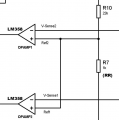
I've noticed you are using LM358's for the comparators. They may be a bit slow, you may have to get proper ones.
 

Thread Starter

q12x

Joined Sep 25, 2015
2,227
Thank you @sarahMCML ! Very cool explanation !
This is my first time when I encounter these sense resistors. Very new concept to me. I understand something from your explanation. I will practice them as you explained. LM358 I have x200pcs. Also uA741 x100pcs. And one or 2 of some other types opamps but not many, <5 and they are scrapped.
Like you I used a 10K pot to vary the sense voltage to the comparators, but I placed it across a 2.5V reference diode to provide a stable voltage, and fed the pair from the +5V via a 2k2 resistor.
I dont understand this part. Draw it.
 
Top