About Stepper Motors

I'm sort of repeating myself, but if you want a flexible test set up it's hard to beat an Arduino UNO. Whether you use a L298 or ULN20003 or SN754410 or a discrete component H bridge circuit for actually driving the coils the beauty of this processor approach is that you have ample digital output lines and analogWrite() lines for PWM into the EN pins and you can write code to accommodate different motors. And with potentiometers into analogRead() pins you can vary the speed and PWM mark/space easily. All this without having to think about the detail of the circuit driving the H Bridge.
 

Thread Starter

q12x

Joined Sep 25, 2015
2,227
Yes, thank you very much for showing me this simulation. Its very good and it shows very clear what to expect.
Unfortunately I only have -1- probe for my 'hercules' osc; I can not compare all those impulses like in the simulation. So here is another example where an oscilloscope with 4 probes will come in handy to have.
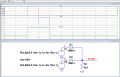
I still dont understand what you are asking me to do. I understand the bigger picture thanks to your simulation. But what to do next? I still dont see if it is a problem as you see it. Where is the problem that you see? I guess.... the longer 15ms on pin4 while the rest were 10ms? That longer signal is the problem that you are telling me? Be more specific. I will recheck the circuit as well.
- to mister @Jerry-Hat-Trick, yes I know the arduino way. It is in plan B. Thank you. I should do it in arduino as well.... to compare the results. Hmmm... not bad idea.
 

ericgibbs

Joined Jan 29, 2010
21,442
hi q,
Make another video, showing the pins a,b,c,d and then u,r,s,t.
Have the 555 frequency set lowish say 100Hz or so.

What are the supply voltages to the 4017 and the stepper motor.?

E
 

Thread Starter

q12x

Joined Sep 25, 2015
2,227
Make another video, showing the pins a,b,c,d and then u,r,s,t.
Have the 555 frequency set lowish say 100Hz or so.
What are the supply voltages to the 4017 and the stepper motor.?
Im sorry I dont understand you. The pins a,b,c,d ? and then u,r,s,t ?
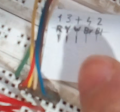
I numbered my motor wires accordingly to the ULN2003 outputs as 1,2,3,4 and their respective color:
1665706132354.png1665706266347.png
The u,r,s,t ? you lost me completely. Haha.
the supply voltages to the 555+4017+ULN2003 and the stepper motor = 15V or so. Until 12V the motor only vibrates even if its the correct wire order! Immediately after 12V, it starts giving signs of spinning but it is so weak, that I conclude it is it's minimum voltage that can operate. Higher voltage will be closer to its nominal operation voltage. The problem is that I have no idea what is its nominal voltage and I have to guess it. I guess it incrementally and I reached 24V at some point in my experiments. But I forgot the IC's in the circuit they are not made to function to 24V. But that being said, the entire circuit worked at 24V for a couple of minutes !!! None of the ICs got hot and the entire circuit was around ~150mA reading from PSU. The only component that was warming up was the motor ! Not the IC's. Which was strange. So I had to back down the voltage until I find a good voltage versus heating ratio to determine the nominal operation of the motor. But you see? as long as I lowered the voltage, the power of the motor decreased and its speed. I kind of find a middle ground around 16V but I give it 15V in the end since the maximum voltage for the IC's is at 15V. 555 is at 16V I just checked, but only 6V for 1type of 4017 and 15V for another type of the 4017. The bottom line is that the circuit works, the motor spins but at VERY low randament. This means this motor was designed only to do a very low type of job, spinning a flower or a paper or that round bar, that was longer and I cut it. It is kind of having power but not really.
- I am not very sure since I am not playing with motors routinely, -I imagine- that a stepper motor with 5wires will only have 1 set of wire arrangement. But I also imagine what if it is having a secondary way of wire arrangement? For more powerful torque? I know 6wires steppers that can do just that, splitting or connecting some specific wires will give you more torque but less speed, and viceversa less torque but higher speed. Again, I imagine, maybe is the case with this 5 wires motor here? that is having so low power? I dont know, I am just imagining. So by finding another wire arrangement maybe it will be more powerful? I did tried everything I could imagined but sadly I only conclude with 1wire arrengement, the one that is currently working right now.
 
Last edited:

Thread Starter

q12x

Joined Sep 25, 2015
2,227
If you want to test the L298 with the stepper motor for 4 wires, you can try this way:
see the L298N Motor Driver Module, connected the EnA and EnB to high, and connected the Sense A and B to Ground (if you don't want to measure the current), check the circuit in post #35, connected the input IN1, IN2, IN3, IN4 of L298N to the input of the ULN2003 which the circuit that I provided, the L298N will replace the ULN2003 circuit.
L298 datasheet.
Aha, I totally see what you mean now. Very smart ! I will do that.
 
Last edited:

Thread Starter

q12x

Joined Sep 25, 2015
2,227
Ive added a voltage regulator to the original 5wire motor circuit, and now is as it should be. But still very weak as before. Short movie
And I've found another similar 5wire motor, but a bit bigger - movie
 
Last edited:

Thread Starter

q12x

Joined Sep 25, 2015
2,227
I didnt show it in the video but I managed to burn completely a 4017 IC. I did push the --motor-- voltage up to 24V and I was playing with the pot on the 555, and after a couple of up and downs, no signal from any of its outputs. I put another one in its place at lower voltage and the entire cct is working again.
This is telling me that the ULN2003 protection diodes inside are not as trusty as I thought. I was counting on them. OR, the AMS1117 voltage regulator had slipped the higher voltage to the chips. It is made for 15V but it was doing its job so far. Probably some capacitors near him may be important for any surprise voltage bypass. I believe. Its one from 2 possibilities. Again, when I push it to 24V. Normally I leave it at 15V as I presented in the video. It's interesting.
With this occasion I buy a couple more 4017 since I only had 2 of them. Now only 1. It will take some good months until they arrive.
 

ericgibbs

Joined Jan 29, 2010
21,442
This is telling me that the ULN2003 protection diodes inside are not as trusty as I though
Hi q,
Those internal diodes are only to protect the internal transistor from the back EMF when switching inductive loads.

Is it now working OK.?
E
 

Thread Starter

q12x

Joined Sep 25, 2015
2,227
Good news.
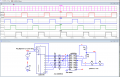
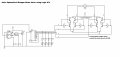
I managed to make a simulation in Proteus that is actually working from the first try, for a variable driver for a 4wire stepper.
I do not have that L298 IC so I made its internal logic as a potential real board to build later.
Heck, I also attach here the actual save file in Proteus for anyone to play with.
4wire 2phase2coil Stepper Motor logic circuit.jpg
 

Attachments

Thread Starter

q12x

Joined Sep 25, 2015
2,227
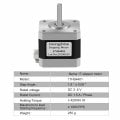
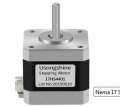
Very good news ! I received today these 5 steppers:
They arrived in only 4 days, incredible. But they arrived with fast courier, thats why. Not through the normal postage. Im really impressed ! And they look and feel brand new. These are the 4wires steppers.
1665752277243.png
Im really-really curious how much torque they have. And how fast. I know you cant have both in the same time, only one or another. I know.
Here is Full Specification:
Nema 17 Stepper Motor 5PCS 17HS4401 - specifications.jpg
 
Last edited:
If you can 3D print a pulley wheel to fit firmly on the shaft, or even fashion one from several layers of cardboard with the outside layers of larger diameter all glued together, run nylon cord around it and hang weights on it. Test at different voltages, weights and speed
 

Thread Starter

q12x

Joined Sep 25, 2015
2,227
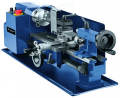
I have a lathe ! In my room. ;] I show it in many of my movies. I can do a pulley wheel with it. But Im limited to a certain diameter, not larger than 10cm since it will vibrate too much, no matter how well is held in the chuck jaws. I can make it from wood or even mild steel if its not too big diameter.
But first, the stepper driver circuit...aiaiaiai. Its a BIG one.
1665756434376.png
 
Last edited:

ScottWang

Joined Aug 23, 2012
7,501
I have a lathe ! In my room. ;] I show it in many of my movies. I can do a pulley wheel with it. But Im limited to a certain diameter, not larger than 10cm since it will vibrate too much, no matter how well is held in the chuck jaws. I can make it from wood or even mild steel if its not too big diameter.
But first, the stepper driver circuit...aiaiaiai. Its a BIG one.
View attachment 278396
I have thought to buy a lathe similar to this one for over 20 years, but I still didn't buy it, and now where I live that the wall was built of wood, so it's too easy to make the noise to affect the neighbor, so I'm still waiting ... :D
 

Thread Starter

q12x

Joined Sep 25, 2015
2,227
Ohohoo, I am working on it at 3 oclock in the morning, Right pass the middle of the night. It is so silent you have no idea. I can make you a short video and demonstrate it if you will. Of course if you catch the material in the cutting knife or make too much drag, the sound will increase, but if you cut light and careful, my neighbors are sleeping very happy, they even praise me how silent I am usually; hahaha. And I have neighbors in 3 directions since Im staying in an apartment. I took it at a lower offer from the tools mall, and the idiots didnt know how to start it, so I lowered the price even more, considering it as faulty, but it was a emergency button stuck on press position, when I reach home. I risk it taking it "damaged" but it was brand new and is still doing a fine job today, after about 20 years. Is a great tool ! Buy it now ! is my recommendation. Seriously. You will thank me later.
This is the model I have and put it in Google Images search: BT-ML 300 from Einhell (made in Germany)
 

Thread Starter

q12x

Joined Sep 25, 2015
2,227
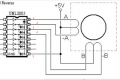
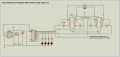
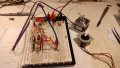
I have breadboarded this circuit:
And super success ! It worked from first try on both different types of 4wire stepper motors I have. With a slight voltage difference between the 2, like 1V or so, and also different fv speed. They are different motors after all. Both working at 5V and with substantial current draw.
At 5V, the scrapped motor is drawing 420mA when the fv(or POT1) is the lowest.
At 5V, the new motor (Nema 17) is drawing 950mA (almost 1A) when the fv(or POT1) is the lowest. Is this normal? Or I got the bad ones here? They both work and no heating whatsoever which is always good. But the power they draw, its a bit much, or at least clearly I am not used to. I included a voltage regulator in the breadboard circuit (not shown in the diagram) specifically for the logic circuit (stupidity) protection. I did jumped the voltage to 6V for a few seconds but I bring it back to 5V and even to 4V which is working fine as well. Very interesting. At lower speeds(fv) both motors are trembling but rotating. At higher speeds(fv) the trembling almost disappears especially for the new one; the scrapped one is a bit too trembling at higher speed-fv andif I turn the fv too much up, is freezing still, sign that the coils inside have a limit. The new one is fine with higher fv. Very cool so far. I am VERY happy!
Ive only breadboarded these 2 circuits for 5wire and 4wire stepper motors. It is time to make the stand alone boards for them.
I also buy that h-bridge driver L298, 10pcs for some sort of good deal, but still expensive in my book.
1665844309178.png

1665842461749.png

20221015_172820.jpg
 
Last edited:

Thread Starter

q12x

Joined Sep 25, 2015
2,227
Thank you very much, imagine that for me is a big deal.
Why don't you start an AAC blog showing the project.?
I really dont know how and here on the forum page is good enough for me. Sharing and getting very good feedback from professional and dedicated people like you guys, is more than I can wish. Its perfect the way it is, haha.
 
Top