So., it’s not actually a dead short, it’s .2Ω ±.02Ω. When it is off, and when it is on after the power up, it’s... not consistent.
At first, it was around 525Ω, on or off. When I went back to check it, it was around 950Ω, then it as about 750Ω. Whatever I get when I check after power up it stays that way after power down, until I power up again and it may say something different.
there is definitely a really involved in the power up sequence, it either makes or breaks exactly when the low resistance disappears, though that’s not proof of anything. I know there is a relay the switches something around 8V, it could be that one.
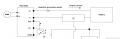
The service manual has NO SCHEMATICS. Sorry... annoyed at that.
Also alludes to protection circuits and I notice the outputs can be combined in parallel or serial fashion, so almost anything could be going on in there so without schematic or tear-down its all guessing.
After a squiz at a SPD3303X control PCB output stages the components directly behind the Ch1/2 output terminals are as follows:
2 paralleled 470uf electrolytics across outputs
1N5302 diode reverse biased
473 400V greencap
I also know these commonly emit a small spark when connecting to a battery due to the charging of the 940uF output capacitance.
I have done no further tests.
After a squiz at a SPD3303X control PCB output stages the components directly behind the Ch1/2 output terminals are as follows:
2 paralleled 470uf electrolytics across outputs
1N5302 diode reverse biased
473 400V greencap
I also know these commonly emit a small spark when connecting to a battery due to the charging of the 940uF output capacitance.
I have done no further tests.
There may well be a good reason for the short condition but I have added a warning label to mine. And I am building up a little box with a 5V relay and the positive lead on the NO contact. I’ll power it from the fixed supply when I am connecting a power source so the shorting can’t actually short the power source.
There may well be a good reason for the short condition but I have added a warning label to mine. And I am building up a little box with a 5V relay and the positive lead on the NO contact. I’ll power it from the fixed supply when I am connecting a power source so the shorting can’t actually short the power source.
My guess is that the short circuit on switch -on is a protective feature to avoid an uncontrolled power output prior to the control circuits becoming stable. The same concept as the speaker protection relay circuit on audio amplifiers. It only takes a few milliseconds of excess voltage to damage some kinds of electronics, such as the expensive precision clock oscillators. That did happen once at one place I worked at.
My guess is that the short circuit on switch -on is a protective feature to avoid an uncontrolled power output prior to the control circuits becoming stable. The same concept as the speaker protection relay circuit on audio amplifiers. It only takes a few milliseconds of excess voltage to damage some kinds of electronics, such as the expensive precision clock oscillators. That did happen once at one place I worked at.
Could be designed to discharge the paralleled 470uf electrolytics or maybe zero calibrate the voltage meter??
Take away is that if connecting the power supply to battery for charging, use blocking diode like in the app note, not just to protect overvoltage diode but to prevent battery from back-feeding the supply.
What's odd to me, is that there's no output voltage at all unless the channel 1/2 is actively selected, each channel is always off by default when we power up.
If the desire was to bleed the output capacitors that could be done by bridging the output terminals with some large resistance (via a relay) so that whenever there's no power, the caps get drained, that is drain them at power off so that there's nothing really to do at power up.
Just postulating, but if you're designing an auto calibration that occurred on power-up, you can't assume the capacitors are discharged and you can't assume what's connected to the output terminals. You would engage a method to ensure caps are discharged and remain discharged during the calibration procedure.
All conjecture without a schematic.....
It strikes me as a design weakness at the very least. If we had a large capacity battery connected (say to manually charge it or trickle charge it) then during the first six seconds of power up, it would short circuit the batter and with thick connecting cable between battery and unit, we'd have a serious problem.
Absolutely, and the idea of connecting two power sources in parallel without some form of isolation (i.e. blocking diode).
IMHO connecting a power supply not designed for directly charging a battery is extremely bad practice.
That can be mitigated by inserting a reverse current blocking diode as you NEVER want to backflow current into a power supply.
Here s what TDK says: notice "Backflow Prevention Diode"
Absolutely, and the idea of connecting two power sources in parallel without some form of isolation (i.e. blocking diode).
IMHO connecting a power supply not designed for directly charging a battery is extremely bad practice.
That can be mitigated by inserting a reverse current blocking diode as you NEVER want to backflow current into a power supply.
There is negligible current in the situation of a higher voltage on the battery side because the output of the supply is high resistance. I often turn down the voltage when charging a battery to get a quick check on the battery voltage with no harm to the supply at all. The meter reads the battery voltage until the set point exceed that.
If a device, not a battery or intended to be a power source, but that happened to have large caps on its input, were connected with charged caps on power up, unpretty things could also happen.
No matter what the rationale, possibly one you’ve mentioned, they could and should galvanically isolate the output during the power on process to avoid exposing shorted terminals.
You are correct and anything is possible so best not to assume we know what the output section of a power supply looks like and to be safe, add a diode to prevent unintended backflow if connecting to a battery or other power source.
Another application is where one places multiple individual power supplies in parallel (for increased current) or series (increased voltage). It is an approved and safe practice as long as you fully understand the capabilities and design of your supply. Used to do this all the time for high-quality HP supplies where the product documentation clearly stated the unit supported.
My problem is when the "design flaw" phrase gets thrown around. A design flaw is when a product does not perform the way it was designed for. We can't say that "isolated" outputs is a standard requirement for DC supplies. What you discovered was a design feature (albeit nasty), not a design flaw.
My problem is when the "design flaw" phrase gets thrown around. A design flaw is when a product does not perform the way it was designed for. We can't say that "isolated" outputs is a standard requirement for DC supplies. What you discovered was a design feature (albeit nasty), not a design flaw.
Thank you for posting this. I did exactly the same thing except I fried the channel. I wondered how a power supply could exhibit this behavior. Now I know. Yes a troubling design choice that should be noted in large text on unit or at least in manual. I looked over the manual and found nothing about this behavior.
Just postulating, but if you're designing an auto calibration that occurred on power-up, you can't assume the capacitors are discharged and you can't assume what's connected to the output terminals. You would engage a method to ensure caps are discharged and remain discharged during the calibration procedure.
All conjecture without a schematic.....
I should add, though this is an old thread, since they are very aware of what the supply does at startup, they can use the same relay they are using when they short the output to isolate the terminals from the process. A diode isn’t “free”, there is a voltage drop that is non-trivial for some applications and in any case would need to be accommodated.
Whatever their reason for shorting the output, it absolutely does not need to also short the user-facing terminals. Since there is absolutely no warning about this either on the device or in the user manual, and since isolating the binding posts would be trivial—I am comfortable calling this a design flaw.
When something is predictable and avoidable, and you do nothing to mitigate the risk it presents when adding a feature to your design, that is a flaw. “Never charge a battery with a power supply“ is a rule that need only exist because of such flaws. It is certainly not a rule in my world.
No - it's a "undocumented safety feature". The designer probably got it into his head that it was a good idea to make sure that whatever you were working on was safe (i.e. had no voltage on it) when the power supply was switched off, but forgot to tell marketing.
Safety features that are more dangerous that the danger they purport to prevent - my new car is full of them!

 Facebook
 Google
 GitHub
 Linkedin