The powerline AC is quite accurate when averaged on the long run.
Let's say you are NOT located in North America, with a powerline frequency of 50 Hz, then the total divider ratio would be:
15 X 60 X 50 = 45000.
A pair of counters and some gates to decode it.
if you are generating clock using some RC oscillator (like NE555), you can set the frequency low... such as 1Hz. then you only need one counter to get longer intervals.
if you want precision, then RC based clock is not going to cut it. you have to use crystal. but lowest frequency crystal is 32kHz. in this case you need two CD4060. one to get crystal frequency down to a low base (like 1-2Hz) and then additional CD4060 to count those seconds to get 15min interval. so in this case you would need two of them.
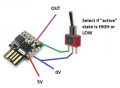
or... get something programmable... like DigiSpark or Arduino and write something like... i don't know...
Code:
bool out_state;

void setup() {
  pinMode(0, INPUT);             // PB0 is an input for switch to select pulse polarity
  pinmode(0, INPUT_PULLUP);
  pinMode(1, OUTPUT);            // PB1 is an output
}

void loop() {
  out_state=digitalRead(0);      // read state of the input (LOW/HIGH)
  digitalWrite(1, out_state);    // write it to an output
  delay(1000);                   // wait 1 sec (1000ms)
  digitalWrite(1, !out_state);   // toggle output
  delay(900000);                 // wait 900 second (900000ms)
}
Does it have to be one pulse every 15 minutes, or is every 16 minutes acceptable?
An alternate approach is a programmable lamp timer plus a 5 V wall wart. Every 15 minutes, the wall wart is powered up, makes the output pulse, and then just sits there. It is turned off after 1 minute, then turned on again in 14 minutes. Repeat. The output pulse circuit is 2 transistors, or 2 logic gates, etc.
Does it have to be one pulse every 15 minutes, or is every 16 minutes acceptable?
An alternate approach is a programmable lamp timer plus a 5 V wall wart. Every 15 minutes, the wall wart is powered up, makes the output pulse, and then just sits there. It is turned off after 1 minute, then turned on again in 14 minutes. Repeat. The output pulse circuit is 2 transistors, or 2 logic gates, etc.
Why don't You just tell everyone what the purpose of this project is ?
You would very likely get some excellent recommendations immediately, instead of all this guesswork.
.
.
.
Why don't You just tell everyone what the purpose of this project is ?
You would very likely get some excellent recommendations immediately, instead of all this guesswork.
.
.
.
It would be repeatable.
You can make a monostable out of a 4060 by feeding the output back to the oscillator with a diode, but the accuracy will be the same.
It would be repeatable.
You can make a monostable out of a 4060 by feeding the output back to the oscillator with a diode, but the accuracy will be the same.

 Facebook
 Google
 GitHub
 Linkedin