A signal question

Thread Starter

hht

Joined Jan 19, 2017
6
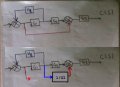
I am not sure whether the operations with parallel line and the feedback H1 is correct. I know there are easieer methods to solve this problem but I would like to analysis this method. I am not sure if I have to multiply parallel line with +1/G1H1 when I carry the feedback with H1 into the parallel line. How can be sure?
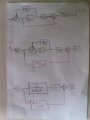
sign error.JPG

Thank you.
 

MrAl

Joined Jun 17, 2014
13,704
Hello,

It is a little hard to tell what you are doing here although i looked at it rather quickly.

A simple method is to just move the red line pickoff point AHEAD (to the right) of the gain block G1 (with an included adjustment gain block of course), which then gives you just two independent feedback loops to reduce which will lead to a more clear solution.

If you still want to do whatever it is you are trying to do, that's fine, but you could use the above method to check your method and also you could explain in detail what you are trying to do and how you are trying to do it.

I can take another better look a little later today, but moving the red line pickoff point ahead of the next gain block is the quickest way to a solution. You can use that to check your other solution, and you can also use Mason's Signal Gain Formula to check this and other problems in the future.
 

Thread Starter

hht

Joined Jan 19, 2017
6
Hello,

It is a little hard to tell what you are doing here although i looked at it rather quickly.

A simple method is to just move the red line pickoff point AHEAD (to the right) of the gain block G1 (with an included adjustment gain block of course), which then gives you just two independent feedback loops to reduce which will lead to a more clear solution.
How can it be ? I think one feedback and one parallel summing. Would not 1/G1 and G2 be parallel in that situation?

Thank you.
 

MrAl

Joined Jun 17, 2014
13,704
How can it be ? I think one feedback and one parallel summing. Would not 1/G1 and G2 be parallel in that situation?

Thank you.
Hi,

Yes that's right, i misspoke when i said there were two feedback paths then, there is really one feedback and one feedforward.
But the results is also not really 1/G1 in 'parallel' with G2, there are just two forward paths that go to the subtractor and then they can be easily reduced. Once they are reduced and the one feedback path is reduced, the solution becomes very clear.
See attachment for illustration.

There are various rules for moving pickoff points forward or backward, we can review them if you like.
 

Attachments

Thread Starter

hht

Joined Jan 19, 2017
6
Hi,

Yes that's right, i misspoke when i said there were two feedback paths then, there is really one feedback and one feedforward.
But the results is also not really 1/G1 in 'parallel' with G2, there are just two forward paths that go to the subtractor and then they can be easily reduced. Once they are reduced and the one feedback path is reduced, the solution becomes very clear.
See attachment for illustration.

There are various rules for moving pickoff points forward or backward, we can review them if you like.
I know most of the rules but it would be very nice to review the some related terms. For example I said 1/G1 in parallel with G2 because they both starts from same point and finishes or enter into the same point, there is nothing between them. So why cannot we call them as parallel? You call them as forward paths. This is confusing for me.

Thank you.
 

MrAl

Joined Jun 17, 2014
13,704
I know most of the rules but it would be very nice to review the some related terms. For example I said 1/G1 in parallel with G2 because they both starts from same point and finishes or enter into the same point, there is nothing between them. So why cannot we call them as parallel? You call them as forward paths. This is confusing for me.

Thank you.
Hi,

I said that i would not call them parallel because although they start from the same node they do not end at the same node, they go to a subtractor. If you want to call them parallel then you have to explain how you differentiate between those two if they go to a summer vs if they go to a subtractor. You can not do this by stating that they are in parallel because then we would have two cases where we would have to find a way to modify that statement in some way. If you really wanted to do this though, that's up to you, but then you'll have to state what is REALLY at the other end (subtractor or summer).
For example, if we had G1 and G2 with a subtractor where G1 goes to + and G2 goes to - then we would have the reduced:
G1-G2

but if G2 also goes to a + then we would have:
G1+G2

and then if instead G1 went to - then we would have:
G2-G1

but if both G1 and G2 went to a - then we would have:
-G1-G2

So you see we can not say they are in parallel, unless we modify that with more information which would tell us which case we really have. In other words, it is probably bad practice to call them parallel, but it's up to you if you want to continue to call them that as i dont know if there is any text that refers to them that way or not with the added modification.

Just to recap a little, if we say that they are in "parallel" then we dont know which of the four cases we actuallly have without referring to the block diagram or signal flow graph.

The term 'parallel' is usually used with impedance elements like resistors.

"Feed forward" or just "forward" refers to a signal that goes from the left to the right while "feedback" refers to a signal that flows from right to left in the usual diagram where we have the input on the left and output on the right. The two paths we had been talking about would therefore be classified as two 'forward' paths or two "feed forward' paths.
 

Thread Starter

hht

Joined Jan 19, 2017
6
If you want to call them parallel then you have to explain how you differentiate between those two if they go to a summer vs if they go to a subtractor.The term 'parallel' is usually used with impedance elements like resistors.
I am new in this topic and I am poor with the terms of it. I have the book Control Systems Engineering by Norman S. Nise but when I am made a search through the book I have seen that even that book do not include the term "subtractor" or "substractor" I think that book is not fundamental but advanced. It's like I lost my way when I try to learn control systems or automatic control. So would you like to advise me a more fundamental source? Meanwhile I usually meet with the terms "parallel" and "cascade or serial". Nise's book uses "parallel" and "cascade"

Feed forward" or just "forward" refers to a signal that goes from the left to the right while "feedback" refers to a signal that flows from right to left in the usual diagram where we have the input on the left and output on the right
Can we also say "forward path" ?

Thank you.
 

MrAl

Joined Jun 17, 2014
13,704
Hi,

Blue is for the new line, red is for the old line that was already there.

A subtractor is what you have drawn in your block diagram. That is where one input is positive and one input is negative.
In an actual signal flow graph all of the summers are simply summers and any subtractions are shown as negative gains. I have seen the word 'parallel' used in that context. In your diagram however, by saying that the two paths are in parallel you imply that you can add the gains and get the right result, when really you cant because the 'summer' is not really a summer it is a subtractor, meaning it subtracts one gain from the other. If you want to call them parallel then you still have to explain that they are being subtracted. So if you tell someone else, "The two paths are in parallel", then they might not know exactly what you mean or they may assume that there is an actual summer after the two, not a subtractor (a summer with one minus input like in your diagram).

Forward path, forward, feed forward, all the same meaning really. A signal that flows from the input side toward the output side is forward, and a signal that flows the other way is feedback.

Also, it's usually better to use all summers and show any subtractions with negative gains. I know we dont always want to do this though.

Once you do a few of these it starts to make perfect sense.
 
Top