A problem with a simple not gate circuit

Tonyr1084

Joined Sep 24, 2015
9,744
So even if i don't need all the gates i shouldn't leave the outputs floating
INPUTS! Do not leave the INPUTS floating (as seen in the diagram on post #38). Outputs do not need to be connected to anything. And that's the recommended approach. Tie all the unused inputs to either source or ground. Leave the outputs unconnected.
 
Last edited:

crutschow

Joined Mar 14, 2008
38,512
An unconnected inverter (that's what you have) can oscillate uncontrollably and cause problems for other gates.
The other thing it can do is that gate voltage will float to to some intermediate voltage and cause both the N-Chan and P-Chan transistors in the gate to conduct, allowing a significant current to flow through both.
I had this happen once, causing the IC to got very warm
 

eetech00

Joined Jun 8, 2013
4,705
This is the ic i am using but i think it is working better with a transistor
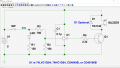
Are you sure about the IC?

The 74HC1G or 74LVC1G types do not look like the IC in the picture posted in #28.
These chips have only one inverter.

Also, be sure to connect a 0.1u cap across the power supply pins of the inverter chip you are using to prevent erratic operation.

1752333200920.png

Edit: U1 inverter types corrected
 
Last edited:

Tonyr1084

Joined Sep 24, 2015
9,744
The other thing it can do is that gate voltage will float to to some intermediate voltage and cause both the N-Chan and P-Chan transistors in the gate to conduct, allowing a significant current to flow through both, • • • causing the IC to got very warm
This is true. Lots of current, lots of heat. Lots of failure on the horizon.
 

MisterBill2

Joined Jan 23, 2018
27,528
My practical, real world, experience has verified that all logic inputs need to be connected: either to logic outputs in an actual application, or to fixed logic levels. EVEN if the logic is some variety with a low impedance, noise can be the other issue.
 
Top