A problem with a simple not gate circuit

Thread Starter

Ghina Bayyat

Joined Mar 11, 2018
148
Hi
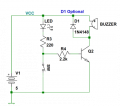
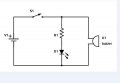
Could you please help me with this circuit
It is very simple and i have done it several times before but i don't know what is wrong with it this time

680484736.png
The problem is that the led stays on all the time even when the switch is open
The buzzer is working correctly : when the switch is open it is on and when the switch is closed it is off
But the led is on all the time either the switch is open or closed
I tried to change the values of the resistor R2 but it didn't help
 

Ian0

Joined Aug 7, 2020
13,097
Assuming you have wired it correctly. . .
Either Q1 is faulty, or the 4069 is faulty.
You have missed out the base current limiting resistor of Q2, which could have damaged IC1.
What is the voltage on Q1 base when the switch is open?
Does the LED go off if you remove IC1?
 

DickCappels

Joined Aug 21, 2008
10,661
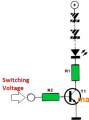
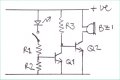
The "base limiting resistor" to which Ian0 referred is a resistor in series with the base to limit the base current. If you want 1 ma of base current (for example) 200 microamps, the resistor R2 in the circuit below would be about 20k. (5V-0.7V)/200e-6.

1751356949971.png
 

eetech00

Joined Jun 8, 2013
4,704
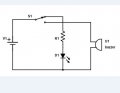
Or, you can configure the circuit this way, and not use an inverter IC.
There will be about 1mA flowing thru LED when switch is open but the 2v@20mA LED will be extremely dim and not visible.

1751380935866.png
 
Last edited:

Tonyr1084

Joined Sep 24, 2015
9,744
The problem is that the led stays on all the time even when the switch is open
The buzzer is working correctly : when the switch is open it is on and when the switch is closed it is off
But the led is on all the time either the switch is open or closed
I tried to change the values of the resistor R2 but it didn't help
Ignoring IC1, the first thing I'd suspect is a faulty Q1. What transistor did you use? IS it a transistor? Or is it a FET? If it's a FET then once the gate is charged it can stay energized for a very long time. Adding a resistor from the gate to the negative rail will drain the capacitive charge the gate can hold, and D1 will shut off.

Before we can do further diagnostics on your circuit we need to know what transistors you used. Otherwise we're just assuming the transistor is a common NPN BJT.
 
Last edited:

Tonyr1084

Joined Sep 24, 2015
9,744
I also notice you have approximately 20mA feeding the base of Q1. Not knowing what transistor you used, you may have shorted the transistor into conduction all the time, thus explaining why the LED is constantly lit.
It is very simple and i have done it several times before but i don't know what is wrong with it this time
It's the simple circuits that most often fool us because we might overlook some small detail. Also, assuming 2Vf for D1 and 0.6Vf for Q1, 5V-2.6=2.4V. Under that assumption; 2.4V÷220Ω= approximately 11mA. Those seem like small currents, but again, we don't know what transistor you used.
 
Last edited:

boostbuck

Joined Oct 5, 2017
1,034
Or, you can configure the circuit this way, and not use an inverter IC.
There will be about 1mA flowing thru LED when switch is open but the 2v@20mA LED will be extremely dim and not visible.
If a milliamp is acceptable, then you can leave quite a lot of components out of it:

1751421664285.png
 

Jerry-Hat-Trick

Joined Aug 31, 2022
777
How about:
1751464992995.jpeg

The (primary) purpose of R2 is to bleed some (or even most) of the current through the LED and R1 so that the current into the base of Q1 is not too high. As long as it turns hard on it will ground the base of Q2.
 

crutschow

Joined Mar 14, 2008
38,322
but the eye would not see a logarithmic intensity curve as in LED dimming, the LED is either on or off.
A logarithmic response has nothing particularly to due with a dimming curve.
It means that a 5% amount of light will look much brighter than if the eye had a linear response to light.
 
Top