A Engineering Solution.... (a touch of humor)

Thread Starter

Jon Chandler

Joined Jun 12, 2008
1,659
I bought a couple Halloween battery LED light strings on clearance at Grocery Outlet. On the drive home, my husband (yes, I'm gay) started asking about LED strings in series or parallel. He knows an incredible amount about many things but his electronics knowledge is limited.

He asked if the strings could be operated in series (no) or in parallel and we talked about paralleling strings, adding resistors if the operating voltage is higher, etc. I got the idea his questions were leading somewhere but he said no.

At some point, I thought he wanted to operate the two strings from a USB power bank. I explained that it would require a resistor in series with each string.

No, he said. "Using just the things in the car, what to I need to operate them from one battery pack?" My engineering solution was to roll down the window and toss one string out. Done.

Ok, I didn't actually throw it out but I did roll down the window
 

MisterBill2

Joined Jan 23, 2018
28,593
Artificial restrictions applied to a theoretical problem:
Consider that you have no assurance of any specifications of those strings of LEDs. So the two strings may not be close to the same. Possibly not even similar.
What drives the requirement that they light up the same??
WHY NOT put them in series??

NONE of the participants here need to be aware of your personal life!!! THAT is not my concern at all!
 

Reloadron

Joined Jan 15, 2015
7,977
Halloween came and went but out of curiosity, exactly what LED string did you have, anything like a name brand, part number, even a picture?

Ron
 

Thread Starter

Jon Chandler

Joined Jun 12, 2008
1,659
NONE of the participants here need to be aware of your personal life!!! THAT is not my concern at all!
Sorry if I've offended you. Well, actually I'm not at all sorry if you're offended – that's your problem, not mine.

It was a humorous moment that required some setup.
 

Thread Starter

Jon Chandler

Joined Jun 12, 2008
1,659
Thank you for the kind remark @MikeA – it's appreciated.

Getting good pictures of LEDs is a challenge....
I 3D printed a quick&dirty 7-faceted sphere using "vase mode" to replace the flexible bat or spider caps these strings came with and I love the result. A soft glow through regular PLA filament.

20261102_073215.jpg

20261029_214210.jpg
 

Thread Starter

Jon Chandler

Joined Jun 12, 2008
1,659
In vase mode, it's one continuous spiral from bottom to top, so the wall is just the thickness of the nozzle diameter, 0.4mm in this case. The nominal 1" diameter spheres weigh almost nothing.

I printed one in transparent PLA – the effect is very different. It looks like a lighted rod through the axis of the sphere.
 

Thread Starter

Jon Chandler

Joined Jun 12, 2008
1,659
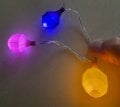
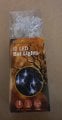
Here are some pictures of the LED strings in question.

20261102_132316.jpg

The purple spider version has the same string of LEDs with different caps.

20261102_132325.jpg

CM261102-132829001.jpg

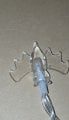
This is the flexible bat cap. The LEDs in both types of string are cold white.

CM261102-132848002.jpg

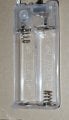
The 2×AA battery compartment with switch.

CM261102-132901003.jpg

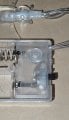
Closeup of the switch end. There are no active components or resistors in the battery box.

CM261102-132922004.jpg

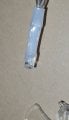
Closeup of an LED. The LEDs are wired in parallel without any visible resistors.
 
Last edited by a moderator:

Thread Starter

Jon Chandler

Joined Jun 12, 2008
1,659
Artificial restrictions applied to a theoretical problem:
Consider that you have no assurance of any specifications of those strings of LEDs. So the two strings may not be close to the same. Possibly not even similar.
What drives the requirement that they light up the same??
WHY NOT put them in series??
Since I have been challenged here, I shall respond.

Yes, I have no assurance of the specifications of these LED strings....

There are 9,187 Dollartree stores in the US. Based on my observations at only one store, I would guess each of the stores had a hundred strings or more, with 10 LEDs per string – that's over nine million LEDs. I would bet they are all reasonably similar.

This was a thought experiment, not a design for an expedition to Mars. So "close enough" is close enough.

In my experience, LED strings may be wired in one of two ways:

● (Series) Current limiting resistor and LED wired in parallel across the power conductors [the preferred method].

● One current limiting resistor in series with the battery with LEDs in parallel with no individual current limiting resistors. This method is often employed in cheap devices.

In this case, I cannot see any resistors in the string. There is none in the battery box or in the cable, and none where the LEDs are connected to the cable. The forward voltage of white LEDs is typically 3.2 volts; discharge voltage of a fresh alkaline battery at small loads is 1.6 volts, dropping to 1.2 – 1.4 volts as it discharges. Seems like some magic going on here. The batteries have survived at least 24 hours of operation.

Why not a series connection?
If series in this case actually means adding a string to the end of an existing string, if the strings are wired in the first LED+resistor in parallel method described above, that would be ok, but halving the battery life.

If the strings were wired in the single resistor/parallel LEDs described above, it would cut the current per LED in half.

Too bad @MisterBill2 can't appreciate a simple humorous event.
 
Top