9V OR 12V

Thread Starter

BZech

Joined May 2, 2022
21
The IC in the Amazon kit has its part number removed then you cannot look it up to see how it works.
A 9V battery is small then it will have a very short life. The battery drains all the time which is why they say to remove it when the light is not lighting.
Thank you, you are correct. That kit was good for learning soldering but that's about it. Also, one of the components was so how it almost burned my finger.

I think the power jack is the way to go.
 

Tonyr1084

Joined Sep 24, 2015
9,744
A CD4017 sequences its 10 outputs one-at-a-time. But none of the photos or videos show the LEDs sequencing, instead 12 or 18 LEDs are all on or they are all off.
I certainly can't account for that.
I can.

In my very first chase light circuit I built it had variable sweep timing. I could sweep it so fast that it APPEARED that all LED's were lit at the same time. But when you slow it down you can then see that it is stepping from one to the next and the next LED.

As for the 12 count and 18 count - the 4017 is a decade counter. How's the circuit coming up with sweeping 12 or 18 LED's? Otherwise, if the 4017 is NOT counting then what are they using it for?

I've built chase lights using two 4017's for a sweep count of 17 LED's. I've used one 4017 and one 4013 (DDFF) to sweep 20 LED's. I've even used two 17's to sweep up to 100 LED's. Latest sweep built is for 30 LED's. Here's a YouTube of it:
https://www.youtube.com/shorts/u-tf7foBMEU
 

BobaMosfet

Joined Jul 1, 2009
2,211
I am trying to create a circuit in which I can use 12V power supply that is plugged into a wall socket with a transformer OR use a 9V battery if the user wants to. I simply want to power about 4 to 5 LED's, (plan on making the final circuit flash using a 555 timer with a switch to change to non-flashing). Any help would be appreciated.
This is a typical power situation- you would use a diode. This will prevent the 12V from attempting to charge the 9V, but if the 12V is not present, the 9V will then power the circuit. 9V can't over-power the 12V, while both are plugged in so the 9V can't harm the 12V source. The diode protects the 9V source from the 12V.
 

Reloadron

Joined Jan 15, 2015
7,889
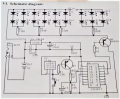
The schematic is on a video of it. The CD4017 is used as an on-off flip-flop. The LEDs are all connected together and are on or they are off.
Yes indeed and nice find of the circuit. The 4017 is configured count to N and recycle and pin 2 is tied to RST. The LEDs are ON/OFF/On/OFF forever and ever. :) Maybe even longer.

Ron
 
Last edited:

Thread Starter

BZech

Joined May 2, 2022
21
This is a typical power situation- you would use a diode. This will prevent the 12V from attempting to charge the 9V, but if the 12V is not present, the 9V will then power the circuit. 9V can't over-power the 12V, while both are plugged in so the 9V can't harm the 12V source. The diode protects the 9V source from the 12V.
Thank You!!! And it seem like I would need a 12V diode?? like this https://www.amazon.com/BOJACK-1N534...strial&sprefix=12v+diode,industrial,66&sr=1-4
 

KeithWalker

Joined Jul 10, 2017
3,607
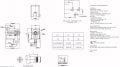
If you use the barrel jack that was recommended in post #4, you don't need diodes or anything else to separate the mains and battery supplies. If you look at the information that was provided, you will see on the first page, lower center there is a small diagram of the connector. It shows three terminals. Terminals 2 and 3 are shorted together,. When a male connector inserted, they separate.
If you connect the ground to #1, output to #2 and battery to #3, The battery will be connected until the power jack is inserted.
barrel.jpg
 
Last edited:

BobaMosfet

Joined Jul 1, 2009
2,211

panic mode

Joined Oct 10, 2011
4,978
Can you explain this a little more? A Zener diode allows current to flow in both directions?

yes...

When zener is forward biased, current flows when voltage reaches low voltage - the usual 0.6-0.7V.
When zener is reverse biased, current flows when voltage reaches listed zener breakdown (12V for example).

Btw rectifier diodes behave pretty much the same, it is just that breakdown voltage is much higher (hundreds of Volts or more).

And same is with LEDs, forward voltage is higher (usually 2-3V) and reverse voltage is very low (few Volts). but LEDs are easily destroyed with reverse polarity.
 

Reloadron

Joined Jan 15, 2015
7,889
If you want to run on a 9.0 volt battery why use a 12 volt wall wart? Why not just run with a 9.0 volt wall wart? They are as common as a 12 volt version. Again, keep in mind that a 9 volt battery has limited life depending on the load.

Ron
 
Top