12VDCHi Arun,
Welcome to AAC.
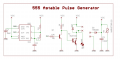
What is the Vcc voltage.??
E
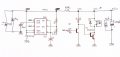
just invert the astable output.What is the GND on the collector of T2? The circuit around T2 is odd.
Do the 2 parts with "X" symbols connect together?
It just looks like T2 is shorted out to me.
Sorry, still does not make sense to me.just invert the astable output.

Thanks for your time, ill check and tell the responseSorry, still does not make sense to me.
What are you driving?
It may be an idea add decent supply bypassing. Try feeding the 555 from Vcc via a 100R resistor, then add a 10uF tanatlum cap and a 100nF ceramic from the 555 supply pins to gnd. Even a 9V zener diode to keep the 555 supply regulated at 9V.
Then on the 12V supply, install a 1000uF electrolytic cap as well as a 10uF tantalum.
Make sure the tants and the electro caps are the correct way around.
View attachment 145602
I can't see any conspicuous reason it should fail, but as dendad says, good supply decoupling right at the 555 is very important. I used to assign an experiment using a 555 configured as an astable, while observing the Vcc pin with an oscilloscope. The students tested with about half a metre (each way) of separate wires to the supply, then with the wires twisted together, then with a decoupling cap right at the 555. It was easy to get 20 volt spikes at the 555 Vcc pin in the first case, while running from a 5 V supply. The shoot-through current in the output totem-pole (both the transistor from output to Vcc and the transistor from output to ground ON at the same time, mostly due to switching speed limitation) of a 555 is quite high, which, when working against inductance without local decoupling results in the big spikes. If Vcc exceeds the breakdown voltage, the whole IC can more or less behave like an SCR between Vcc and ground.
If may simply be that the added current due to driving the base of T1 is enough to produce voltage so high at the Vcc pin of the 555 to damage it. You may not need to resort to the zener circuit as dendad has shown, but do add a 100 nF (at least) of ceramic capacitor on the shortest leads possible between the 555's Vcc & ground pins, and at least 10 µF (that should be 10 muF - I haven't tested to see if mu character µ shows up properly here) of decent-quality electrolytic capacitor somewhere nearby. The 100 ohm resistor dendad shows could be reduced to say 10 ohms, if you aren't using the zener, to aid in decoupling from anything on the supply rail coming from the load. Stick with dendad's values if you try his circuit with the zener. Be sure the wires to your power supply are twisted together to minimize the inductance, especially if they are long (the magnetic fields of the two wires "cancel", greatly reducing the inductance). Capacitance near the load, as dendad has shown, is also important.
If you are intending the varistor to clamp transients, I recommend a zener-type transient suppressor instead. They are extremely fast, but more important is that they conduct at a voltage that is more predictable so you can select a clamping voltage closer to the supply voltage.
A 1N5408 will turn on quite slowly, so it may limit the performance of what I assume is intended to aid clamping any spikes generated by the load, but like dendad, I don't really understand that part of your circuit. You don't say what type D3 is, but if it is also a 1N5408, its turn-on delay (called "forward recovery time") may allow a narrow but very high voltage spike if T2 turns off fast enough. Darlingtons are usually pretty slow to turn off, so it likely is not a problem, but a Schottky diode might perform better. A diode rated at 1 A and say 20 V would be adequate, even for a fairly large inductive load. A 3 A rating would certainly be high enough (if the load is inductive, it will have to conduct 3.5 A when T2 turns off, but only for a short time unless the inductance is very high). In general, in any diode family, high voltage rating goes with slower switching. A 1N5401 will be faster than a 1N5408.
Thanks for your time, ill check and tell, D3 - 1N4007.I can't see any conspicuous reason it should fail, but as dendad says, good supply decoupling right at the 555 is very important. I used to assign an experiment using a 555 configured as an astable, while observing the Vcc pin with an oscilloscope. The students tested with about half a metre (each way) of separate wires to the supply, then with the wires twisted together, then with a decoupling cap right at the 555. It was easy to get 20 volt spikes at the 555 Vcc pin in the first case, while running from a 5 V supply. The shoot-through current in the output totem-pole (both the transistor from output to Vcc and the transistor from output to ground ON at the same time, mostly due to switching speed limitation) of a 555 is quite high, which, when working against inductance without local decoupling results in the big spikes. If Vcc exceeds the breakdown voltage, the whole IC can more or less behave like an SCR between Vcc and ground.
If may simply be that the added current due to driving the base of T1 is enough to produce voltage so high at the Vcc pin of the 555 to damage it. You may not need to resort to the zener circuit as dendad has shown, but do add a 100 nF (at least) of ceramic capacitor on the shortest leads possible between the 555's Vcc & ground pins, and at least 10 µF (that should be 10 muF - I haven't tested to see if mu character µ shows up properly here) of decent-quality electrolytic capacitor somewhere nearby. The 100 ohm resistor dendad shows could be reduced to say 10 ohms, if you aren't using the zener, to aid in decoupling from anything on the supply rail coming from the load. Stick with dendad's values if you try his circuit with the zener. Be sure the wires to your power supply are twisted together to minimize the inductance, especially if they are long (the magnetic fields of the two wires "cancel", greatly reducing the inductance). Capacitance near the load, as dendad has shown, is also important.
If you are intending the varistor to clamp transients, I recommend a zener-type transient suppressor instead. They are extremely fast, but more important is that they conduct at a voltage that is more predictable so you can select a clamping voltage closer to the supply voltage.
A 1N5408 will turn on quite slowly, so it may limit the performance of what I assume is intended to aid clamping any spikes generated by the load, but like dendad, I don't really understand that part of your circuit. You don't say what type D3 is, but if it is also a 1N5408, its turn-on delay (called "forward recovery time") may allow a narrow but very high voltage spike if T2 turns off fast enough. Darlingtons are usually pretty slow to turn off, so it likely is not a problem, but a Schottky diode might perform better. A diode rated at 1 A and say 20 V would be adequate, even for a fairly large inductive load. A 3 A rating would certainly be high enough (if the load is inductive, it will have to conduct 3.5 A when T2 turns off, but only for a short time unless the inductance is very high). In general, in any diode family, high voltage rating goes with slower switching. A 1N5401 will be faster than a 1N5408.
| Thread starter | Similar threads | Forum | Replies | Date |
|---|---|---|---|---|
| T | 555 timer kit modification show-and-tell | General Electronics Chat | 11 | |
|
|
Appliance on-off timer with LM555 and CD4020B | Analog & Mixed-Signal Design | 18 | |
| R | bypass timer on circuit board? | IC Design | 5 | |
|
|
NE555 timer pin5 | Digital Design | 13 | |
|
|
555 timer in astable mode, first pulse longer | Digital Design | 12 |