555 Timer Frequency and Pulse Width Circuit Issue

Thread Starter

Joester0064

Joined Jun 14, 2023
77
Hi All,

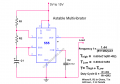
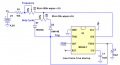
I have bread boarded up the circuit shown below and double checked all connections. It does oscillate and I can change the frequency but not pulse width. For some reason, both pots do the exact same thing, adjust the frequency, one is supposed to adjust the pulse width. Any thoughts are much appreciated!

Thanks!

Joe
555 osc.png
 

dl324

Joined Mar 30, 2015
18,220
For some reason, both pots do the exact same thing, adjust the frequency, one is supposed to adjust the pulse width.
One would expect both pots to change the frequency because the capacitor(s) charge through both and discharge through one. Are you trying to vary duty cycle without changing frequency?
Any thoughts are much appreciated!
The symbol used for the timer is terrible; only two of the pins should have bubbles. Pin function should be where you have pin numbers as many will not have memorized pin function. The symbols for the pots are also less than useful. For those of us who don't use pin numbers, we can't tell which direction is clockwise rotation.
 

sghioto

Joined Dec 31, 2017
8,633
Any thoughts are much appreciated!
They actually do both.
Adjusting either pot will move the frequency and duty cycle over a range.
Run the circuit through This calculator with different values for the two pots and see.
BTW there should be a small value resistor in series with the J6 pot because if it's at zero ohms there is a direct short from pin7 to Vcc.
1726236808947.png
 

Thread Starter

Joester0064

Joined Jun 14, 2023
77
One would expect both pots to change the frequency because the capacitor(s) charge through both and discharge through one. Are you trying to vary duty cycle without changing frequency?
The symbol used for the timer is terrible; only two of the pins should have bubbles. Pin function should be where you have pin numbers as many will not have memorized pin function. The symbols for the pots are also less than useful. For those of us who don't use pin numbers, we can't tell which direction is clockwise rotation.
yes I need independent control
 

dl324

Joined Mar 30, 2015
18,220
yes I need independent control
Google "555 PWM". I think all solutions will be less than optimal. For easier/better control, use a square wave oscillator with an integrator and a comparator. You can Google that too.

EDIT: did it for you:
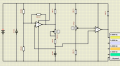
1726237745194.png
This uses an opamp as a comparator because it's using a quad opamp.
 

Attachments

Last edited:

Thread Starter

Joester0064

Joined Jun 14, 2023
77
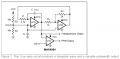
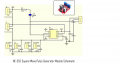
thanks very much, ill try that. I built the circuit below and it works perfectly, I tried to build another one using two OP27G and it works (kind of) I get a waveform but the adjustments to not work right. From what I have found I need to use a specific type of opamp (kind of though they are all generally the same??), the first one I built that works perfect, I use a 4558D dual op amp, I tried swapping that out for a OP200 (literally just removed the 4558D from the 8 pin socket and placed OP200) and I get no output at all even though the two ics have the same pinout

op amp pulse and freq gen.png
 

dl324

Joined Mar 30, 2015
18,220
kind of though they are all generally the same??
Bad assumption. They all "generally" amplify signals, but they all have their advantages and disadvantages. It's up to the user to know enough to pick one that's appropriate for the task.
I built the circuit below and it works perfectly
That's good because that schematic is drawn so poorly that I can't force myself to read it...
 

Thread Starter

Joester0064

Joined Jun 14, 2023
77
I meant there may be some interaction between the frequency adjustment and the duty-cycle adjustment, but it should be quite (likely negligibly) small.
ok perfect thanks very much for this schematic, this is one I have been looking for! I built something like this with the two diodes about a year ago and it worked well but dissembled it and didn't save the schematic! haven't been able to build it again since!!
 

crutschow

Joined Mar 14, 2008
38,324
I need to retract my statement.
There is indeed some interaction, as the frequency adjust will affect the duty-cycle in the 555 circuit.
So you will need to account for that when you design for the amount of frequency and duty-cycle adjustment you need.

If you want no interaction, then you will need use a circuit such as in post #8.
 

sparky 1

Joined Nov 3, 2018
1,218
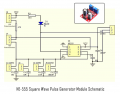
His pcbway shared projects show his pcbs are better than average and his tutorials are clear.
Note that some suggestions above explain that better ramp waveforms and ltspice ideal pwm generation will give the precise dead time.
They all have dead time, however some boards and the included documentation are easier to decipher, trouble shoot,
when it works it's a Fun project, before in his other video he used a board with 1 potentiometer. The pcbs he offers now have 2 pots.
The improved revision continues with through hole parts and by providing 2 potentiometer separate controls for frequency and other for
duty cycle gives added versatility, this improvement is a start toward a basic adjustable function generator. The adjustable op amp sine wave
generator is not a question of either/or. The square wave duty cycle AND the op amp adjustable sine wave.


Last edited:

LowQCab

Joined Nov 6, 2012
5,101
It's very unusual to need to have a Pot adjustable Frequency on a PWM Generator.
They're normally fixed Frequency.

Why do You need adjustable Frequency ?, and over how large of a Frequency-Range ?

And, normally, the Pulse-Width is controlled by an external Voltage-Signal, rather than a Pot.

I usually prefer a Dual-Op-Amp, or a push-pull-Output-Dual-Comparitor, over a 555,
but a 555 is an excellent learning tool.
.
.
.
 

sparky 1

Joined Nov 3, 2018
1,218
For those who only use fixed frequency video 1 potentiometer,
There are times you have to vary the frequency. One example is lowering vibration on a small lathe.
A lathe operator knows about speed and feed but an expert knows that changing the motor frequency
it is possible to operate away from undulation which gives a much better finish and tolerance. usually the final
pass. In the first electronics workbench I used both duty cycle and frequency and still use that feature in tuning.
Many people use a 555 PWM module for lack of something better.
 
Top