555 PWM

ericgibbs

Joined Jan 29, 2010
21,443
hi Matt,
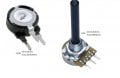
You can see the 'tolerances' on the stated values, especially the left side trim pot.
If you are using the right side spindle pot in your project, it should give you the range of control required.

Thanks for the feedback.

E
 

Thread Starter

MATT838383

Joined Jul 31, 2019
144
(The oscillator on the left is not connected to the modulation input, and thus its frequency cannot be affected by that.) sorry do i need to connect them ?
 

Thread Starter

MATT838383

Joined Jul 31, 2019
144
Hi eric
yes i have controlled the resistors value , the supp voltage, the pwm output dutycycles but still the frequency changes with de dutys i really dont know where is the failure!
 

Thread Starter

MATT838383

Joined Jul 31, 2019
144
Hello Eric sorry i am late i have tested your circuit and here are my resutlts:
6,4%= 224,1 HZ
24%= 224,2 HZ
35%= 224,3 HZ
57%= 224,4 HZ
69%= 224,5 HZ
75%= 224,6 HZ
85%= 224,7 HZ
99,7%= 253,4 HZ
is there a solution to obtain a fixed frequency? (i have tested two circuit to be sure and the results are identical!)
thank you
have a n ice day!
 

Alec_t

Joined Sep 17, 2013
15,119
is there a solution to obtain a fixed frequency?
For most PWM applications the precise frequency is not critical. What is the PWM going to be used for, which requires a fixed frequency?
Frequency drift due to temperature changes and component tolerances is likely going to occur with any analogue approach. Duty cycle is also likely to drift and could be particularly noticeable at values close to 100% or 0%.
 
Last edited:

ericgibbs

Joined Jan 29, 2010
21,443
hi Matt,
A couple of points , where on the circuit are you measuring the frequency and what is measurement device.?

Lets know the results of the modification.
E
 

ericgibbs

Joined Jan 29, 2010
21,443
hi matt,
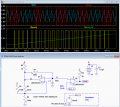
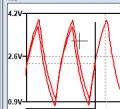
Using LTSpice with the plots expanded in the time axis thse are figures for 0% and 100% PWM.
~229Hz...

EImage1.gif
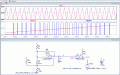
Added: Overlay of 'tri' signal at 0% and 100%.

ESP_ 09.png
 
Last edited:
Top