5 Pin Automotive Relay Question

Tonyr1084

Joined Sep 24, 2015
9,744
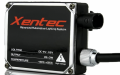
Just a note for others here, not the TS, a common Halogen bulb will not wink out during switching. Well, actually it will wink a little, but the wink will be so fast and so minimal it won't be noticed without sophisticated sensing equipment. A Halogen bulb is what the TS drew. This is an HID (High Intensity Discharge) lamp: It has no filaments, just a spark gap inside a gas filled glass bulb encapsulated in a glass tube. A ballast is required to provide sufficient voltage to bridge the gap. Once lit the current or voltage is probably modulated to some lower level. It's that high draw at startup the TS may be wanting to avoid when switching power sources.
1699024111575.png
 

crutschow

Joined Mar 14, 2008
38,549
A large capacitor (likely in the neighborhood of 25mF or more) from the lamp input to ground should solve the problem.
A small resistor in series with the capacitor may be needed to reduce the initial surge current.
 

Tonyr1084

Joined Sep 24, 2015
9,744
How much current the bulb takes is irrelevant because HID is powered via a ballast. Since the kits are rated at 35 and 55 watts, I'd assume that's how much power each kit draws.
Clarification: I BELIEVE 35 watts is an individual ballast. I don't know for sure if 35 watts is divided between TWO ballasts.
25mF or more) from the lamp input to ground
I believe you mean the ballast input, not the bulb input; as likely the HID bulb operates at a considerably higher voltage. The kits come with the caution not to contact the bulb output due to the presence of high voltages.
 

eetech00

Joined Jun 8, 2013
4,709
That's what I figured you meant. The TS mentioned:

To me that indicated a 3rd 12 volt source which is used to power the bulb and the other two 12 volt sources control the relay coil.
If that is true and not wanting to use diodes than 2 relays would suffice or 1 relay coil controlled by two transistor in parallel to isolate the the 12 volt sources

View attachment 306587
View attachment 306589
Hi shigoto

Sorry, but I still don't see how that will prevent an interrupt of power to the lamp.
 

Tonyr1084

Joined Sep 24, 2015
9,744
1699035334076.png
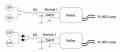
Method 1 requires a user to switch between power sources.
Method 2 will power the HID from either source or both sources simultaneously.
 

panic mode

Joined Oct 10, 2011
5,037
Yes, by lamp input I meant the lamp assembly input (the ballast).
correct, HID require high voltage to ignite and few tens of volts to operate. all power switching would be before ballast, at the 12V side. and for that current draw would determine suitable circuit, Diode OR circuit would make transition instantaneous. the ballast would see it as a small step in the supply.

diodes cause voltage drop. so do the issue is of efficiency.
adding RC filter after diodes would further drop the voltage.

35W variant would draw some 3A, With 4Ohm inline resistor there would be nothing left for the ballast or HID unless supply was somehow increased from 12V to 24V. i do not see it practical in this case to use any inline resistor.
 

panic mode

Joined Oct 10, 2011
5,037
Method 1 requires a user to switch between power sources.
Method 2 will power the HID from either source or both sources simultaneously.
Method 1 will cause the power glitch that may be noticeable in light output. the good side is that there is no voltage drop
Method 2 should eliminate blackout that user reported (instantaneous switching) but it will have voltage drop on the diode. this could be reduced using MOSFETS for switching
 

ThePanMan

Joined Mar 13, 2020
933
My understanding of HID and automotive electricity is this: A battery that has not been charged in 12 hours will have a voltage depending on how old it is between 12 and 12.6 volts. When the engine is running and the battery has had a full charge the voltage will float at around 13.8 volts. A diode drop won't cause any irregular heartbeat for the ballast. It probably operates anywhere from 10V to 16V. Maybe even higher. I'm going to research it.
 

ThePanMan

Joined Mar 13, 2020
933
Ballast Size Slim Slim Standard Plus Standard Slim Compact
Wattage 45W +/-2 35W +/- 3 55W +/-3 35W +/-3 55W +/-3 35W +/-3
Input Range 9-24V 9-16V 9-24V 9-16V 9-16V 9-16V
Material Stainless Steel Alloy Alloy Alloy Alloy Composit
Built-in Canbus Driver
Color White White White White White White
Bulb Size 9006 9006 9006 9006 9006 9006
Max light output (lumen) 3800lm 3000lm 4000lm 3000lm 3800lm 2800lm
 

MisterBill2

Joined Jan 23, 2018
27,683
What is the intended purpose of the insertion of the relay to change power sources??
If the TS is able and willing to explain the actual intent then a few more useful suggestions may arrive,
 

MisterBill2

Joined Jan 23, 2018
27,683
View attachment 306615
Method 1 requires a user to switch between power sources.
Method 2 will power the HID from either source or both sources simultaneously.
At four amps that four ohm resistor will provide quite a voltage drop, but because the current will drop with the voltage it will not be a calculated 16 volt drop.
ALSO, that driver for an HID light may not really be a ballast device.
 
Top