4-bit adder. Carry out problem.

Thread Starter

Mr.Alan

Joined Aug 15, 2016
14
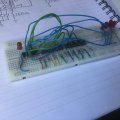
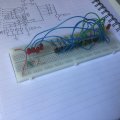
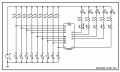
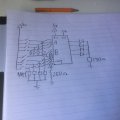
I want to experiment with digital electronics but i have a problem When im experimenting with SN74LS283N. It does not matter how i connect the circuit but it always the red l.e.d on the carry glows but When i press the Buttons nothing happends. What did i do wrong?IMG_0210.JPGIMG_0211.JPGIMG_0212.JPG
 

Papabravo

Joined Feb 24, 2006
22,082
You don't have the pin numbers on your diagram. This is a SERIOUS mistake. How can you check your wiring against the schematic. Is the carry pin on the left side of your symbol an input or an output?
Two more things:
  1. LS TTL inputs source current. DON'T use pulldown resistors. Pulldown resistors only work reliably for CMOS devices.
  2. LS TTL outputs will sink way more current than they can source. Do not attempt to drive grounded loads with an LS TTL output!
 

Thread Starter

Mr.Alan

Joined Aug 15, 2016
14
You don't have the pin numbers on your diagram. This is a SERIOUS mistake. How can you check your wiring against the schematic. Is the carry pin on the left side of your symbol an input or an output?
Two more things:
  1. LS TTL inputs source current. DON'T use pulldown resistors. Pulldown resistors only work reliably for CMOS devices.
  2. LS TTL outputs will sink way more current than they can source. Do not attempt to drive grounded loads with an LS TTL output!
Thx a lot for the advice i did not know that!
 

GenJacks

Joined May 15, 2016
19
You don't have the pin numbers on your diagram. This is a SERIOUS mistake. How can you check your wiring against the schematic. Is the carry pin on the left side of your symbol an input or an output?
Two more things:
  1. LS TTL inputs source current. DON'T use pulldown resistors. Pulldown resistors only work reliably for CMOS devices.
  2. LS TTL outputs will sink way more current than they can source. Do not attempt to drive grounded loads with an LS TTL output!


This is a good answer. Worth sharing too for others to see.
 

EM Fields

Joined Jun 8, 2016
583
PIN NUMBERS?!!?
As you note, "Life is too short to sweat the small stuff."
The notations on the drawing serve to identify the chip's logic functions which is, in my opinion, all that's required for a conceptual disclosure.

If someone needs to identify the chip's pinout in order to, say, actually build the circuit, then the legwork is on the builder and there are data sheets with that data available for the asking.
 

Papabravo

Joined Feb 24, 2006
22,082
As you note, "Life is too short to sweat the small stuff."
The notations on the drawing serve to identify the chip's logic functions which is, in my opinion, all that's required for a conceptual disclosure.

If someone needs to identify the chip's pinout in order to, say, actually build the circuit, then the legwork is on the builder and there are data sheets with that data available for the asking.
You remind me of those authors who say: "The details are left as an exercise for the reader". It is just a matter of having a capture program that gives you what you want. Even when I used hand drawn schematics I always put the pin numbers on so I wouldn't have to go hunt up a datasheet or a databook. That was in the days before the internet, and I guess old habits die hard.
 
Top