3PDT switch pop

Thread Starter

rpschultz

Joined Nov 23, 2022
833
Hi,

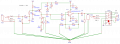
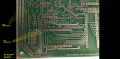
I have a guitar circuit I've been working on. Newest iteration has switch pop that I didn't have before - this is usually considered DC offset across the switch hitting the audio path. I've simplified the circuit to just the below, a JFET and buffer. The switch is simply wired as a test case, to pass signal or mute. I've tried different values of R11. Initially had nothing, then 1M, lastly 10k. The 10k worked for a few seconds but eventually the charge built up and wouldn't go away.

In a previous iteration, JK1 went directly to the switch, and then the JFET, buffer and rest of circuit. But to cut down on noise pickup I wanted the JFET as close to the jack as possible so I rearranged the routing as such. I'm not sure if that's related to the switch pop or not. But the previous version doesn't have switch pop.

I'm not sure what to do next. (Disclaimer, I'm a mechanical engineer, not EE)
Any ideas?
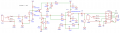
1780777252388.png

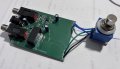
IMG_8182.jpeg
 
Last edited:

MisterBill2

Joined Jan 23, 2018
27,618
It may be that charge: " eventually the charge built up "??? The charge ON WHAT???
Aside from that, you are switching the relay coil current inside the same relay that is switching the AUDIO SIGNAL. ALSO, you are switching an audio line between a coupling capacitor and a solid ground. Two probable sources of a dc offset.
In addition, the relay coilcurrent is flowing thru the signal output ground. That is always a source of a DC voltage. AND, besides that, the relay connection thru the NC contact will assure that it acts like a buzzer when the relay coil is operated.
 
Last edited:

Thread Starter

rpschultz

Joined Nov 23, 2022
833
Turns out it was leakage through the electrolytic c10. Changed it to a 2.2u film, problem solved.

I don’t have a relay. The switch is a mechanical 3PDT.

But c10 is a coupling cap as you say, is that the right configuration for it?
 

MisterBill2

Joined Jan 23, 2018
27,618
Turns out it was leakage through the electrolytic c10. Changed it to a 2.2u film, problem solved.

I don’t have a relay. The switch is a mechanical 3PDT.

But c10 is a coupling cap as you say, is that the right configuration for it?
The symbol for the switch looks like a relay to me. So thatis the reason for my comment.
Experimenting wiith the value of resistor R11 may help, and a smaller value of capacitor C10 might still allow adequate frequency response.
 

MisterBill2

Joined Jan 23, 2018
27,618
My experience is that ANY mechanical contacts in a low llevel audio line will add a bit of a click. There is a "clickless" switching scheme that uses a photo-resistor and a controlled light source. that is claimed to be clickless.
 

Thread Starter

rpschultz

Joined Nov 23, 2022
833
My experience is that ANY mechanical contacts in a low llevel audio line will add a bit of a click. There is a "clickless" switching scheme that uses a photo-resistor and a controlled light source. that is claimed to be clickless.
I looked into this, using an LDR and vactrol style optocoupler. I've used these in compressors, but hadn't considered them as a swtich. I'll put this on my list to prototype. Thanks for the tip.
 

panic mode

Joined Oct 10, 2011
5,011
the switch is indeed represented like a relay rather than illuminated switch. this should clear confusion.


1781640710212.png
what schematic does not show is where is the +9V for the switch LED coming from, and how is that referenced to rest of the circuit.
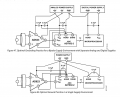
it would also be a good idea to inspect how AGND is routed. this should be star connection - with all AGND connections joining in just one point.
if there is a DGND as well, that too will have to connect as a single ray to the AGND star. in this case LED circuit for the FSW1 is a concern.
to confirm that is the case, look at the gerber files would be needed.
1781641417743.png

here are some examples:
1781641634479.png
1781642341368.png
 

eetech00

Joined Jun 8, 2013
4,709
Hi,

I have a guitar circuit I've been working on. Newest iteration has switch pop that I didn't have before - this is usually considered DC offset across the switch hitting the audio path. I've simplified the circuit to just the below, a JFET and buffer. The switch is simply wired as a test case, to pass signal or mute. I've tried different values of R11. Initially had nothing, then 1M, lastly 10k. The 10k worked for a few seconds but eventually the charge built up and wouldn't go away.

In a previous iteration, JK1 went directly to the switch, and then the JFET, buffer and rest of circuit. But to cut down on noise pickup I wanted the JFET as close to the jack as possible so I rearranged the routing as such. I'm not sure if that's related to the switch pop or not. But the previous version doesn't have switch pop.

I'm not sure what to do next. (Disclaimer, I'm a mechanical engineer, not EE)
Any ideas?
View attachment 368077

View attachment 368073
You have three mechanical switched devices, 2 jacks and 1 switch.
Under what switch condition(s) is the "pop" heard?
 

eetech00

Joined Jun 8, 2013
4,709
Hi,

I have a guitar circuit I've been working on. Newest iteration has switch pop that I didn't have before - this is usually considered DC offset across the switch hitting the audio path. I've simplified the circuit to just the below, a JFET and buffer. The switch is simply wired as a test case, to pass signal or mute. I've tried different values of R11. Initially had nothing, then 1M, lastly 10k. The 10k worked for a few seconds but eventually the charge built up and wouldn't go away.

In a previous iteration, JK1 went directly to the switch, and then the JFET, buffer and rest of circuit. But to cut down on noise pickup I wanted the JFET as close to the jack as possible so I rearranged the routing as such. I'm not sure if that's related to the switch pop or not. But the previous version doesn't have switch pop.

I'm not sure what to do next. (Disclaimer, I'm a mechanical engineer, not EE)
Any ideas?

View attachment 368077

View attachment 368073
You can also try changing C10 to a non-polar capacitor (It's passing audio so shouldn't be polar anyway).
 

Thread Starter

rpschultz

Joined Nov 23, 2022
833
You can also try changing C10 to a non-polar capacitor (It's passing audio so shouldn't be polar anyway).
Right. Solution in post #3 was to use a film cap, highest I had was 2.2u. Polarized caps leak dc current, film caps do not. I didn’t know that at the time, but someone off forum suggested that might be it.
 

Thread Starter

rpschultz

Joined Nov 23, 2022
833
the switch is indeed represented like a relay rather than illuminated switch. this should clear confusion.


View attachment 368419
what schematic does not show is where is the +9V for the switch LED coming from, and how is that referenced to rest of the circuit.
it would also be a good idea to inspect how AGND is routed. this should be star connection - with all AGND connections joining in just one point.
if there is a DGND as well, that too will have to connect as a single ray to the AGND star. in this case LED circuit for the FSW1 is a concern.
to confirm that is the case, look at the gerber files would be needed.
View attachment 368422
I've always understood STAR grounding for perf board and wired projects, like amps where there's a lot of wires going here or there. But I don't understand how STAR applies to a multi layered PCB with ground planes. I started a new thread on my ground plane dilemma. Feel free to chime in.
Thanks!
 
it is simple really... you want to avoid effects of one circuit on another.

different strategies exist...

using star ground removes possibility of "floating ground" that changes potential based on current draw in some other circuit. this approach does not care about ohmic resistance of individual branch ("ray"). it works very well even if ohmic resistance of the branches is different... and even significant. in essence, this is the same principle used by Kelvin connection. it is based on idea that no conductor is perfect, even short and thick piece of metal has resistance.... and that resistance need to be taken into account or designed out by proper strategy.
 
Top