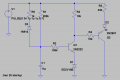
Q1 starts to conduct when the capacitor reaches 18+0.6v (nominal). that pulls down Q2's base so the load is turned on.
The issues are as we discussed earlier:
1) the fully 34v goes onto the load;
2) the circuit does not react to quick supply losses: as the capacitor cannot be discharged through R1 fast enough.
both can be cured in a variety of ways depending on your design goals.
on the 24v relay vs. 34v rail: if you move the relay to Q2's emitter (vs. collector now), you just need to clamp Q2's base to 10v so the load will see 34v-10v = 24v.
To do that, use a 10v zener instead of a 18v zener.
To compensate for it, double R1 to 200K to maintain the same timing behavior.
that saves you a zener, at the expense of increased power dissipation of Q2 -> its Vce = 10v now so power dissipation = 60ma * 10v = 600mw.
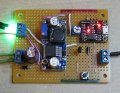
Thinking back to the suggestion to stick with a micro-controller, maybe using two zeners and a linear regulator would be a cleaner solution. One zener for 24V and the other for 7V, regulated down to 5V. That might take up less room on the control board. The buck converter is a bit "bulky." Here is my prototype which is being used right now.
the answer relies on the mcu's current consumption.
most avrs mcu can run at 1Mhz. with a 8:1 prescaler. and in this case, it has a 128khz internal clock -> more than enough for what you are trying to do. At that, your current consumption will be less than 1ma. That allows you to easily power the mcu off with a resistor + a couple leds.
obviously, the relay will have to be driven with a driver, like a npn or nmos (2n7000 for example).
it should take much less space than your current set-up.
to continue on the analog delay-on timer, here is what I would do:
it follows the basic design, with two changes:
1) the additional of D3/R6 to deplete C1 in case the rail voltage is lost; the value / parts aren't that critical;
2) moving the load (R5/D2 to the emitter) to achieve a 24v driving voltage on the load. Resizing D1 accordingly.
all pre-cautions noted earlier apply. I would use a to220 as Q2 - the metal tab serves as a heatsink. or at least to126 devices (bd140 for example).
if you use a pmos for Q2, D2 could be a small voltage zener or a couple of LEDs.
I was about to build a test circuit, but then I looked at the simulation and wondered, would the first transistor turn on quick enough by itself to engage the relay cleanly? Is 112ms too slow? I guess 28ms is a bit better.
EDIT: Started to build the first part of the circuit. Just the first resistor and capacitor. Then I found that the filter capacitor interfered with it. Basically ended up being two caps in parallel. Pulled the power plug and the voltage kept going up at what would be the base of the first transistor! hehe Then I reminded myself that the original circuit worked by completing the connection to ground, not by switching +V off. So, yeah, it doesn't work like in the simulation, switching pure DC on and off.

 Facebook
 Google
 GitHub
 Linkedin