3 phase terminology, semantics

Thread Starter

ebeowulf17

Joined Aug 12, 2014
3,307
If you use three different phases, but you're only putting loads between phase and neutral (never phase to phase) are you really using 3-phase power?

I'm curious about this because we make machines that draw up to 50 amps at 240V single phase (or split phase - the machine doesn't know the difference.) We've had a number of customers over the years do "3-phase" conversions on them, but the descriptions of what they were doing mystified me for a long time.

I'm used to North American non-industrial power, where you've basically got 208-240VAC available no matter which of several common scenarios you encounter:
  • Split phase: 2 x 120 = 240
  • Common 3 phase, using two legs phase to phase: 2 x 120 (with 120deg phase diff) = 208
  • High leg delta, any two legs, either 90 or 180deg phase diff = 240
  • High leg delta, high leg to neutral = 208
What these Australians (and a few others) have is 240/415V 3 phase, so if they put any two lines across a load in our machine, it's fried instantly.

What they do instead is bring all three lines and the neutral into our machine, then divide the various heating circuits so that each line only feeds 15-18A max through a load to neutral.

They get the same total power into the machine, but with smaller conductors and smaller breakers (albeit requiring two extra conductors.) Apparently 40-50A circuits are rare and expensive there, but 3 phase at ~15-20A is ubiquitous, so this conversion is quite popular.

Once I understood the nature of their power system, I understood the conversion they were wanting, but when my coworkers first described it to me as a 3 phase conversion, it confused the &@$?% out of me - I thought that would mean using the various phases with each other, not just with the neutral. In the conversion they're doing, they only ever use the 240V line voltage, not the 415V you'd get between two lines.

The confusion was GREATLY exacerbated by the fact that my coworkers mostly don't understand 3 phase power at all and kept talking about voltage combinations that don't exist there - saying that there would be 480V between any 2 lines of Australian 240, when in fact there would be 415 because of the phase difference. I might've grasped things sooner if the voltages had all been described accurately in the first place.

Anyway, I'd appreciate any thoughts on how best to describe this type of conversion, and what is usually meant by various terminology related to 3 phase power.
 

Dodgydave

Joined Jun 22, 2012
11,395
In Europe the 3 phase system is 415V phase to phase and 230V phase to Neutral.

If you only use any phase and neutral then it's just a single phase supply.
 

Thread Starter

ebeowulf17

Joined Aug 12, 2014
3,307
In my country we theoretical have 230V/400V but in practice it is around 240V/415V (TN-C-S).
And we also used 3 individual phases ( L1 - N , L2 - N, L3 - N) and we are trying to load them symmetrically.
Only for heavy loads are using "3-phase power" lika Induction cooking, central water heating e.t.c

look here for more info
https://en.wikipedia.org/wiki/Earthing_system#Types_of_TN_networks
Yes, at this point I'm pretty comfortable with my understanding of the voltages and their relationships - it's just the terminology and ability to communicate about it that I'm interested in.

If you use three individual phases in one device, each one working line-neutral, do you consider that three phase operation or just three separate single phase supplies in one machine?
 

Jony130

Joined Feb 17, 2009
5,598
For the domestic users (at home) it is a "single phase".
But in the plant, inside machine control box cabinet, the "3-phase power " is coming. And we connect a "single phase" load to it.
 

MaxHeadRoom

Joined Jul 18, 2013
30,657
If you use three different phases, but you're only putting loads between phase and neutral (never phase to phase) are you really using 3-phase power?


  • Common 3 phase, using two legs phase to phase: 2 x 120 (with 120deg phase diff) = 208
What these Australians (and a few others) have is 240/415V 3 phase, so if they put any two lines across a load in our machine, it's fried instantly.

.
Phase to phase only is 1ph 180°.
Countries such as UK Australia and others, use a 3phase star 415, with 230v to neutral and residential service used the neutral to phase, with every so many number of residences each sharing one phase.
N.A. 240v equipment will operate on Australia service with no problem, unless the equipment is sensitive to 50Hz from 60Hz change.
Max.
 

Thread Starter

ebeowulf17

Joined Aug 12, 2014
3,307
N.A. 240v equipment will operate on Australia service with no problem
Right, we've been selling machines worldwide since years before I started with the company, and we know it'll work fine on the Australian and European 230-240V, 50Hz.

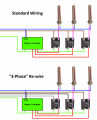
It's just the question of using all three phases in one machine that I find odd. I feel like my explanation isn't working, so here's an image to illustrate the basic concept.

three-phase-rewire_A-B.png

Each machine that gets rewired in this new configuration has all three phases in it, but individual loads within the machine only operate from 240V from a single phase to neutral. I'm curious if it's considered normal "single-phase" operation (or normal with some other name) to run a machine this way, or if this is considered bad form. Even if it is acceptable, I wouldn't expect to call it "three phase," but that's what it's been described as for as long as I've been with the company.
 
I think I could define it better for you: Three phase resistive heating.

You can cut the wire size down and that's a good thing. There may not be a lot of 3-phase panels in a lab. I'm in the US and where I worked had like 36 heat pumps run at something like 460 3-phase. Nothing else did. All of that fed back to motor starters back in the electrical room. So, just the HVAC system was the higher voltage.
We had two 3 phase 208 panels and one was full. One was for a machine shop that had a higher voltage feed stepped down to 208.

One piece of equipment required 200 A, 3 phase 208 service and this was basically an entire sub-panel feed.

We two electron beam guns. The single one required 60 A, 208 3 phase and the 3-gun 90 A 208 3-phase.
Internally, you could, but would not want to operate it on single phase. The 3-phase, got the machine around 15 kV at 1.5 Amps DC. Taps were available for various voltages like 208/240.

We had a German research form that used German furnaces. They had a problem and they required 240 V. 208 would not work. They got 240 V power.

We had some equipment that had heaters. They had to be changed from 240 to 208 when we moved.

This http://www.thermalcorporation.com/3-phase-industrial-heaters/ may explain why.
 
Last edited:

Thread Starter

ebeowulf17

Joined Aug 12, 2014
3,307
I think I could define it better for you: Three phase resistive heating.

You can cut the wire size down and that's a good thing. There may not be a lot of 3-phase panels in a lab. I'm in the US and where I worked had like 36 heat pumps run at something like 460 3-phase. Nothing else did. All of that fed back to motor starters back in the electrical room. So, just the HVAC system was the higher voltage.
We had two 3 phase 208 panels and one was full. One was for a machine shop that had a higher voltage feed stepped down to 208.

One piece of equipment required 200 A, 3 phase 208 service and this was basically an entire sub-panel feed.

We two electron beam guns. The single one required 60 A, 208 3 phase and the 3-gun 90 A 208 3-phase.
Internally, you could, but would not want to operate it on single phase. The 3-phase, got the machine around 15 kV at 1.5 Amps DC. Taps were available for various voltages like 208/240.

We had a German research form that used German furnaces. They had a problem and they required 240 V. 208 would not work. They got 240 V power.

We had some equipment that had heaters. They had to be changed from 240 to 208 when we moved.

This http://www.thermalcorporation.com/3-phase-industrial-heaters/ may explain why.
It sounds like your examples are using heating elements in what I would consider the normal, real, standard 3 phase arrangement, where each leg of the heating element is between two lines, or phases, and the neutral doesn't play a role. In the conversion shown above, each element is a separate entity, running from one line to neutral. Nothing is running line to line.

That's what's weird to me. We make a machine that expects 240V (really 200-250 is fine.) For most of the world outside of North America, that means using just one line and one neutral. But in Australia, many of our users are running three separate lines into the machine (L1, L2, L3) and feeding different heating elements off of each line - BUT STILL LEAVING THE OTHER SIDE OF THE ELEMENT CONNECTED TO NEUTRAL.

So, I don't think this is the same as what you're describing - if it were like your examples the elements would be like this:
Element 1: L1-L2 (415V)
Element 2: L2-L3 (415V)
Element 3: L3-L1 (415V)

What they're doing is:
Element 1: L1-N (240V)
Element 2: L2-N (240V)
Element 3: L3-N (240V)
 

Jony130

Joined Feb 17, 2009
5,598
But in Australia, many of our users are running three separate lines into the machine (L1, L2, L3) and feeding different heating elements off of each line - BUT STILL LEAVING THE OTHER SIDE OF THE ELEMENT CONNECTED TO NEUTRAL.
Why is it strange to you ? This is a normal and logical situation. The distribution box is 3-phase already, So 5-wire cables (L1 , L2 L3 , N , PE) are standard ones.
And this cable is use to connect the distribution box with the machine. So in the machine we already have 3P + N + PE (no additional work is needed ). So why not "equality" load the phases.
See the example schematic
 

Attachments

Last edited:

MaxHeadRoom

Joined Jul 18, 2013
30,657
@ebeowulf17 There are two methods of applying 1ph phase loads to a 3ph source.
One is from a Delta secondary transformer and each element is connected from phase to phase.
With a Star secondary, you have two options depending on the voltage rating of the load, either each load from phase to neutral, or each load from phase to phase.
Max.
 

Janis59

Joined Aug 21, 2017
1,894
Most of Europe uses 220/380 V network (except England with it`s "left handed" 240/415 V;
that means:
1) between EACH of 3 phases are 380V but the phase are shifted by 120 grades, therefore may not use the any one-phase combination for three phase load. May freely uze if one phase load if 380 V.
More specific: A to B=380, B to C=380, C to A=380
2) between ANY phase wire versus gnd exsist 220 V. The same way, 120 grades and one phase network may not substitute all three (this case four) wires. May freely use if one-phase load of 220V.
more specific: A to gnd=220; B to gnd=220; C to gnd=220, but A to B is 380 instead of zero and the same B-C and C-A
3) after full wave rectifier between phase and gnd exist 311 V, but the capacitor is mandatory for such voltage
4) after three-phase full wave rectifier between phases exist 535 V, but capacitor is needed.
5) "Old system" what was condemned about 1955 and last transformers was utilized about 1990 was 220/127 V what means between phases 220 and from phase to gnd 127 V. But forget about prehistoric memories.
 
The terminology doesn't matter. The need of a neutral does. Not everyone has 3 phase easily available.

The idiots (managers) that specified our new building said the equipment need 240, V 50 A and that;s what they got. but for all of those machines they forgot that the 240 V needed a neutral. A big Oops. 3-phase with neutral is not a common configuration in the US. It's easy to pull, but a 3-phase motor does not need a neutral. Controls are usually provided from a control transformer or in the case of PLC controlled stuff 24 VDC.

A piece of equipment added later was 3 phase with a circuit breaker in the neutral on the equipment.
Permitted, but very odd.

Asides:
The engineers for the building were a "little off" too. They expected to use a 6 PSI 90 F cooling loop with a booster pump to pump a system that was designed to pump groundwater at about 40 PSI through a 3/8 cooling line. That didn't work either.

The builders had their own problems. To pour an "isolated concrete pad", they poured everything and then broke up where the isolated pad should go and poured that.

Floor plans didn't show support posts, and sometimes equipment was supposed to go there.
 

Hymie

Joined Mar 30, 2018
1,347
If you use three different phases, but you're only putting loads between phase and neutral (never phase to phase) are you really using 3-phase power?

I'm curious about this because we make machines that draw up to 50 amps at 240V single phase (or split phase - the machine doesn't know the difference.) We've had a number of customers over the years do "3-phase" conversions on them, but the descriptions of what they were doing mystified me for a long time.

I'm used to North American non-industrial power, where you've basically got 208-240VAC available no matter which of several common scenarios you encounter:
  • Split phase: 2 x 120 = 240
  • Common 3 phase, using two legs phase to phase: 2 x 120 (with 120deg phase diff) = 208
  • High leg delta, any two legs, either 90 or 180deg phase diff = 240
  • High leg delta, high leg to neutral = 208
What these Australians (and a few others) have is 240/415V 3 phase, so if they put any two lines across a load in our machine, it's fried instantly.

What they do instead is bring all three lines and the neutral into our machine, then divide the various heating circuits so that each line only feeds 15-18A max through a load to neutral.

They get the same total power into the machine, but with smaller conductors and smaller breakers (albeit requiring two extra conductors.) Apparently 40-50A circuits are rare and expensive there, but 3 phase at ~15-20A is ubiquitous, so this conversion is quite popular.

Once I understood the nature of their power system, I understood the conversion they were wanting, but when my coworkers first described it to me as a 3 phase conversion, it confused the &@$?% out of me - I thought that would mean using the various phases with each other, not just with the neutral. In the conversion they're doing, they only ever use the 240V line voltage, not the 415V you'd get between two lines.

The confusion was GREATLY exacerbated by the fact that my coworkers mostly don't understand 3 phase power at all and kept talking about voltage combinations that don't exist there - saying that there would be 480V between any 2 lines of Australian 240, when in fact there would be 415 because of the phase difference. I might've grasped things sooner if the voltages had all been described accurately in the first place.

Anyway, I'd appreciate any thoughts on how best to describe this type of conversion, and what is usually meant by various terminology related to 3 phase power.

Something else that that might help you is the convention used when specifying equipment three phase ratings.

Where an end user converts a single phase machine to 3 phase; with each phase loaded to neutral (star) – what was a 240V, 50A rating will now be assigned 415V, 16.7A (assuming a balanced load between phases).

What is important to appreciate is where the load is not balanced, then the 3 phase rated current is highest of the phases – this is to ensure that the installation has adequately rated wiring for the current drawn.
 

Thread Starter

ebeowulf17

Joined Aug 12, 2014
3,307
Where an end user converts a single phase machine to 3 phase; with each phase loaded to neutral (star) – what was a 240V, 50A rating will now be assigned 415V, 16.7A (assuming a balanced load between phases).
Thanks! I've been hung up on the terminology, and feeling frustrated and misunderstood a little on that front, but this was going to be my next question.

So, even though no single load in the machine is seeing more than 240V across it, since there's the potential for 415V between various points (if something were mis-wired, or if an accident or part failure occurred) the machine as a whole is now considered 415V, right?

That makes a lot of sense to me, and it was one of my concerns. When it's just random end users in the field doing these conversions, it's not a regulatory issue for us... but if we ever sold a machine in this configuration, we'd need to label it as 415V or more, and pass UL, CSA, CE, etc. at the higher voltage standards. Does that sound right?

Thanks again.
 
Comment:

To make it easier for you, you could just install a 3-phase breaker for everyone and essentially keep the wiring nearly the same. I'm thinking about something like DIN terminal blocks that would be bussed for single phase, or effectively use two blocks. So, it;s just a "slight" wiring change. Maybe you already have that.

Just make it so all of the power gets changed at one spot with a few wire moves if possible.

If you needed the control circuit to trip use a breaker with contacts and shunt trip. It's likely that a heater opens rather than shorts.
 

MrAl

Joined Jun 17, 2014
13,702
If you use three different phases, but you're only putting loads between phase and neutral (never phase to phase) are you really using 3-phase power?

I'm curious about this because we make machines that draw up to 50 amps at 240V single phase (or split phase - the machine doesn't know the difference.) We've had a number of customers over the years do "3-phase" conversions on them, but the descriptions of what they were doing mystified me for a long time.

I'm used to North American non-industrial power, where you've basically got 208-240VAC available no matter which of several common scenarios you encounter:
  • Split phase: 2 x 120 = 240
  • Common 3 phase, using two legs phase to phase: 2 x 120 (with 120deg phase diff) = 208
  • High leg delta, any two legs, either 90 or 180deg phase diff = 240
  • High leg delta, high leg to neutral = 208
What these Australians (and a few others) have is 240/415V 3 phase, so if they put any two lines across a load in our machine, it's fried instantly.

What they do instead is bring all three lines and the neutral into our machine, then divide the various heating circuits so that each line only feeds 15-18A max through a load to neutral.

They get the same total power into the machine, but with smaller conductors and smaller breakers (albeit requiring two extra conductors.) Apparently 40-50A circuits are rare and expensive there, but 3 phase at ~15-20A is ubiquitous, so this conversion is quite popular.

Once I understood the nature of their power system, I understood the conversion they were wanting, but when my coworkers first described it to me as a 3 phase conversion, it confused the &@$?% out of me - I thought that would mean using the various phases with each other, not just with the neutral. In the conversion they're doing, they only ever use the 240V line voltage, not the 415V you'd get between two lines.

The confusion was GREATLY exacerbated by the fact that my coworkers mostly don't understand 3 phase power at all and kept talking about voltage combinations that don't exist there - saying that there would be 480V between any 2 lines of Australian 240, when in fact there would be 415 because of the phase difference. I might've grasped things sooner if the voltages had all been described accurately in the first place.

Anyway, I'd appreciate any thoughts on how best to describe this type of conversion, and what is usually meant by various terminology related to 3 phase power.
Hi,

We usually call the wire to wire voltage the "line to line" voltage, which means across two lines not using the neutral. We then call the single phase of a wye system the "line to neutral" voltage. So here we might have 120vac line to neutral, but 208vac line to line.

Once of the differences in 3 phase wye (which is three lines and a single neutral) as compared to three separate phases is the 3 phase system has 4 wires and three separate phases would have 6 wires.
Yes three of them are neutral, so the voltages are (almost) the same. But with only one neutral you have only imbalance current in the neutral wire. In the 3 separate single phase system you have current in all three neutrals, at least until they get back to the breaker box.

So do this:
Calculate the current in all three neutrals of the 3 single phase circuits which will have neutral wires that extend all the way back to the breaker box.
Now later connect the three neutrals together AT THE LOAD and recalculate the current in the (now) one wire that is now the neutral wire.
Compare results, current in three neutrals vs the current in the one neutral.
You may be surprised a little if you've never done this before.
BTW used a balanced 3 phase load to start, or just 3 resistive loads of the same value ofr each phase.
This little experiment will show the difference between a 3 phase system and 3 completely separate phases.
 

Thread Starter

ebeowulf17

Joined Aug 12, 2014
3,307
Comment:

To make it easier for you, you could just install a 3-phase breaker for everyone and essentially keep the wiring nearly the same. I'm thinking about something like DIN terminal blocks that would be bussed for single phase, or effectively use two blocks. So, it;s just a "slight" wiring change. Maybe you already have that.

Just make it so all of the power gets changed at one spot with a few wire moves if possible.

If you needed the control circuit to trip use a breaker with contacts and shunt trip. It's likely that a heater opens rather than shorts.
I'm sincerely hoping we ultimately choose not to offer this as an option, but if we do I'll keep those ideas in mind.

I hadn't thought of reconfiguring the standard wiring to centralize the changes, and make switching easy, but I really like that idea.

As for breakers, I'll have to give that a little more thought to wrap my head around things.
 
Top