Facebook
 Google
 GitHub
 Linkedin
If you use three different phases, but you're only putting loads between phase and neutral (never phase to phase) are you really using 3-phase power?
I'm curious about this because we make machines that draw up to 50 amps at 240V single phase (or split phase - the machine doesn't know the difference.) We've had a number of customers over the years do "3-phase" conversions on them, but the descriptions of what they were doing mystified me for a long time.
I'm used to North American non-industrial power, where you've basically got 208-240VAC available no matter which of several common scenarios you encounter:
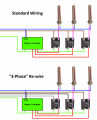
What they do instead is bring all three lines and the neutral into our machine, then divide the various heating circuits so that each line only feeds 15-18A max through a load to neutral.
They get the same total power into the machine, but with smaller conductors and smaller breakers (albeit requiring two extra conductors.) Apparently 40-50A circuits are rare and expensive there, but 3 phase at ~15-20A is ubiquitous, so this conversion is quite popular.
Once I understood the nature of their power system, I understood the conversion they were wanting, but when my coworkers first described it to me as a 3 phase conversion, it confused the &@$?% out of me - I thought that would mean using the various phases with each other, not just with the neutral. In the conversion they're doing, they only ever use the 240V line voltage, not the 415V you'd get between two lines.
The confusion was GREATLY exacerbated by the fact that my coworkers mostly don't understand 3 phase power at all and kept talking about voltage combinations that don't exist there - saying that there would be 480V between any 2 lines of Australian 240, when in fact there would be 415 because of the phase difference. I might've grasped things sooner if the voltages had all been described accurately in the first place.
Anyway, I'd appreciate any thoughts on how best to describe this type of conversion, and what is usually meant by various terminology related to 3 phase power.
I'm curious about this because we make machines that draw up to 50 amps at 240V single phase (or split phase - the machine doesn't know the difference.) We've had a number of customers over the years do "3-phase" conversions on them, but the descriptions of what they were doing mystified me for a long time.
I'm used to North American non-industrial power, where you've basically got 208-240VAC available no matter which of several common scenarios you encounter:
- Split phase: 2 x 120 = 240
- Common 3 phase, using two legs phase to phase: 2 x 120 (with 120deg phase diff) = 208
- High leg delta, any two legs, either 90 or 180deg phase diff = 240
- High leg delta, high leg to neutral = 208
What they do instead is bring all three lines and the neutral into our machine, then divide the various heating circuits so that each line only feeds 15-18A max through a load to neutral.
They get the same total power into the machine, but with smaller conductors and smaller breakers (albeit requiring two extra conductors.) Apparently 40-50A circuits are rare and expensive there, but 3 phase at ~15-20A is ubiquitous, so this conversion is quite popular.
Once I understood the nature of their power system, I understood the conversion they were wanting, but when my coworkers first described it to me as a 3 phase conversion, it confused the &@$?% out of me - I thought that would mean using the various phases with each other, not just with the neutral. In the conversion they're doing, they only ever use the 240V line voltage, not the 415V you'd get between two lines.
The confusion was GREATLY exacerbated by the fact that my coworkers mostly don't understand 3 phase power at all and kept talking about voltage combinations that don't exist there - saying that there would be 480V between any 2 lines of Australian 240, when in fact there would be 415 because of the phase difference. I might've grasped things sooner if the voltages had all been described accurately in the first place.
Anyway, I'd appreciate any thoughts on how best to describe this type of conversion, and what is usually meant by various terminology related to 3 phase power.