Facebook
 Google
 GitHub
 Linkedin
Just thought of something else... what about suitable protection diodes for the MOSFETs? I have no idea about how to select some for this...
Cheers
Shaun
Cheers
Shaun

They are indeed ST Microelectronics... on the MOSFETs themsleves it says:That's a thought. I've been going by ST Microelectronics' datasheet for your MOSFETS; their part number is STP55NF06, their datasheet indicates it has built-in Zener diodes that would protect against both overvoltage and reverse EMF.
I've been going on the assumption that these are industry standard components.
Who is the manufacturer of the components you're actually using?
Right, so lamps it has to be then... I hope this is just for testing purposes? I can't quite see me having 16 headlamp bulbs inside the train![eta]
The reason for specifically using lamps is that they have a non-linear resistance; if the current flowing through them is low, they will act almost like a dead short. The higher the current through them gets, the more resistance they have. MOSFETS exhibit a similar characteristic on a much smaller scale; the hotter they get, the greater their resistance. This is completely opposite to most other semiconductors which generally decrease in resistance with increased temperatures. This can easily lead to the dreaded "thermal runaway" condition and meltdown of the components involved.
Ah, I could use copper... or I could use water cooling for a pc... in fact I can put a radiator in the front of the bonnet... I think about this.Meanwhile, I understand that space constraints are tight. However, using small aluminium (preferred UK spelling) angles will do next to nothing for dissipating MOSFET heat. The tab on your MOSFETS are most likely made of copper that is tin plated. Copper is one of the better metals for conduction of heat. Aluminium is roughly half as good at conducting heat as copper, but it's cheap. If you really are in a crunch for space, you might have to consider water cooling. Of course, this means everything will have to be water-tight.
Sure its http://manners.homelinux.com it hasn't been updated in quite some time! I'll try and get round to doing that this week.I think you posted the link of your train project before - but post it again, would you? I've lost it.
OK, good deal - we are indeed on the same page then!They are indeed ST Microelectronics... on the MOSFETs themselves it says:
P55 NF06 @
GK 2W4 V6
CHN 752
Yes indeed, it's just for testing. The whole idea is to protect your MOSFETS and alternator-turned-motor should current draw get out of hand.Right, so lamps it has to be then... I hope this is just for testing purposes? I can't quite see me having 16 headlamp bulbs inside the train!
Copper is roughly 1.7 times better at conducting heat than pure aluminium. Water is roughly 1.5 times better at conducting heat than copper is!Ah, I could use copper... or I could use water cooling for a pc... in fact I can put a radiator in the front of the bonnet... I think about this.
Good deal!Sure its http://manners.homelinux.com it hasn't been updated in quite some time! I'll try and get round to doing that this week.
Had you considered some type of a blower? I'm afraid that a standard PC fan just won't do. Perhaps a squirrelcage-type auto heater blower from the auto wrecking yard would do the trick. While you're in the heater section, might as well get a heater core too - you could use that for the radiator for the water-cooled electronic components ExcellentYes indeed, it's just for testing. The whole idea is to protect your MOSFETS and alternator-turned-motor should current draw get out of hand.
I went to a car breakers yard yesterday and spent some time removing headlamp bulbs from a huge collection of old headlamps! I kinda knew copper was better as thats why the best PC heatsinks are copper... but I used the ally as that was what I had to hand...Copper is roughly 1.7 times better at conducting heat than pure aluminium. Water is roughly 1.5 times better at conducting heat than copper is!
Nickel is far worse of a heat conductor than aluminium, worse than that is iron, and even worse yet is tin. For that reason, I suggest that instead of trying to solder copper tubing to a copper heatsink, that you fabricate your individual heatsinks from fairly thick flat or bar copper stock, and drill the water passage edgewise right through the sink. You might bore out either side a bit, and sweat-solder something like barb fittings in for the interconnecting plumbing. You wouldn't want to try to tap threads into it, as copper is so soft it will tear easily. Besides, you wouldn't want water leaks over your circuit board.
Perhaps you mean Farnell? yes they do it, as do number of other places.. in fact I have some from when I built my pc, its called ArcticSilver.Something else - have you been using heat sink compound? I don't know where you get it in the UK, perhaps Maplin or Ferrel (sp), but it's available at local Radio Shack stores here in the States. Comes in a small tube, looks like a ghostly-white paste. It makes the thermal bond between the semiconductor and heat sink much better.
oopsGood deal!
I did some poking around on there - happened to notice the PC heatsink that you machined down on the bottom so that it was flat. While the flatness may add to the asthetic appeal, I'm afraid that you diminished the efficiency of the heat sink by removing a fair portion of the "heat distribution channel", if you will - the bottom of the heat sink needs to be fairly thick to efficiently conduct the heat towards the radiating fins.
Yes... well the fins on the top of the engine will keep air moving, and the alternator has a fan ont he shaft which will be underneith the train blowing cold air up inside. Not sure if this would be enough.Oh, one other thing that hasn't been talked about - cooling for the alternator-turned motor. You'll need quite a bit of air moving through it to keep it from turning into a molten blob. Had you considered some type of a blower? I'm afraid that a standard PC fan just won't do. Perhaps a squirrelcage-type auto heater blower from the auto wrecking yard would do the trick. While you're in the heater section, might as well get a heater core too - you could use that for the radiator for the water-cooled electronic components
No I haven't...OK, before you power it up again...have you done something to improve the cooling on your power MOSFETS?
Whilst specatacular and quite fun... no I don't really want to do that again!I really don't want for you to have to go to the bother and expense of replacing another set of those MOSFETs, and I know you don't either.
I suggest the most rapid path to success is carefully going over all of the options prior to flipping the switch on; as that switch may yet again trigger the release of the magic smoke.
No, you need direct contact with the copper heatsink.No I haven't...
(snip)
So, water cooling then.. hmm there is a slight problem... the high side FETs will be ok, but when it comes to the low side, I cannot connect the heatsinks together as it will short out the three output phases as the case is connected to the drain... I could buy some insulating thingies.. but I assume the heat transfer wouldn't be anywhere near as good as having it directly in contact with the heatsink (and thermal paste)...
400Hz wouldn't be a bad choice. You'd be able to hear it, and it may prove tiresome after a while. If you were up around 25KHz or so, it would be out of the audible range. However, switching that fast may keep the MOSFETS in the linear (transition) region for too long. This is dependent upon your driver circuit, and the MOSFETs themselves.Going back to the frequency/inductance of the windings... what minimum frequency would you suggest? I am looking at about 400Hz would this be enough do you think?
Thats what I thought you'd sayNo, you need direct contact with the copper heatsink.
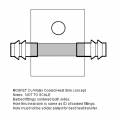
I have some 3/8" plastic tubing... so I'll be able to use that...I suggest that you need FOUR heatsinks; one long one for the three high-sided FETs, and three short ones for the low-side MOSFETs. You could do the plumbing using surgical tubing. Barbed fittings should make a water-tight seal that doesn't require clamps.
The pump can move 400l/h so hopefully that'd be ok... with the radiator at the front of the bonnet with perhaps a fan...If you can keep the water flow rate high enough, you may be able to get away with plumbing up to three in series.
To avoid sharp bends in the tubing, consider staggering the positions of the low side MOSFETs. That would give you room to do a loop-the-loop with the surgical tubing.
So it would just create a hum at 400Hz... I'm not sure I'd mind that as I'm not going to be keeping it on.. it'll just be on for a matter of seconds to get the petrol engine turning over.400Hz wouldn't be a bad choice. You'd be able to hear it, and it may prove tiresome after a while. If you were up around 25KHz or so, it would be out of the audible range. However, switching that fast may keep the MOSFETS in the linear (transition) region for too long. This is dependent upon your driver circuit, and the MOSFETs themselves.
Thanks for the messageShaun,
Haven't forgotten about you, I just haven't had the time to read through all the datasheets and compare them to your observations. I have never used an IGBT, so this will be new territory for me.
It's very good of you to give up your time for everybody on here... so if/when you find the time it is very much appreciated A Yank expression for that is "Stuff happens"First of all sorry for dropping off the face of the planet for a while!
Interesting. It's been so long since I've visited the thread, and so many other projects in between, I'll have to read back and take a look at why that might've happened.I have managed to try out the water cooling and everything... but I had the funny feeling that those MOSFETs just weren't up to the job...
I tried watercooling an IRAM20UP60A and got the headlight bulbs to light nicely and got a nice slightly flat A hum out of them! Hooked up the alternator and it turned for about 1/8 of a turn and then it died. before it died though the current went over 40A...
Power dissipated in the device = Current through the device x Voltage drop across the device.Anyway, this made me think perhaps I should go back to making my own bridge out of individual devices. The first thing I thought about was the fact that it was at least 40A @ 24V... not far off 1kW... and the MOSFETs I was using were only rated at 30W... I have no idea how to work out how much power would be going through each device..
) that perhaps you are using the same power source to control the gates as you are using for the power to the load. As the current increases through the wires from the power source (or light bulbs), the voltage drop across them also increases. Rather discouraging when things start blowing up. Well, we're in rather unexplored territory at the moment.Anyway, I tried the driver that S_lannan suggested... in fact it turned out to be the same driver thats in the IRAM20UP60... and I got some IGBTs for the bridge...
I connected the headlamps to the alternator and it worked! at least a little bit... the alternator turned and as the bulbs got brighter it stopped... it didn't have any kind of power there. At this point it was drawing about 9A.
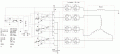
Schematics are always good to put up. You don't have to draw in all of the IGBT's; merely indicate which sections that are repeated "n" times.I then tried connecting the alternator directly.. and one of the IGBTs failed.. so I was wondering about doubling them up? would the driver be able to drive 12 IGBTs? also, in the circuit diagram in the driver datasheet it shows a resistor between the output and the gate... what is the purpose of this? I put in a 100ohm as a pure guess, but have no idea if that is a good thing or not. I have googled around but cant seem to find anything, or at least anything that I understand about this resistor and how to choose a value for it.. or if it is in fact needed at all...
Is it worth me drawing up a schematic for you?
Thanks for all your help so far and as always its much appreciated.
I think that IGBT failed because of a bent pin on the driver... so that would be one thing solved, and would explain why none of the others went, nor have gone since.A Yank expression for that is "Stuff happens"
Interesting. It's been so long since I've visited the thread, and so many other projects in between, I'll have to read back and take a look at why that might've happened.
Yes that makes sense... what I meant though was - I know the whole bulb array/alternator setup was drawing x current... but how much of that total current was going through each device... I think it is 2/3? so if it was drawing 9amps in total, each device would have 6amps going through it... am I along the right lines?Power dissipated in the device = Current through the device x Voltage drop across the device.
I'm not surprised that that thought was painfulI just had a thought (yes, 'twas painful
If the voltage on the gates caused the MOSFETS to enter the linear region under such a heavy load, power dissipation (meaning heat) in the MOSFETs would increase a great deal.
MOSFETS have a positive temperature coefficient, meaning the hotter they get, the more resistance they have. This usually means they are much easier to parallel then "normal" BJTs are.
However, if the temperature rise was quite rapid, it may burn out immediately. Once one MOSFET burned out, the remaining MOSFETS would "pop" very quickly. This would be difficult to diagnose unless you had a storage 'scope that was capable of measuring/storing gate voltages and their transitions from the start of the test to the failure of the component.
Yes quite... and well I don't mind stuff blowing up.. I look at it as R&DRather discouraging when things start blowing up. Well, we're in rather unexplored territory at the moment.
however, I am pleased that its not the actual bridge devices that are blowing up now... it just seems this bridge driver is the weak link now...ok.. I have found some other half bridge drivers which I want to give a go (based on my theory) if that doesn't work then I'll draw up the schematic and post it on hereSchematics are always good to put up. You don't have to draw in all of the IGBT's; merely indicate which sections that are repeated "n" times.
Makes sense, but wouldn't R be 1ohm?OK, current in series is like voltage in parallel.
If, for instance, you have a 10v supply with a lightbulb connected to the + side of that supply, then an inductor, and then the drain of an N-ch MOSFET, and the source of that N-ch MOSFET connected to the - side of the supply - when you turn on the MOSFET, let's say there is 10A going through the MOSFET. Well, that same 10A is going through the inductor and the light bulb. Since I=E/R, and your E=10, and your I=10, the R must also be 10.
its the frequency of each phase... and there are 6 steps per cycle:Let's talk about your PIC program for a bit. You say you're switching the MOSFETs on and off at 400Hz (or thereabouts.) Are you actually swapping between phases at that rate? Or are you just turning them all on and off?
yes it doesIf you're trying to spin the phases at a 400Hz rate without the rotor moving first, it's not likely that the rotor will ever get going - there is simply too much rotor inertia.
You'll still need to turn the bridge on and off to limit current flow to acceptable levels, but you also need to start the phases in the field windings switching polarity between each other at a slow rate when the power is first applied, then ramp up the rate of change.
I hope this is making sense to you.
the thing is, the alternator started to turn... but within a few seconds, the headlamps got brighter and it stopped turning... my guess was that as the headlaps got hot, their resistance increased, am I wrong in that assumption?