24Volt dimmer circuit for multiple strings of LED's

Thread Starter

k7elp60

Joined Nov 4, 2008
562
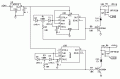
This circuit was designed to work on 24VDC. It is for a project that has multiple strings of LED's. The individual strings have an average of eight LED's in series with a current limiting resistor in each string. The value of the resister varies with the color of the LED's. There are four groups of strings, as a result, there will be 2 ea LM556, two more transistors (2N3904) and two more IRF9530's. I used parts I have on hand. I used the 7812CT to provide power for the LM556's and the 7809CT to supply 9V to the emitter of the 2N3904 transistor so the gate voltage of the IRF9530 did not exceed the maximum of +20V.
Are there any suggestions to improve this circuit?DIMMER.jpg
 

ronv

Joined Nov 12, 2008
3,770
This circuit was designed to work on 24VDC. It is for a project that has multiple strings of LED's. The individual strings have an average of eight LED's in
series with a current limiting resistor in each string. The value of the resister varies with the color of the LED's. There are four groups of strings, as a result, there will be 2 ea LM556, two more transistors (2N3904) and two more IRF9530's. I used parts I have on hand. I used the 7812CT to provide power for the LM556's and the 7809CT to supply 9V to the emitter of the 2N3904 transistor so the gate voltage of the IRF9530 did not exceed the maximum of +20V.
Are there any suggestions to improve this circuit?View attachment 106891
I think the base emitter voltage on the 3904 is only 5 volts, so the 9 volts might hurt it.:eek:
You could, I think, just use a voltage divider between the collector of the 3904 and +24 - Say 1K each, so the gate source voltage is only 12 volts. Then the 3904 could go to ground.
 

ScottWang

Joined Aug 23, 2012
7,499
You can using a 9.1V zener diode and a 1K resistor to provide the 9V in stead of LM7809 or change to 78L09.

How much current will be draw for the multiple strings of LEDs?
 

ScottWang

Joined Aug 23, 2012
7,499
I think the base emitter voltage on the 3904 is only 5 volts, so the 9 volts might hurt it.:eek:
You could, I think, just use a voltage divider between the collector of the 3904 and +24 - Say 1K each, so the gate source voltage is only 12 volts. Then the 3904 could go to ground.
LM7812(12V) → out pin5(12V-1.4V=10.6V) → 1K → [Vb = (9V+0.65V)] → Ve (9V)
 

ScottWang

Joined Aug 23, 2012
7,499
I think the base emitter voltage on the 3904 is only 5 volts, so the 9 volts might hurt it.

???
Sorry, I lost the LM556, that was calculated for what you said about the 2N3904.
LM7812(12V) → LM556 out pin5(12V-1.4V=10.6V) → 1K → [Vb = (9V+0.65V)] → Ve (9V)
 

John P

Joined Oct 14, 2008
2,054
If you added an extra 10K resistor between the gate of the IRF9530's and the collector of the 2N3904's, then the gate would be driven by a voltage divider and would never go below 12V. You could dispense with the 9V supply.

However, why use P-channel FETs at all? If you used N-channel FETs driven directly off the oscillator outputs and with the load coming from the +24V side, you could simplify the circuit and solve any worries about gate drive level.

Finally, you could combine the drive transistor with another small transistor to make a current-control circuit which would give you much more accurate control of current than you'd get with a simple resistor.
 

ScottWang

Joined Aug 23, 2012
7,499
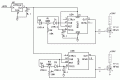
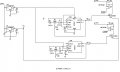
I took LM7809 away and modified the driver circuit, R7, R8 increasing from 1K to 10K, and in series with a 12V zener diode in Vc to protecting the Vg for P mosfet.


DIMMER_ScottWang-Mod0.gif
 

Thread Starter

k7elp60

Joined Nov 4, 2008
562
You can using a 9.1V zener diode and a 1K resistor to provide the 9V in stead of LM7809 or change to 78L09.

How much current will be draw for the multiple strings of LEDs?
I calculate the total current for all the strings to be slightly over 500Ma, I tested the dimmer circuit with a 450Ma load.
 

Thread Starter

k7elp60

Joined Nov 4, 2008
562
I took LM7809 away and modified the driver circuit, R7, R8 increasing from 1K to 10K, and in series with a 12V zener diode in Vc to protecting the Vg for P mosfet.


View attachment 106902
I think this is a good idea, but if I replace R5 and R6 with 4.7k resistors and then replace the two 12V zener diodes with a 4.7K resistors that would be the best for me, thanks for all the responses
 

Thread Starter

k7elp60

Joined Nov 4, 2008
562
If you added an extra 10K resistor between the gate of the IRF9530's and the collector of the 2N3904's, then the gate would be driven by a voltage divider and would never go below 12V. You could dispense with the 9V supply.

However, why use P-channel FETs at all? If you used N-channel FETs driven directly off the oscillator outputs and with the load coming from the +24V side, you could simplify the circuit and solve any worries about gate drive level. A N-channel will not work, as the gate voltage has to higher than the source voltage

Finally, you could combine the drive transistor with another small transistor to make a current-control circuit which would give you much more accurate control of current than you'd get with a simple resistor.
I don't think the N-channel FET will work as the gate voltage has to be more positive than the source, since I want the source near 24 volts it would not work.
 
Last edited by a moderator:

Thread Starter

k7elp60

Joined Nov 4, 2008
562
This circuit would work fine except all my strings of LED's have a common ground. If I duplicate my project in the future I will use this circuit.
I really like it because each string of of LED's would have two wires from the dimmer, and I would not need a common ground everywhere.
Great Circuit ScottWang!!!!!
 

John P

Joined Oct 14, 2008
2,054
ScottWang has it right, but that's exactly what I was saying you should do. However, I'd also recommend using the FETs as part of a constant-current circuit, which is an easy addition. That would give you much more accurate control of current than just a resistor.
 

Thread Starter

k7elp60

Joined Nov 4, 2008
562
ScottWang has it right, but that's exactly what I was saying you should do. However, I'd also recommend using the FETs as part of a constant-current circuit, which is an easy addition. That would give you much more accurate control of current than just a resistor.
John P, I'm sorry I didn't understand what you meant when you first talked of N-channel Mosfet. I would be interested in a circuit that uses constant current
 
Top