24v problem need help

Thread Starter

Steve01234

Joined Feb 28, 2025
9
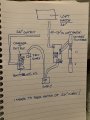
Need help I have a loft hatch supplied by a 230v step down 24v transformer with comfort switches reversing polarity to open and close.

If I have a power cut I have no way of opening the hatch.

I have tried to use 3amp 230v / 24v battery charger to bypass transformer and switches but this doesn’t work
When I cut the power the battery gives me 24v as I require but once I try to open hatch I lose power.
Can anyone suggest a way round this.
I hope I’ve given enough info
 

MrChips

Joined Oct 2, 2009
34,812
Need help I have a loft hatch supplied by a 230v step down 24v transformer with comfort switches reversing polarity to open and close.

If I have a power cut I have no way of opening the hatch.

I have tried to use 3amp 230v / 24v battery charger to bypass transformer and switches but this doesn’t work
When I cut the power the battery gives me 24v as I require but once I try to open hatch I lose power.
Can anyone suggest a way round this.
I hope I’ve given enough info
Maybe the internal resistance of the charger is too high.
Do you have a 24 V battery or two 12 V batteries you can try?
 

BobaMosfet

Joined Jul 1, 2009
2,211
This might help everyone understand
This is not a question of voltage, it's a question of current. When you put a battery across a heavy load like this, basically you're shorting the battery through the load until the load starts to move. Just like starting a car. If the load won't move, you're killing your battery.

What you haven't told us is exact specifications for the loft-hatch motor, which is what we need to know.
 

sghioto

Joined Dec 31, 2017
8,634
I’m not there, but I can open it with a 18v Makita battery if I reverse polarity if I connect just to the hatch
Can you close the hatch with the battery reversing the connections or just need to open?
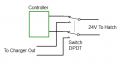
If just need to open then this arrangement might suffice with the correct polarity from the charger output.
1740769950384.png
 
Last edited:

MisterBill2

Joined Jan 23, 2018
27,522
A battery charger IS NOT MADE TO POWER THE LOAD, it is only made to slowly charge the battery. So the charger may not be able to operate the motor.
BUT if you have a power cut, how will the battery charger operate??? OR is what you call a "battery charger" really a portable battery?? That is entirely different.
ALSO!! there is more to operating the "hatch" than just a transformer. There must be switching, and probably a rectifier as well.
 

Thread Starter

Steve01234

Joined Feb 28, 2025
9
A battery charger IS NOT MADE TO POWER THE LOAD, it is only made to slowly charge the battery. So the charger may not be able to operate the motor.
BUT if you have a power cut, how will the battery charger operate??? OR is what you call a "battery charger" really a portable battery?? That is entirely different.
ALSO!! there is more to operating the "hatch" than just a transformer. There must be switching, and probably a rectifier as well.
I probably didn’t make it clear enough the charger is just to make sure that in the event of a power cut there would be a battery available so that the hatch could be opened.
if I connect the hatch directly to the battery I can open it. But if I leave AC/DC unit in place with comfort switches then I can’t
So I’m looking for a solution that doesn’t involve removing the hatch wiring to connect to the battery in the event is a power failure.
 

Attachments

Thread Starter

Steve01234

Joined Feb 28, 2025
9
I probably didn’t make it clear enough the charger is just to make sure that in the event of a power cut there would be a battery available so that the hatch could be opened.
if I connect the hatch directly to the battery I can open it. But if I leave AC/DC unit in place with comfort switches then I can’t
So I’m looking for a solution that doesn’t involve removing the hatch wiring to connect to the battery in the event is a power failure.
I’m going to try a dual supply switch to see if this will get me over this problem without having to disconnect everything in the event of failure.
 

boostbuck

Joined Oct 5, 2017
1,043
From what I can make out, it seems that your 24V primary supply (with switches) is interfering with the battery supply.

How are you isolating the supplies from each other? Your diagram shows no interconnection.
I take it the primary supply with the control switches reverse power to the hatch depending on direction of travel? If so it is likely the battery is shorting through the primary supply if they are connected together.

Perhaps you just need a DPDT switch to select between the supplies, or the equivalent relay if you want it to be automatic.
 

MisterBill2

Joined Jan 23, 2018
27,522
OK, given the additional information, then a simple scheme can be described: From the battery: A three position, center off, spring return to center off, DPDT switch. That DPDT switch is wired for polarity reversal in the standard manner with outside terminals crossed. The two commons on that switch thus have reversible polarity. The two output leads from that switch tie to the N.O. terminals of the second DPDT two position switch. The DC motor connects to the two common terminals of that second switch, and the present transformer/control box leads connect to the two N.C terminals of that two position switch. Thus the two sources of motor drive power are totally isolated from each other. Now the two position switch selects either the present control scheme or, with the power cut, it would select the alternate connection to the battery drive power.
 
Top