24V Battery back up

ifixit

Joined Nov 20, 2008
652
The YCP03A24 charger is one of several recommended in the NP4-12 battery spec. C for your battery is 4 Amphours. The charger you selected charges at a constant current of 300mA until it switches to float, where it will supply a small current to keep the battery at the float voltage.

Since you have a load current of 200mA that is always connected to the battery this will subtract from the charge current and leave only 100mA to charge the battery. This is kinda low and it would take much longer to charge the battery. What is the typical load current?

A better charger choice would be the YCP1.5A24. 1.5 Amp charger minus .3 Amp leaves 1.2 Amps for charging. Charge time would be much better. The spec recommends a maximum charge rate of .25C (1 Amp) for float service. So 1.2A is a little higher, but I can't see it being a problem for your situation since it only happens after recovery from a power outage.

Your choice.

Regards,
Ifixit
 

evilclem

Joined Dec 20, 2011
118
Only use a 4 or 6 Ah battery if you want it to last for only 1 power out. Best to double the capacity required and include a low voltage disconnect to ensure the battery can be recharged and survive happily with little sulphation for further power outs.

I would suggest purchasing SLA batteries designed specifically for a float charge and applying a float charge to them. That is 2 x 12V 12Ah batteries and charge each with a fixed 13.8V power supply. Test power supply on battery to ensure it will not sink any current when not plugged into mains.

If you anticipate regular power outs then purchase cyclic rated SLA batteries and a 3 stage battery charger.
 

Thread Starter

bowlingo

Joined Jun 29, 2011
162
Hi,

I am now in a bit of a pickle with the recomendations in the last 2 posts. The power outage will be very rare as we dont get many power cuts around these parts.

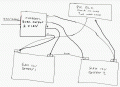
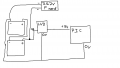
See below a rough diagram as to how I believe the circuit will work

If it is best to have 2 x 12V chargers charging each of the 2 batteries then in theory I cant see this as a problem but I am not sure how to wire it..I am asuming the PICPLC will some how have to be isolated from the charging side of things and run off the 24V output the 2 x batteries will give when in series but I cant picture this...please can you help with a diagram etc

Does the below look correct when using 1 x 24V 1.5A charger?

As of the spec it says the PICPLC power consumption is 120mA when all on board modules are off...the only thing it will try to do when there is a power outage is communicate with the second PICPLC and when it dosent get a reply due to the second PICPLC loosing its power it will send out a text message saying "mains power supply lost"

Here are the available chargers for the Yuasa batteries

http://www.batterymasters.co.uk/Catalog-Battery-Chargers-For-Sealed-Lead-Acid-Batteries_182.aspx

 
Last edited:

ifixit

Joined Nov 20, 2008
652
Your schematic looks okay for the 1 24V charger version.

A bank charger will have to 2 sets of leads coming out of it, one set for each battery. The outputs are isolated from each other so the charging processes don't interfere with each other. Using a dual charger ensures each battery is charged properly regardless of the battery starting condition.

I suppose 2 separate 12V chargers would work as well if it is cheaper.

evilclem has a good suggestion; to have a way for the load (PICPLC) to disconnect from the batteries when they are at the completely discharged voltage level, should a power outage take that long.

Regards,
Ifixit
 

Attachments

Thread Starter

bowlingo

Joined Jun 29, 2011
162
ok...

I think I will go for 2 x 12V chargers and 2 x 4AH 12V Batteries. Can anyone provide me with a drawing on how this can be wired as I dont understand how if the batteries are connected in series to create the 24V 4AH supply how the 2 x chargers would be isolated from each other as they wouldnt charge each battery independantly.

evilclem has a good suggestion; to have a way for the load (PICPLC) to disconnect from the batteries when they are at the completely discharged voltage level, should a power outage take that long.

I dont understand what the benefit of the above would be as once the batteries are flat the PICPLC would simply stop working?

Thanks
 

Thread Starter

bowlingo

Joined Jun 29, 2011
162
I have just spoken to a technical chap at http://www.batterymasters.co.uk

He is saying to go for 2 of these batteries (Yuasa 12V 7AH)

http://www.batterymasters.co.uk/Pro...ttery-(L(mm)-W(mm)-H(mm)-151-65-98)_1761.aspx

And one of these chargers

http://www.batterymasters.co.uk/Product-Yuasa-SLA-Charger-24v-2Amp,-YCP2A24_1868.aspx

I asked him if it would be best to go for 2 x 12V independant chargers but he said due to the batteries being exactly the same there wont be an issue with one having a different impedance of which will cause the charger to favour one from the other...I can see they wont be exactly the same impedance but he is saying this definitely wont be a problem.

He said if I get the above 2A charger working on the 200mA load basis they will last for well over 24 hours and if they were to go flat they would take 8-10 hours to fully recharge with the system back up and running and drawing 200mA or so for the PICPLC. He also said when the PICPLC is in normal use the charger will be continuously float charging even when the batteries are charged and a yellow LED will stay on permanantly due to it drawing a continuous 200mA or so load.

Thanks
 

evilclem

Joined Dec 20, 2011
118
I dont understand what the benefit of the above would be as once the batteries are flat the PICPLC would simply stop working?

After the batteries go flat, the PICPLC will keep going until the batteries are dead, depending of course on it's own brown-out voltage settings.

SLA batteries should never be fully discharged. I would disconnect the load at 24.8V personally, if uptime is a definite requirement then I would cut the load at 24.0V. Anything less than 23.6V will introduce far too much sulphation and drastically reduce the capacity of the battery.

If the charger gets stuck in absorption mode due to your current drain and cannot enter standby mode then you may risk gassing the batteries.

You could do just as well to use a fixed 27.6V (13.8 * 2) float charge across the batteries (in series).
 

Thread Starter

bowlingo

Joined Jun 29, 2011
162
I dont understand what the benefit of the above would be as once the batteries are flat the PICPLC would simply stop working?

After the batteries go flat, the PICPLC will keep going until the batteries are dead, depending of course on it's own brown-out voltage settings.

SLA batteries should never be fully discharged. I would disconnect the load at 24.8V personally, if uptime is a definite requirement then I would cut the load at 24.0V. Anything less than 23.6V will introduce far too much sulphation and drastically reduce the capacity of the battery.

If the charger gets stuck in absorption mode due to your current drain and cannot enter standby mode then you may risk gassing the batteries.

You could do just as well to use a fixed 27.6V (13.8 * 2) float charge across the batteries (in series).
Thanks evil...

I am confused about how to cut the load at a specific voltage? I am also confused about how to wire 2 x 12V chargers so they charge each battery independantly i.e how do they not only independanty charge each 12V battery but also connect in series at the same time giving the 24V series load..

Any chance of a diagram?

With 2 x 12V 7AH batteries on the system it will keep going for 24 hours. I have never known a power cut in my lifetime to go on for this length of time...its happened in certain areas where lines have come down etc...so the odds of the batteries actually going flat are very slim

Going by the above charge voltages 27.6V or 13.8V x 2 the picplc can handle 16-30V DC acording to its spec so this wouldnt be a problem...would there be volt drop across the charger and battery i.e when the charger is topping up the battery at the same time as its supplying the PICPLC would there be a volt drop situation?
 
Last edited:

evilclem

Joined Dec 20, 2011
118
Don't worry about charging the batteries individually. Just charge them in series, simplifies things immensely.

The low voltage disconnect typically sits in series with the battery. A decent one will be microprocessor controlled with hysteresis, not too sure where to find them other than built into solar charge controllers, we built our own. If you don't anticipate the unit running off battery long enough to go flat then you can probably bypass this and just replace the batteries if they do go flat.

Oh and it's implied that the fixed supply doesn't sink any current from the battery when the mains dies, if it does then you'll need a diode and the supply tweaked up in voltage so that the battery side of the diode is at 27.6V.
 

Attachments

Thread Starter

bowlingo

Joined Jun 29, 2011
162
Don't worry about charging the batteries individually. Just charge them in series, simplifies things immensely.

The low voltage disconnect typically sits in series with the battery. A decent one will be microprocessor controlled with hysteresis, not too sure where to find them other than built into solar charge controllers, we built our own. If you don't anticipate the unit running off battery long enough to go flat then you can probably bypass this and just replace the batteries if they do go flat.

Oh and it's implied that the fixed supply doesn't sink any current from the battery when the mains dies, if it does then you'll need a diode and the supply tweaked up in voltage so that the battery side of the diode is at 27.6V.
I am a bit confused regarding this 27.6V...is this the charging voltage the 24V charger will be at?..so the PICPLC will be running on 27.6V along with the batteries being charged at 27.6V?

Oh and it's implied that the fixed supply doesn't sink any current from the battery when the mains dies, if it does then you'll need a diode and the supply tweaked up in voltage so that the battery side of the diode is at 27.6V.

Sorry about this I am having trouble understanding the above...are you saying if the charger drops due to power fail when it takes its power from the batteries only there could be a volt drop?...although the batteries should be at a steady 2 x 12V = 24V?

Thanks

In you opinion would the below work?

2 x http://www.batterymasters.co.uk/Pro...ttery-(L(mm)-W(mm)-H(mm)-151-65-98)_1761.aspx

1 x http://www.batterymasters.co.uk/Product-Yuasa-SLA-Charger-24v-2Amp,-YCP2A24_1868.aspx

Wired as of your drawing but without the undervoltage protection?

thinking about this now...the undervoltage protection is important in case the user were to pull the mains plug on the system without turning off the power button (breaking the battery circuit) and it would empty the batteries thus potentially damaging the batteries...if there is an undervoltage protection device on it it will drain the batteries to a safe level, the user can then power it up again and it will take around 10 hours to recharge but the PICPLC will work as its charging...is this paragraph correct?
 
Last edited:

evilclem

Joined Dec 20, 2011
118
Your two batteries and 24V charger will probably work fine. You just risk venting the batteries after a few days (unless they can take a good beating) if the charge does not enter maintenance (float) mode. If your batteries are tough enough they may be fine.

The battery charger will charge at 28.8V for a 24V battery whilst in absorption mode. If the charger is stuck in this mode then it does not enter into the 27.6V float stage, this float stage is safe to be permanently attached to the battery.

With the charger you have been recommended the PICPLC will be running at 28.8V. A float charger (or fixed power supply) will run it at 27.6V along with the batteries, that is correct.

although the batteries should be at a steady 2 x 12V = 24V?

No, unlike power supplies the output of the battery is not fixed. Lead acid batteries are not 12 volts. They are about 2.1V per cell when fully charged and require more than that to charge. Your system (no load) will be 25.2V fully charged and 23.6V when fully discharged.
 
Top