2024 April 8 - Total Solar Eclipse across North America

WBahn

Joined Mar 31, 2012
33,072
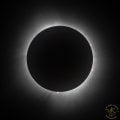
I am here in Dallas. Despite some cloud cover, there was a momentary break precisely at the point of totality.
I have watched many eclipses on videos, but it is one of those things which one has to really experience it personally.
Curious how dark it got (qualitatively).

The last one (2019) hit a bit more than 90% here and if you didn't know it was happening, you would not have noticed anything. Those of us that were standing out in the sun could perceive a lowering of the temperature, but very slight and less than you would normally perceive walking from sunlight to shade (we did that as soon as it passed to get a feel for the comparison). We noticed absolutely no difference in perceived light (despite several light meters and solar panels and other devices clearing indicating a significant drop in illumination). People that were standing nearby in the shade of the building noticed no temperature difference (we didn't have any thermometers around, so we don't know if there was any actual drop in air temperature, but we all doubted it).

I was surprised by that, because I figured a 10:1 change would be sensible to humans, but apparently not. But that had me wondering how much the perceived light change is under totality, given the amount of light that would still be scattering from the rest of the atmosphere. Does it get anything close to night-time dark, or twilight, or what?
 

cmartinez

Joined Jan 17, 2007
8,830
Curious how dark it got (qualitatively).

The last one (2019) hit a bit more than 90% here and if you didn't know it was happening, you would not have noticed anything. Those of us that were standing out in the sun could perceive a lowering of the temperature, but very slight and less than you would normally perceive walking from sunlight to shade (we did that as soon as it passed to get a feel for the comparison). We noticed absolutely no difference in perceived light (despite several light meters and solar panels and other devices clearing indicating a significant drop in illumination). People that were standing nearby in the shade of the building noticed no temperature difference (we didn't have any thermometers around, so we don't know if there was any actual drop in air temperature, but we all doubted it).

I was surprised by that, because I figured a 10:1 change would be sensible to humans, but apparently not. But that had me wondering how much the perceived light change is under totality, given the amount of light that would still be scattering from the rest of the atmosphere. Does it get anything close to night-time dark, or twilight, or what?
Down here it got to a bit over 95% occultation, and the sky turned afternoon-like in its lighting ambiance (except for the lack of colors on either horizon, which was kind of weird) and there also was a very noticeable drop in temperature.
 

panic mode

Joined Oct 10, 2011
5,164
that is an amazing photo, thanks for sharing.
first i had high hopes as yesterday was without a cloud, then this morning it was 100% overcast... :oops:
and then mere minutes before the event, clouds cleared. whew... what a cliffhanger...
 

Ya’akov

Joined Jan 27, 2019
10,276
that is an amazing photo, thanks for sharing.
first i had high hopes as yesterday was without a cloud, then this morning it was 100% overcast... :oops:
and then mere minutes before the event, clouds cleared. whew... what a cliffhanger...
The photo would have been better but there was a great deal of haze and high thin cloud cover.
 

schmitt trigger

Joined Jul 12, 2010
2,172
Curious how dark it got (qualitatively).

The last one (2019) hit a bit more than 90% here and if you didn't know it was happening, you would not have noticed anything. Those of us that were standing out in the sun could perceive a lowering of the temperature, but very slight and less than you would normally perceive walking from sunlight to shade (we did that as soon as it passed to get a feel for the comparison). We noticed absolutely no difference in perceived light (despite several light meters and solar panels and other devices clearing indicating a significant drop in illumination). People that were standing nearby in the shade of the building noticed no temperature difference (we didn't have any thermometers around, so we don't know if there was any actual drop in air temperature, but we all doubted it).

I was surprised by that, because I figured a 10:1 change would be sensible to humans, but apparently not. But that had me wondering how much the perceived light change is under totality, given the amount of light that would still be scattering from the rest of the atmosphere. Does it get anything close to night-time dark, or twilight, or what?
Well, it was dark enough for the street lights to turn on. But it was a weird twilight. With normal twilights the West sky is brighter than the East sky. With an eclipse the twilight is uniform across the sky.
 

panic mode

Joined Oct 10, 2011
5,164
it is a nice day and i was in a T-shirt hoping for feeling the difference in temperature change but apparently i am not sensitive enough... the lights turned on. during totality it looked like ring was vibrating string... then the diamond appeared, i was trying to snap few images with my phone while shading it with a weld glass but the images did not turn out as i hoped...
 

geekoftheweek

Joined Oct 6, 2013
1,429
Awesome photo!! I can here looking for one. We shut down a bit early and was able to watch at work. It did get noticeably cooler here, the street lights came on, and it ended up being more of a spectacle than I imagined! It was amazing how much of the sun actually had to be blocked before it started to get dark, and just about as soon as the first sliver of the sun was visible it was quite bright again.

Luckily the drive home after work was the other direction of everyone returning from their adventure!! The only other time I75 is that congested is when there is an accident.
 

Reloadron

Joined Jan 15, 2015
7,903
Well against the odds a beautiful day, the rain and clouds moved out around noon and a perfect eclipse followed. My sisters enjoyed their ride up here and everything went well. We made 70 F at eclipse time so just perfect. :)

Ron
 

Ya’akov

Joined Jan 27, 2019
10,276
Hola Ya'akov
Could you tell what you used to get this and the other pictures? Thanks
Sure. I used my Canon EF 600mm ƒ/4L IS USM lens with a 1.4x Extender III (teleconverter) for an effective focal length of 840mm. This is the same lens I use for many of my bird photos. This, but with a different camera body:

1712614803473.jpeg
Instead of the Canon EOS 1DX Mark II in the photo, I used my Canon EOS 5D Mark IV to take advantage of the higher resolution. They are both equipped with full frame sensors, but the 1DX Mark II has a 20.1MP sensor while the 5D Mark IV has a 30.1MP.

I used the Gitzo Systematic 6 carbon fiber legs and the Gitzo GH1 gimbal seen in the photo as well.

For a filter, I used a 16-stop ND (Neutral Density) filter. The filter is so dark that even the brightest flashlights right up against is appear as dim images. It can be a challenge to frame the sun with it in place.

The objective (front) element of the lens is about φ152mm! A filter for that would be… less than affordable. Fortunately Canon provides the lens with a 52mm drop-in filter holder that inserts the filter right before the last element of the lens. 52mm is affordable, 152mm—not so much.

You have to be careful, though, since the filter blocks (absorbs) just about all the focused radiation of the sun. It gets warm. To avoid melting something, I removed it and let it cool every few minutes during the brighter times. It was mich less of an issue as totality approached.

I also used a remote shutter release to avoid disturbing the camera.
 

WBahn

Joined Mar 31, 2012
33,072
I'm always blown away by the apparent size of the two objects. I wonder how often this occurs in planetary systems and if gravitational forces have something to do with it.
Nothing more than an interesting coincidence -- the distances involves are dependent on the mass and the orbital velocities, while the sizes are dependent on the mass and the density. Pure coincidence that the angle subtended by both the moon and the sun, as seen from the surface of the Earth, are very close to the same.
 
Top