2 way LED blinker with adjustable timing.

Thread Starter

angelus2141

Joined May 9, 2018
10
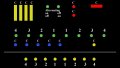
First let me say. I know nothing. I mean i've watched youtube videos on PCBs and I remember the potato and lightbulb thing from school but thats about it. I want to create one or two LED boards that have the LEDs turn off then the next set moving away turn on and so until the end when it starts from the beginning the picture probably illustrates better what I mean.

Anything with C is constantly on. Alternating on off is simple enough, when one is on the other is off and they bounce back and forth. The green and yellow dots though, i want number 1s to come on at the same time and as they switch off number 2s come on and as they switch off number 3s come on and so on. Given the constraints of the case im working in the white line represents splitting the board as i may need to have this as two seperate PCBs. The size of the board right now is not too important.
Untitled-2.jpg

So from what ive seen I think i need a NE555 chip, and 4017, several resistors, a poteniometer to vary the speed of the LEDs to what I want, but beyond that im at a bit of a loss. Im trying to learn Easyeda but having no knowledge makes things a little difficult. For example i think i need capacitors but I have no idea why. If someone could give me an idea of the parts I would need to make these (as two boards or one) and a basic circuit layout (by basic I mean something like resistor has to go between 4017 and yellow leds numbered one to limit/control current/voltage). i would be very grateful. Then I could take this and try designing an actual PCB without my head and eyes hurting lol.

Thanks in advance!
 

WBahn

Joined Mar 31, 2012
32,823
For the two alternating green dots, do you want them synched in any way to the other two sets of active green and yellow dots?
 

WBahn

Joined Mar 31, 2012
32,823
No not at all. They just alternate on and off status every second or two.
So, going the other way, would it be acceptable for them to be synched to the other sets of dots? Say the left one being on whenever the odd numbered dots are on and the left on being on when the even numbered dots are on.
 

Thread Starter

angelus2141

Joined May 9, 2018
10
So, going the other way, would it be acceptable for them to be synched to the other sets of dots? Say the left one being on whenever the odd numbered dots are on and the left on being on when the even numbered dots are on.
yes that would be fine but if that needs to happen id like them linked to the yellow running LEDS (yellow will run slower than green)
 

WBahn

Joined Mar 31, 2012
32,823
yes that would be fine but if that needs to happen id like them linked to the yellow running LEDS (yellow will run slower than green)
Okay -- then that means that your original description was misleading because you only talked about wanting the 1's to come on and then the 2's to come on when the 1's go off and so forth. That means that the four LEDs (two yellow and two green) go on and off together and the same for the other three groups of four LEDs each.

This matters because, as described, someone will make a single circuit that has four outputs with each output driving one set of four LEDs (two yellow and two green).

But that appears not to be what you want.

Another thing that is not clear -- if you split the bottom part of the board off, is it simply gone completely, or is it just moved to someplace else and still needs to work?

With this in mind, try to provide a more detailed description of what you require. It would also be good to throw together a sketch of the timing you would like and give an idea of the time scales involved. Do you want the alternating LEDs to cycle once per hour or once per millisecond or what.

Also, do you need any adjustability in anything, including the rate at which everything works?
 

Thread Starter

angelus2141

Joined May 9, 2018
10
Okay -- then that means that your original description was misleading because you only talked about wanting the 1's to come on and then the 2's to come on when the 1's go off and so forth. That means that the four LEDs (two yellow and two green) go on and off together and the same for the other three groups of four LEDs each.

This matters because, as described, someone will make a single circuit that has four outputs with each output driving one set of four LEDs (two yellow and two green).

But that appears not to be what you want.

Another thing that is not clear -- if you split the bottom part of the board off, is it simply gone completely, or is it just moved to someplace else and still needs to work?

With this in mind, try to provide a more detailed description of what you require. It would also be good to throw together a sketch of the timing you would like and give an idea of the time scales involved. Do you want the alternating LEDs to cycle once per hour or once per millisecond or what.

Also, do you need any adjustability in anything, including the rate at which everything works?

yeah im not the best at describing it. Heres a link to a youtube video of what i want to build. best view is about 30 seconds in

for now im just focusing on the top part of the tricorder.
 

Thread Starter

angelus2141

Joined May 9, 2018
10
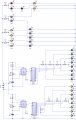
Right so I think ive managed to go and figure it out but id like some feedback on circuit ive made. Ive colour coded the LEDs so you can see what they represent. The timing with the potentiometers seems right based on circuit wizards simulation. The location of the LEDS are wrong but that doesnt matter so much right now. Any ideas on if I can reduce the number of IC chips or resistors. Its not necessary but id like the most efficient design.

Thanks

Untitled-4.jpg
 

AnalogKid

Joined Aug 1, 2013
12,126
Two things right up front.

1. A CD4017 output cannot source or sink very much current. You are going to have only about 1 mA through the traveling green and yellow LEDs. One ULN2003 has 7 driver transistors and is perfect for this application. With it, you can go daylight-visible.

2. Putting two LED directly in parallel usually does not work well. It won't hurt anything, but which ever LED has the lower forward voltage drop (by even just a few millivolts) will hog most of the available current. LEDs in series is fine, but parallel isn't. Use individual current limiting resistors for each single or series string.

ak
 

Thread Starter

angelus2141

Joined May 9, 2018
10
Two things right up front.

1. A CD4017 output cannot source or sink very much current. You are going to have only about 1 mA through the traveling green and yellow LEDs. One ULN2003 has 7 driver transistors and is perfect for this application. With it, you can go daylight-visible.

2. Putting two LED directly in parallel usually does not work well. It won't hurt anything, but which ever LED has the lower forward voltage drop (by even just a few millivolts) will hog most of the available current. LEDs in series is fine, but parallel isn't. Use individual current limiting resistors for each single or series string.

ak
Ok so im a little confused by what you said. So here is my interpretation let me know if im right.

1. Running 2 LEDs from a single output of the 4017 is a bad idea because of low current. so use the ULN2003 as 1 output on that IC to two LEDS provides more current.

but if your saying run one output to one LED that wont work for me as I need 2 LEDs active at the same time and im trying to do it all with hardware (no coding)

2. instead of connecting the LED to LED to output connect them like in a row so LED D23 connect to all leds up to LED D30 and just have one resistor at the beginning of the chain?
 

dendad

Joined Feb 20, 2016
4,637
Last edited:

ScottWang

Joined Aug 23, 2012
7,501
If the LEDs type were not like as 100mA(Power LED) then maybe you can use 74HC4017(page 6) to replace CD4017 and it can provides ±25mA current, and you can reduce the numbers of resistors as D1~D4, D5~D8, D10~D13, D14~D17, they just need to use a common resistor for each 4 LEDs, it means that you only need 4 resistors for 16 LEDs, and in series the resistor with the LEDs at the negative pin.

You haven't mention the V/I of LEDs, if we know that then we can give you a more appropriate values of current limiting resistor, and you also missed to connect the pin 2 of VR1 and VR2, they should be connected to pin 1 or 3, it depends on which direction(the values of VR decreasing or increasing) that you want to do the adjustment.
 
Top