19V supply to -9, 0 & +9V supply

Thread Starter

djsfantasi

Joined Apr 11, 2010
9,237
I’ve performed several searches and didn’t find a post that described how to do this.

Is it possible? I want to take a laptop brick @ 19V, and create a split power supply of -9 and +9 volts. Or so. The required current could be as much as 5A (12 standard hobby servos)

There are embedded audio circuits therein, for which having a dual sided supply might be useful.

In actuality, I may not need 9-0-9V, (maybe I need -6,5,6). But I’m starting with this question to learn the approach.

Thanking you in advance.
 

Papabravo

Joined Feb 24, 2006
22,083
That is because it is difficult. If the brick outputs 19 VDC then you have to make a buck converter to get 9 VDC. Then you need to make an inverter to -19 VDC and regulate that down to -9 VDC. The output current will be nothing like what you need.
 

Thread Starter

djsfantasi

Joined Apr 11, 2010
9,237
If you can pick them up cheap enough, why not two with combined outputs?
Max.
Because I wasn’t thinking. I had selected a 19V supply. I’ll look to see if I can find something. Size is a concern; cannot be larger than a brick. Current needs are high. And I preferred one barrel jack connection. Somewhere between 20 or 30 will be required and moved frequently (monthly), so minimizing connection time must be considered.

But t
 

Thread Starter

djsfantasi

Joined Apr 11, 2010
9,237
I know Cosel USA makes DC/DC dual output converters but depending on your needs I would do as Max suggested with a few off the boat flavors.

Ron
Thanks, Ron
I’ll check that reference.

When I started this investigation, I had a much simpler solution in mind.

Something like dual VRs across the 19V. Something like this based on a chip like the LTC3388-3. That chip has a maximum of 5V, not 9. But that might work for me. Like what Jim Drew wrote about here.
 

Papabravo

Joined Feb 24, 2006
22,083
Thanks, Ron
I’ll check that reference.

When I started this investigation, I had a much simpler solution in mind.

Something like dual VRs across the 19V. Something like this based on a chip like the LTC3388-3. That chip has a maximum of 5V, not 9. But that might work for me. Like what Jim Drew wrote about here.
That is kinda what I described in post #3. At least it is a step in that direction. I think getting the right part and the right design on a PCB is going to be a heavy lift.
 

crutschow

Joined Mar 14, 2008
38,537
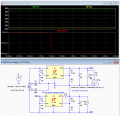
Below is the LTspice simulation of a circuit that should do what you want (discussed here).
It uses the LT1118 regulator, that can either source or sink current, which is necessary to handle any imbalance currents between the plus and minus loads.
Notice that the output voltages stay constant as the load imbalance shifts from plus to minus.
It can deliver up to 400mA of current with adequate heat-sinking.

1586991264726.png
 
Last edited:

dendad

Joined Feb 20, 2016
4,641
Why do you need +/- supplies?
An H bridge will give reversible motor drive off a single supply.
Hobby servos are single supply.
Try to keep it as simple as you can.
And what are the audio circuits that you want the split supplies for?
 

Thread Starter

djsfantasi

Joined Apr 11, 2010
9,237
Below is the LTspice simulation of a circuit that should do what you want (discussed here).
It uses the LT1118 regulator, that can either source or sink current, which is necessary to handle any imbalance currents between the plus and minus loads.
Notice that the output voltages stay constant as the load imbalance shifts from plus to minus.
It can deliver up to 400mA of current with adequate heat=sinking.

View attachment 204508
This one is going into my notebook.

Thanks
 

Thread Starter

djsfantasi

Joined Apr 11, 2010
9,237
Why do you need +/- supplies?
An H bridge will give reversible motor drive off a single supply.
Hobby servos are single supply.
Try to keep it as simple as you can.
And what are the audio circuits that you want the split supplies for?
The +/- supply was for the audio circuit alone.

I’ve used H-Bridges before. And I know hobby servos very well. Such as that they are single supply.

But there is one area that I was very confused about for some time. An op-amp circuit to interface between and audio source and a microprocessor. At one time, I had a working circuit which I was told should not work at all. I was told that I’d need a +/- supply. And, a solution I had forgotten that didn’t need a split power supply.

That was what was in my head.

I also had to add a boost converter to take 5V to 9V for the microprocessor.

So, I thought that I needed a 9V @ 500mA, a +/-5V @ 30mA and a 5V @ 5A supplied.

Talking to everyone here, I’ve realized (as my memory improved) that all I need is a 5V @ 6A power supply. And I can get them for $15 US.

But the information I’ve been given is priceless. Thanks to everyone
 
Top