12v to 24v dc booster

MrChips

Joined Oct 2, 2009
34,842
Get down to basics.
20A x 12V = 240W
20A x 10h = 200Ah

Don't waste more power than you need to.
The bottom line is, increase the current carrying capacity of your cables.

Calculate the resistance of your cables.
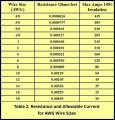
Use these tables.
1643038820743.png

Assuming 30m of cable.
Resistance of 30m of #10AWG is about 40mΩ
Power loss @20A is 16W.
 

Thread Starter

mendoza

Joined Nov 8, 2021
19
Looking for information on internet I have read that DC motors consume "X amps" for starting, but once they are running they can consume much less.

In the specifications of my motor it says that the rated current is between 10-20A, but the motor is 12V and has a power of 360W How is it possible?. Shouldn't it consume 30A?, does the motor have less power than indicated and that is why it consumes less?
Finally, could it be that the 10-20 amps are consumed at begining but then it consumes much less?

In the specifications it also says that the motor can work between 12-24V, in both cases the power is the same, the difference is that at 12V you have 6000rpm and with 24v you have 12000rpm.

I'm sorry I didn't tell you the engine specifications earlier
 

Ya’akov

Joined Jan 27, 2019
10,253
The motor will draw current based on the load. The stall current is what the motor will draw for some time at startup and if the rotor is locked while in use. At other times, the power needed by the motor is determined by the load, up to that stall current.
 

Thread Starter

mendoza

Joined Nov 8, 2021
19
In that case I should measure the current it consumes during the work and look for a suitable wire for that, because as the load is small it may consume much less than I thought. Is that correct?
 

BobTPH

Joined Jun 5, 2013
11,546
Well, clearly it is not possible that all of the specs you quoted are true. I suspect it will not use 360W at 12V.

Bob
 

MisterBill2

Joined Jan 23, 2018
27,611
If the motor is rated for 24 volts, then THAT is the voltage that will lead to drawing 30 amps. A DC motor is not a constant power device, nor is it a linear resistor. As the voltage drops the speed and available torque will drop, as well as the current. BUT it is not a nice straight line relationship. The stall current is what will flow at the rated voltage with only the DC resistance limiting the current. As soon as the motor is spinning the back-EMF reduces the effective voltage and so the current drops. It is not a simple relationship.
And at 12 volts the motor will draw quite a bit less than the 30 amps max.
 

Bordodynov

Joined May 20, 2015
3,431
There is an alternative way. It is to convert the 12 V DC voltage to 120 V AC voltage. Transfer this AC voltage, feed it into a transformer, and then rectify it. The frequency can be on the order of 20 kHz. This will reduce the transformers.
If you are interested, I can work out a scheme. As a humanitarian aid.
 

MisterBill2

Joined Jan 23, 2018
27,611
There is an alternative way. It is to convert the 12 V DC voltage to 120 V AC voltage. Transfer this AC voltage, feed it into a transformer, and then rectify it. The frequency can be on the order of 20 kHz. This will reduce the transformers.
If you are interested, I can work out a scheme. As a humanitarian aid.
This is a complicated and more expensive method and it will be much less efficient. It would work, but I do not recommend it.
 

Ian0

Joined Aug 7, 2020
13,157
This is a complicated and more expensive method and it will be much less efficient. It would work, but I do not recommend it.
You can get a 1600W vacuum cleaner motor that runs on 230V AC for £16. That’s much cheaper than stepping it back down to 12V. It might have a rated life of <500 hours, but that’s a lot of tree-shaking.
 

MisterBill2

Joined Jan 23, 2018
27,611
How well would a 4000RPM motor shake a tree? All of the trees that I have seen have a much lower resonant frequency.
Of course, the fact that I have not shaken an olive tree means that I don't know what their resonant frequency is. But I am guesing lower than 50 Hz.
 

Thread Starter

mendoza

Joined Nov 8, 2021
19
The frequency of the machines on the market is between 800 and 1200 per minute. In my case using gears I have made the oscillation speed to be around 1100 oscillations per minute.
 

Ya’akov

Joined Jan 27, 2019
10,253
Were it me, I would be doing seem empirical testing about now. Measure the rake in operation and see what it actually draws. I think I would also take a cheap and cheerful (or a good one, if you have a use for it in the case it doesn't pan out) 12AWG outdoor extension cord and see if it was sufficient. I wouldn't cut the rod up in case it didn't work out, so I would still be left with a useful cord.

I find prototyping immensely helpful in design and I never expect to purely "think out" my final design.
 

Ian0

Joined Aug 7, 2020
13,157
How well would a 4000RPM motor shake a tree? All of the trees that I have seen have a much lower resonant frequency.
Of course, the fact that I have not shaken an olive tree means that I don't know what their resonant frequency is. But I am guesing lower than 50 Hz.
Same as it would do with a 4000rpm DC motor - with some sort of speed-reduction mechanism such as a pulley or a gearbox - like there is in a vacuum cleaner to reduce the speed to the brushes.
Just a suggestion as I don't know much about olive trees as they don't grow at 53°North.
 
Top