Facebook
 Google
 GitHub
 Linkedin

Hello
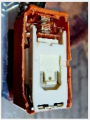
I'm using relay with datasheet in a link, it is R1, RT314012. I operate the relay with about 10.5 volts to turn it on. DC coil is 12V. I have no problem turning it ON. I maintain the relay in ON position with constant 6V. I have no issues keeping it ON. I have an issue where relay will not turn OFF even when voltage across terminals is virtually 0V. I tried shocking it with knocks, shorting the terminals after disconnecting the whole board from power, it has no capacitors. I use transistors to operate it. Most of the time it works but once it "latches" not even removing relay from circuit will help. I had to connect it manually to 12V battery several times, switching the polarity to return it to normal state. Funny thing is that click is always heard as it turns on/off but nothing happens. I turn it OFF from 6V to 0V dozens of times continuously but it won't turn off while clicking, while board is powered. I replaced it with new one and it operates the same.
Load on relay is 230V, couple of amps at best, maybe 2 on peak usage (LCD, two active speakers, two small switching PSUs). Circuit operates reliably. I have flyback diode connected.
Power rating is 4000VA, it has NO and NC contacts, there is almost no load on it and I wonder what could be the cause for the problem and how to solve it. I shorted pins in pairs since it has two pins for each contact but that should not be the issue. I suspect it is not meant to be ON permanently since it happens after being on for couple of minutes at least or 6V is not enough to keep it on so contacts don't make good connection and area is small so they fuse but that seems odd. I tried running 2.5kW load, motors (fan and vacuum cleaner), LED lights, phone chargers, all separately, and it will work with no issues.
Thanks.
Link to relay datasheet
https://image.schrackcdn.com/katalogseiten/k_energen6_518-524_en.pdf
I'm using relay with datasheet in a link, it is R1, RT314012. I operate the relay with about 10.5 volts to turn it on. DC coil is 12V. I have no problem turning it ON. I maintain the relay in ON position with constant 6V. I have no issues keeping it ON. I have an issue where relay will not turn OFF even when voltage across terminals is virtually 0V. I tried shocking it with knocks, shorting the terminals after disconnecting the whole board from power, it has no capacitors. I use transistors to operate it. Most of the time it works but once it "latches" not even removing relay from circuit will help. I had to connect it manually to 12V battery several times, switching the polarity to return it to normal state. Funny thing is that click is always heard as it turns on/off but nothing happens. I turn it OFF from 6V to 0V dozens of times continuously but it won't turn off while clicking, while board is powered. I replaced it with new one and it operates the same.
Load on relay is 230V, couple of amps at best, maybe 2 on peak usage (LCD, two active speakers, two small switching PSUs). Circuit operates reliably. I have flyback diode connected.
Power rating is 4000VA, it has NO and NC contacts, there is almost no load on it and I wonder what could be the cause for the problem and how to solve it. I shorted pins in pairs since it has two pins for each contact but that should not be the issue. I suspect it is not meant to be ON permanently since it happens after being on for couple of minutes at least or 6V is not enough to keep it on so contacts don't make good connection and area is small so they fuse but that seems odd. I tried running 2.5kW load, motors (fan and vacuum cleaner), LED lights, phone chargers, all separately, and it will work with no issues.
Thanks.
Link to relay datasheet
https://image.schrackcdn.com/katalogseiten/k_energen6_518-524_en.pdf