12v power to wireless garage door opener

Thread Starter

scotchjeff

Joined Aug 13, 2024
1
Last edited by a moderator:

activerfid

Joined May 30, 2020
31
Hello,

I have a new Ineos Grenadier, it has all kinds of 4WD stuff i don't need but does not have a homelink button for my sliding gate. It has several extra 10amp switches overhead.....
https://www.topgear.com/car-news/suvs/ineos-grenadier-retirement-home-proper-interior-buttons

I would like to run the garage door opener to one of these 10amp switches...I think I would need to step down the 12v to 3v?

Thanks,
Jeff
Would need a lot more info to assist. Do you just want to power the homelink transmitter (which either requires a power source to match the battery, or a dry relay contact in series with the battery) or just activate the homelink transmitter (which requires a dry contact across the open button)?
 

Ya’akov

Joined Jan 27, 2019
10,226
Hello,

I have a new Ineos Grenadier, it has all kinds of 4WD stuff i don't need but does not have a homelink button for my sliding gate. It has several extra 10amp switches overhead.....
https://www.topgear.com/car-news/suvs/ineos-grenadier-retirement-home-proper-interior-buttons

I would like to run the garage door opener to one of these 10amp switches...I think I would need to step down the 12v to 3v?

Thanks,
Jeff
Welcome to AAC.

Your original post is a little short on details but if I fill things in with some informed guesswork…

The image in the linked story suggest those overhead switches are lighting circuits. This is the least best way to deal with the opener remote. They could be used, as is, but there is a problem: the proper switch would be a momentary one. If you use one of those circuits, you can turn it on and off but if you leave it on in error , in the absence of some sort of logic between it and the remote, you could be (very illegally) driving down the road broadcasting your garage door open signal.

So, if you can’t replace the switch with a momentary one (and they don’t look standard, so that seems out) you need to put something in between that operates the remote of a fixed period every time the state of the switch changes.

The first approach that comes to mind is a monostable multivibrator with a delay also called a one-shot or a time delay relay. Now stick with me because it’s not as arcane to do as it sounds. Thanks to the proliferation of modules that can be cobbled together into working systems, most of the work is done for you already.

1723805210344.jpeg
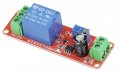
12V Automotive-targeted One-Shot [on Amazon⤷]​
An example of such a module is above. When it gets power it will turn on for a fixed interval (in this case 0-10s, adjustable with the brass screw on top of the blue component). Then it will shut off a not operate again until power is removed and reapplied.

So with this arrangement the operation would look like:

Turn on the lighting switch—or, if it is already on turn it off and back on.
The one-shot module operates the remote for n seconds (I would guess 3 is enough, but you can decide on that).
The whole thing waits for the next power cycle.

So, you can connect this to one of the presumed lighting circuits and interface the module's relay (the large blue box) to the opener remote. The relay has three terminals: NO, NC, and Common. NO and NC are normally open and closed respectively. This means that when the relay is not operated the NO contact has no continuity with Common and the NC contact is connected to Common.

When operated, the situation reverses. You will want to connect your remote to the NO and Common terminals so that when the power causes the module to fire, and the relay to operate, the remote will see a switch closure. As far as interfacing the remote, I think the easiest would by to mechanically force the operating button on and apply power to the remote through the battery connector. You can do this from the same circuit powering the one-shot module.

This way, you don't have to alter the remote at all. Alternatively, you could connect to the button on the remote by opening it and soldering to the appropriate spots but that seems to have no advantages over the first method and definitely has disadvantages.

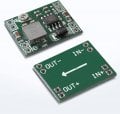
To power the remote, you have to know the supply voltage (what sort of batteries does it use?). Then you can get a buck converter also called a DC-DC converter that reduces the 12V to the 3V, 6V, or 9V the remote turns out to need. Fortunately, the popularity of modules comes to the rescue again.

This module is rated for an Input voltage range from 4.5V to 28V and output voltage adjustable from 0.8V to 20V. One thing to keep in mind is to take great care when adjusting this to power the remote. Use a good DMM (Digital MultiMeter) to measure the output and confirm it is correct before connecting it. This will ensure the magic smoke stays inside the remote where it needs to be for your garage door to listen to it.

So this is the basic idea which, it is my surmise, fits the requirements and constraints of the situation. Of course there are details, and there is also testing to be done. These modules are generally decent and reliable but it is absolutely required to confirm assumptions about their behavior before putting the whole thing together.

For example, does the one-shot operate as expected, that is, turn on immediately after the power is applied and then off after the configured seconds or does it wait until the seconds after power up to turn on and stay that way? (this is a legitimate sort of behavior but not the desired one, and sometimes descriptions are misleading or just plain wrong)

Is the DC-DC converter able to provide enough current to operate the remote? Almost certainly yes, but due diligence is called for.

Then, when wired together as planned does the whole thing operate as expected?

After this the parts can be put into a small enclosure and wired to the car and the remote. Remember that the automotive environment is a notoriously harsh one and protecting these modules is a good idea. I strongly recommend an aluminum enclosure (it can be very small as these modules are only digit millimeters on a side.

1723804775501.jpeg
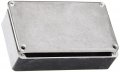
A “Bud Box” Aluminum Enclosure [on Amazon⤷]
This aluminum enclosure from Bud Industries would be my first choice—really good stuff. The exact dimensions will be determined by the actual components in the finished project but some version of this would even allow you to locate it in the engine compartment.

Well, there you go—a lot of guesswork but this should give you a direction. Ask questions as needed, and good luck!
 

Phil-S

Joined Dec 4, 2015
241
Can't really see what the problem is.

Just needs a matching push button switch to put in parallel with the remote controller.

At the price that vehicle is, I would expect some help from the dealer.
 

Ya’akov

Joined Jan 27, 2019
10,226
Can't really see what the problem is.

Just needs a matching push button switch to put in parallel with the remote controller.

At the price that vehicle is, I would expect some help from the dealer.
The TS said he wants to use one of the existing overhead switches which are not momentary, they are (unused) lighting circuits. They are not standard switches so they can’t just be replaced with momentary ones.

So the problem is he has a 12V circuit he can turn on and off and wants to operate a remote control using that 12V. Your “solution“ isn’t to his problem. Also, there is hardly a reason to believe the dealer would have th expertise to adapt a garage door remote to a vehicle—that’s just a little odd.
 

Phil-S

Joined Dec 4, 2015
241
The TS said he wants to use one of the existing overhead switches which are not momentary, they are (unused) lighting circuits. They are not standard switches so they can’t just be replaced with momentary ones.

So the problem is he has a 12V circuit he can turn on and off and wants to operate a remote control using that 12V. Your “solution“ isn’t to his problem. Also, there is hardly a reason to believe the dealer would have th expertise to adapt a garage door remote to a vehicle—that’s just a little odd.
There's a possibility that you could replace the unused switches with a momentary type, or just generate a single pulse. But of course, if looks matter, maybe not.

At £45000 for the vehicle, it might be worth asking. Just saying
 

Ya’akov

Joined Jan 27, 2019
10,226
There's a possibility that you could replace the unused switches with a momentary type, or just generate a single pulse. But of course, if looks matter, maybe not.

At £45000 for the vehicle, it might be worth asking. Just saying
There is not much possibility of replacing the switch, and it would be a pretty big job from the looks of it.

Yes, he could certainly ask—but it would be a very exceptional dealer that I would trust even if they suggested it could be done. It’s just not something dealer‘s do. Asking might not hurt—or it might if they said yes and produced a mess as a result.

His proposed method is particularly good because no modifications are made to the vehicle at all and removing it would leave everything stock.
 

MisterBill2

Joined Jan 23, 2018
27,193
The whole concept of linking any part of a vehicle electrical system to a typical 3 volt battery powered garage/gate remote control seems rather disturbing. And so, for starters, I echo the concerns that "Y" has expressed.

NOW I OFFER A SUGGESTION: In at least one of my recent cars there was a compartment intended for a remote garage opener. That compartment had a mechanism that would trigger the remote very well. And thT car cost a fair bit less that 45,000.
So it seems reasonable that the TS vehicle already has exactly what the TS wants, already in place but not obvious. So I also suggest asking the dealer customer service folks about what the vehicle already has in place. Much simpler, easier, and more reliable.
 
I’m wondering if wiring in parallel with the headlight flashing momentary switch would work? Yes, the transmitter would need something in the way of a voltage regulator to power it with 3V
 

MisterBill2

Joined Jan 23, 2018
27,193
I’m wondering if wiring in parallel with the headlight flashing momentary switch would work? Yes, the transmitter would need something in the way of a voltage regulator to power it with 3V
The function of that "headlight flash switch" is to momentarily apply the power to the headlights. Connecting in parallel with that switch would power the remote at all times EXCEPT when the headlights are on. Connecting in parallel with the switch load would power the remote when the headlights were on.
IF that "flash" switch powers a relay, then connecting across the relay coil could work. BUT, in a current production vehicle it is more likely that the "flash switch" is multiplexed into the Lighting controls computer module, and not available for other applications.
 

Tonyr1084

Joined Sep 24, 2015
9,744
Do you just want to power the homelink transmitter
does not have a homelink button
I attempted something similar with poor results. I took a universal remote and programmed the opener to recognize that transmitter. It, too, was powered from a 3V coin cell. So as to not have to worry about battery replacement I took a 12V to 5V adapter and modified it to output 3.3V. It worked. For a while. Then it died. I used a momentary push button to provide 12V to the modifed adapter only when I wanted the transmitter to transmit. While I don't recall how long it DID work, it didn't last long. By that I mean within 6 months (if not shorter) it was a dead puppy inside the dash.

I could resurrect that project and give it another go using a different sort of regulator. But 12V to 3V is a big step. Not to mention that auto electrics can see voltages as high as 15V in rare circumstances. But when running, the typical auto voltage is 13.6 to 13.8V. Perhaps a buck converter would be efficient enough and provide sufficient power to the bodged GDO Remote, but as others are saying it's kind of a useless task as transmitters operating on a 3V coin cell don't often need their batteries changed for a few years, depending on how often you open the door.

This module is rated for an Input voltage range from 4.5V to 28V and output voltage adjustable from 0.8V to 20V. One thing to keep in mind is to take great care when adjusting this to power the remote. Use a good DMM (Digital MultiMeter) to measure the output and confirm it is correct before connecting it. This will ensure the magic smoke stays inside the remote where it needs to be for your garage door to listen to it.
Obviously MY modification was not 100% successful. Now you have me resurrecting the idea of having a powered remote. And I can mount it behind the headliner in the back of my truck. I always back into the garage. Reason is children play in the street and backing into the street could be hazardous to their wellbeing. For now I have a small remote hanging on my sun visor. I don't particularly care for advertising to thieves I have a way into the house through the garage. Break in and take it and copy my address from my registration. A hidden device DOES make sense. Either something home made or the "HomeLink" button. My wife's car has that. My truck doesn't. And Toyota's with HL in them are hard to find in a junk yard. Otherwise that would be the perfect solution to this problem.
 
Last edited:

MisterBill2

Joined Jan 23, 2018
27,193
Certainly the automotive electrical system is not for the weak!
My suggestion is that before even the input filters, a series resistor to limit the current and then a clamp diode, probably a zener rated for a few amps. Follow that with a noise filter at 12 volts, and then a regulator down to five volts, followed by another current limiting resistor and four shunt silicon diodes in a stack to allow a nominal 2.8 volts.
The current limit resistors do not need to handle much power because the remote does not draw much current.
 

Tonyr1084

Joined Sep 24, 2015
9,744
NOW I OFFER A SUGGESTION: In at least one of my recent cars there was a compartment intended for a remote garage opener. That compartment had a mechanism that would trigger the remote very well. And thT car cost a fair bit less that 45,000.
My Chevy S10 Pickup had a compartment to both hold and press the button on a remote about the size of a pack of cigarettes. That was back in 2001. I haven't seen such a compartment in any vehicles I've driven since then. 89 Celica, 03 Sonata, 09 Venza (which has the home link) or 17 Tacoma. Nor have I noticed any such thing in any of my friend's vehicles. And he's had several over the past 20 years. No one in my extended family has such compartment either. But that's MY experiences. I could be wrong, and often am.

As mentioned, I'm seriously considering making another stab at solving this problem but this time using the suggested regulator Y linked to. As for controlling power output, since a coin cell can directly power an LED I figure if I set an LED / Resistor to 20mA I should be able to ascertain whether I'm at the proper voltage to achieve 20mA @ 3.3V.

And NO, I'm not trying to hijack this thread. Just sharing my experiences with the TS (Thread Starter).
 

Tonyr1084

Joined Sep 24, 2015
9,744
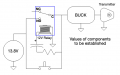
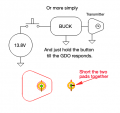
Something like this: I think this will work with the right components.
And you don't need to tap into another switch, just power. Even if it's
constant power. But keyed power would be better. But then you need
to have the vehicle powered (ACC or engine running).
Screenshot 2024-08-17 at 7.48.45 AM.png
And since posting this question the TS has not made further comment.
We may be chasing wild geese again.
 

MisterBill2

Joined Jan 23, 2018
27,193
How about a really "retro" concept: A small motor with a reduction gear train and a cam, that could deliver one button press and then open a contact to stop the motor until next time? No risk of power transients and no digging into the remote.
 

Tonyr1084

Joined Sep 24, 2015
9,744
@MisterBill2: That simple (last) drawing has power going to the transmitter momentarily. The TS wants to push the button and forget it while the transmitter THINKS it's still being commanded to transmit for 2 or 3 seconds beyond the push of a button. My thinking is that simply powering the transmitter momentarily WITH the push button shorted closed should (and I don't know that for sure) transmit the open/close signal the TS wants. The relay and cap approach is only to give him that 2 to 3 second closure regardless of how long the button is pushed. Since I'm considering something similar I don't need to have something hold my command for a period of time after I release the button. Not sure how you're seeing a "Long external connection"; perhaps you can enlighten me on your thinking.
 

Ya’akov

Joined Jan 27, 2019
10,226
@MisterBill2: That simple (last) drawing has power going to the transmitter momentarily. The TS wants to push the button and forget it while the transmitter THINKS it's still being commanded to transmit for 2 or 3 seconds beyond the push of a button. My thinking is that simply powering the transmitter momentarily WITH the push button shorted closed should (and I don't know that for sure) transmit the open/close signal the TS wants. The relay and cap approach is only to give him that 2 to 3 second closure regardless of how long the button is pushed. Since I'm considering something similar I don't need to have something hold my command for a period of time after I release the button. Not sure how you're seeing a "Long external connection"; perhaps you can enlighten me on your thinking.
I would favor mechanical rigging of the pushbutton (e.g.: something to apply pressure and a zip tie around the remote to hold it there, or similar).
 
Top