12V LM350T Lead Acid battery charger question

Thread Starter

khatus

Joined Jul 2, 2018
115
Hello friends, I want to make this lead acid battery charger.


Here, I want to use 1000pF polyester film capacitor instead of the electrolytic capacitor C3? My first question is can I use 1000pF polyester film capacitor instead of 1000pF electrolytic capacitor?


if i use the DPDT Self-Locking Push-Button Switch, in the place of the S1 Start pushbutton, will there be any problem?


crutschow

Joined Mar 14, 2008
38,316
can I use 1000pF polyester film capacitor instead of 1000pF electrolytic capacitor?
Yes, that is not a electrolytic capacitor even though it is shown as being polarized.
if i use the DPDT Self-Locking Push-Button Switch, in the place of the S1 Start pushbutton, will there be any problem?
Yes, there is a problem.
It wouldn't go into the trickle-charge mode.
The circuit needs a momentary push-button for proper operation.
 

Thread Starter

khatus

Joined Jul 2, 2018
115
Will there be a problem if I use 15 ohm and 230 ohm 1/4 watt resistors? The value of these two resistors must be high wattage or low wattage? If it is high wattage then how much wattage should I use?
 

crutschow

Joined Mar 14, 2008
38,316
What is the function of push button in this circuit?
The op amp detects charge current and when it drops below a certain point, indicating the battery is charged, it reduces the output to a trickle-charge level.
Since it detects little current at start-up, it is in the trickle-charge mode.
The PB puts it in the high-charge mode until it detects the charge current so it can stay in that mode until the battery is charged.
 

schmitt trigger

Joined Jul 12, 2010
2,027
Think of that button as something similar to your “engine start” in your vehicle.
Would you like to keep the starter running even after the engine has come up to life?

Of course not! That is the same reason this has to be a normally open, momentary switch.
 

Thread Starter

khatus

Joined Jul 2, 2018
115
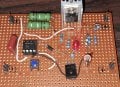
Hello friends,I have completed soldering of the circuit on perfboard according to this Lead acid battery charger diagram, and got the exact output according to the formula given in the datasheet.Here is my resistor value,

R2+R3 = 239.6 k Ω
R1 = 3.276 k Ω
According to the formula given in the LM350T datasheet,


Vout = 1.25×(1+ 3276/239.6) + 50×10-6×3276
Vout = 18.34+0.1638
vout = 18.50
and I have got exactly this output voltage.
Now my question is ,
1) charging a 12 volt lead-acid battery with this 18.5v output voltage cause any damage to the battery?
2) What is the optimum output voltage to charge the 12V lead acid battery if it is not charged at 18.5 volt.
3) What is the purpose of the 15KΩ resistor in the circuit?
4) If I make the output voltage slightly higher than 12 volts (say 13.5 volts) will the LM301A OPAMP would work properly? Because it requires +/-15 volts at pin 7,4.
 

crutschow

Joined Mar 14, 2008
38,316
charging a 12 volt lead-acid battery with this 18.5v output voltage cause any damage to the battery?
Likely.
What is the optimum output voltage to charge the 12V lead acid battery if it is not charged at 18.5 volt.
The maximum is about 14.6V.
What is the purpose of the 15KΩ resistor in the circuit?
It reduces the charge voltage to the trickle-charge value when the op amp output goes high.
If I make the output voltage slightly higher than 12 volts (say 13.5 volts) will the LM301A OPAMP would work properly? Because it requires +/-15 volts at pin 7,4
Yes.
It doesn't require ±15V, that's just the nominal voltages used for characterizing its operation, as that was the common voltages used by the early discrete transistor op amp brick modules.
Op amps are seldom operated at those high voltages now.
If you look at the LM301A data sheet, you will see that the operational spec graphs go down to ±5V.
 

boostbuck

Joined Oct 5, 2017
1,034
Yes, that is not a electrolytic capacitor even though it is shown as being polarized.
It's my understanding that the curved plate shows the end connected to the foil layer on the outside of the capacitor (although I don't think it will be important in that circuit).
 

MisterBill2

Joined Jan 23, 2018
27,164
For many of us, the curved line in the capacitor symbol reminds us that it is not a relay contact like we see in a control system ladder drawing. Knowing the outside foil in a tubular capacitor is of the greatest value when it is tied to common in a low level circuit. That was more important in high impedance vacuum tube circuits. Less common today. The polarized cap was because one who drew the circuit used the same symbol instead of inserting the non-polarized symbol. An easy error.
 
Top