120v supply to 3v LED?

Thread Starter

SilverGorilla

Joined Jun 8, 2024
2
I am self-taught (which means I lean on experienced people like you to learn new things)!

I need to create an indicator light system in a mobile application. The power will be supplied via 48v to 120v inverters or generators (vehicles are configured to switch between the two). 50 amp max current. The lights are on/off indicators for each 120v circuit as well as backlighting for circuit labels. Room is limited so I have to choke the 120v power directly to the LED via resistors. I just don't know the exact resistors to use. Best I can calculate through the online tools is that I need resistors rated 2.4W and equal to 5850 ohms resistance.

Is my math right? Can you point me to part numbers for existing components? I have no time to make this happen, so I am hoping to find my "silver bullet" rapidly! Please be out there!
 

dl324

Joined Mar 30, 2015
18,287
Welcome to AAC!

You're fortunate that forum rules now allow LED to mains posts.

You didn't show your calculations, so I can't tell if you did them correctly.

Assuming when you say "120V", you mean 120VAC, if you operated the LED at 10mA:
\( \large R=\frac{V}{I}=\frac{120VAC}{0.01A} =12k\Omega \)

I ignored LED voltage because it doesn't affect the calculations much.

\( \large P=\frac{V^2}{R}=\frac{120VAC^2}{12k\Omega}=1.2W \)

Use at least a 2W resistor. Make sure the working voltage for the resistors is at least 200V. You'll also require a diode like 1N4148 anti-parallel to the LED because the LED won't tolerate much reverse voltage.
 
Last edited:

LowQCab

Joined Nov 6, 2012
5,101
With possibly fluctuating Voltages,
You would be much better-off using a Current-Regulator-Chip, plus a Resistor.
Using "just" a Resistor may be OK if the Voltage-Outputs are stable and either On or Off.
The Calculator gave You the Wattage-Dissipation,
the actual Resistor should be rated for at least twice that Wattage.

What is the Maximum-Continuous-Current-Rating of your LED-Indicator ?
.
.
.
 

Thread Starter

SilverGorilla

Joined Jun 8, 2024
2
Welcome to AAC!

You're fortunate that forum rules now allow LED to mains posts.

You didn't show your calculations, so I can't tell if you did them correctly.

Assuming when you say "120V", you mean 120VAC, if you operated the LED at 10mA:
\( \large R=\frac{V}{I}=\frac{120VAC}{0.01A} =12k\Omega \)
\( \large P=\frac{V^2}{R}=\frac{120VAC^2}{12k\Omega}=1.2W \)

Make sure the working voltage for the resistors is at least 200V. You'll also require a diode like 1N4148 anti-parallel to the LED because the LED won't tolerate much reverse voltage.
Thats a little more advanced than I am. I think I understand your equation. But yes, 120vac. The LED’s are 3v 20mA. So I’ll have to plug in the numbers and run the equation. But it looks like my original math wasn’t even close. But I used an online calculator to do it, so I just plugged in numbers and it ran the math.
 

LowQCab

Joined Nov 6, 2012
5,101
A SMPS Module,
along with a simple Current-Regulator-Chip like a CL520,
would be the best overall solution.
But if you're wild and crazy and want to piece a Circuit together,
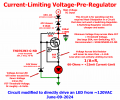
the below Circuit is just one "reasonably" safe way to do it

First You need to drop some significant Voltage so that You can work with more sanity in parts selection
and dissipate some of the Heat generated with a transistor-Package designed to move a lot of Heat.
( See the attached PDFs )
Then use the Circuit below to regulate the Maximum-Voltage and the Maximum-Current.

If You don't understand the instructions in the Picture, just ask for addition help.
The PDFs for the recommended FETs are attached below.
Low-Current, Voltage-Regulator FET
Low-Current, Current-Regulator FET
.
Current Limiting Voltage Pre Regulator  .png
.
.
.
 

Attachments

Last edited:

Jerry-Hat-Trick

Joined Aug 31, 2022
806
Generally, I don’t think running an LED from 120 VAC is a good idea. Commercially offered mains powered LED indicator lights have the three components housed in plastic for safety.

You can reduce the power loss in the resistor by having the LED in series with the resistor also in series with a silicon diode so that the mains voltage is half wave rectified and you can halve the value of the resistor because a 20mA LED will withstand 40mA half the time. But with modern high brightness LEDs you really don’t need more than around 5mA so a higher resistance will bring the resistive power loss way down.

With that arrangement the anti parallel diode is not necessary because the silicon diode in series offers an effectively high resistance to limit the reverse leakage current.
 

Sensacell

Joined Jun 19, 2012
3,780
Just buy a $2 5Volt USB phone charger and run the LED's off that.
Safer, cheaper and more efficient.

When you start shopping for 5W resistors you will see what I mean.

Use a 220 Ohm resistor in series with each LED.
 

Dodgydave

Joined Jun 22, 2012
11,395
I am self-taught (which means I lean on experienced people like you to learn new things)!

I need to create an indicator light system in a mobile application. The power will be supplied via 48v to 120v inverters or generators (vehicles are configured to switch between the two). 50 amp max current. The lights are on/off indicators for each 120v circuit as well as backlighting for circuit labels. Room is limited so I have to choke the 120v power directly to the LED via resistors. I just don't know the exact resistors to use. Best I can calculate through the online tools is that I need resistors rated 2.4W and equal to 5850 ohms resistance.

Is my math right? Can you point me to part numbers for existing components? I have no time to make this happen, so I am hoping to find my "silver bullet" rapidly! Please be out there!
Use a Capacitor in series with the mains supply , like a 150 to 220nf ( 400V rated) this will drop the supply down and then you can use a 1.5K to 3K resistor in series with the leds, , this is what I always do.

A 220nF capacitor is 12K at 60Hz , what current do you need for the leds?
 

BobTPH

Joined Jun 5, 2013
11,488
Using "just" a Resistor may be OK if the Voltage-Outputs are stable and either On or Off.
An LED with resistor could almost certainly tolerate more variance of the AC voltage than any device he is powering with it. I would not consider that at all even if the fluctuation was ±50%
 
Top