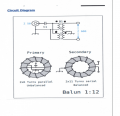
12:1 balun widing directions ??

MisterBill2

Joined Jan 23, 2018
27,377
Are you able to show us the actual circuit of the proposed balun?? AND please let us know if that 12:1 ratio is voltage, or impedance. I would also be interested in the frequency range and the actual impedance you are wanting to match to.
IT seems to me that a better choice will be a regular transformer scheme with an isolated primary and secondary.
Recall that for a standard arrangement of a transformer, the impedance ratio is the square of the turns ratio.
 

Thread Starter

AnneRanch2442

Joined Oct 3, 2022
12
Thanks very much for all replies. Would it be asking too much to actually get an answer / comment / hint for the original question about winding direction?
 

ronsimpson

Joined Oct 7, 2019
4,664
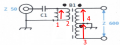
If I was doing this; I would do the secondary like this.
For the secondary I would start at either end. Maybe bottom right end. Wind 11 turns over 1/2 the area, pull out the wire 1 inch and then back in and do 11 more turns covering 1/2 the area.
(It does not matter if you start at the top right end. It will invert the signal but at RF that does not matter.)

For the primary I would not follow the picture. I would hold two wires in my hand and wind them together for 6 turns. Spread out the turns to cover most of the transformer core.
1771780959250.png
Here is another way to say what I want to say.
I would wind 1&2 at the same time. Pull two wires through together as one wire.
Then wind 3, stop, then wind 4. (or you can think of 3&4 as a 22 turn winding with a tap at 11 turns)
1771781880143.png
 

Thread Starter

AnneRanch2442

Joined Oct 3, 2022
12
hi Anne,
The windings are Bifilar woud, that means that both windings are made at the same time using a pair of wires, in the same direction
E
https://www.google.com/search?client=firefox-b-d&q=bilifilar+winding

Thanks. Not to make things more complicated... balun is essentially a transformer and as such the relation of windings phase (direction) and core of the transformer - torroid in this case - is essential. Lets concentrate on the "primary". The description states "parallel winding" ,hence SAME direction -bifilar . Unfortunately 1mm wire used in original design is too stiff to be wound in same time. Since this is for matching Beverage antenna ( low RF power, experimental frequency around 14MHz) the "even distribution of winding arouind the core " is not important. I am changing the design
to use plain AC twin lead cord as primary .
 
Last edited by a moderator:

MisterBill2

Joined Jan 23, 2018
27,377
@#8:: Using AC line cord is not a "new" scheme, but the variety of the insulating materials includes a large realm of dielectric properties. Thus results may vary for those using a similar scheme.
 

ronsimpson

Joined Oct 7, 2019
4,664
Unfortunately 1mm wire used in original design is too stiff
I use Litz wire. My source in Russia dried up. (Probably Ukraine)
I now get it on ebay.com Search for "Litz wire, antenna wire, HAM radio."
I make lots of transformers. We have the machines to wind the bobbins. Also, machines for winding loops for degaussing coils, which sometimes get used for metal detectors.
Litz wire has higher DC resistance but work better at RF. It is stranded so flexible. Most of what I use has more insulation over the outside.
 

Thread Starter

AnneRanch2442

Joined Oct 3, 2022
12
I use Litz wire. My source in Russia dried up. (Probably Ukraine)
I now get it on ebay.com Search for "Litz wire, antenna wire, HAM radio."
I make lots of transformers. We have the machines to wind the bobbins. Also, machines for winding loops for degaussing coils, which sometimes get used for metal detectors.
Litz wire has higher DC resistance but work better at RF. It is stranded so flexible. Most of what I use has more insulation over the outside.
I can probably find some litz wire in my junk boxes. Since this is just an experiment and I am not planning to theoretically analyze , but get on the air a see the results, I am not too concerned about the property of the dielectric. On the other hand - plain AC twin cord has impedance pretty close to 50 Ohms and that may be more beneficial.
 
Top